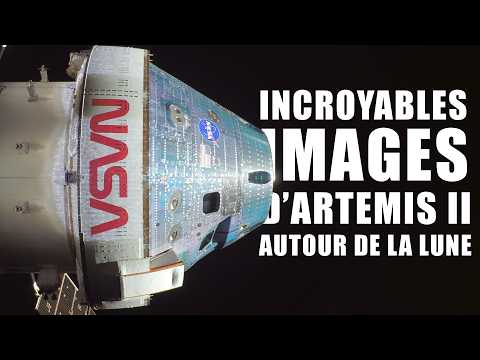
ARTEMIS II - L'incroyable SURVOL de la LUNE, et les IMAGES MAGNIFIQUES !
Audio Summary
AI Summary
The Artemis 2 crew recently completed an incredible flyby of the Moon, a feat not achieved in over half a century. This historic event was marked by moments of joy, record-breaking achievements, and even a solar eclipse.
Leading up to the lunar flyby, the crew shared stunning photographs of Earth, which progressively appeared smaller through the spacecraft's window. One image, taken just after translunar injection, shows our entire planet fitting within a small window, offering a stark contrast to views from the International Space Station where Earth always appears immense. This perspective provided an "overview effect," a profound realization described by many astronauts seeing Earth from afar for the first time. Subsequent photos continued to depict an increasingly tiny Earth, lost in the vastness of the solar system, with one particularly striking image showing a minuscule Earth against the deep black of space.
As Earth receded, the Moon grew larger in the spacecraft's view. On April 6th, the vessel entered the Moon's sphere of influence, and over the following hours, the Moon gradually expanded in the cameras. The crew remained highly active throughout the night, benefiting from a seven-hour observation window where Orion was close enough to the Moon for significant observations. NASA assigned 30 targets for the crew to observe and photograph.
During this period, the four astronauts achieved a symbolic milestone, reaching a greater distance from Earth than any previous human mission, including Apollo crews. They set a new frontier for humanity, 406,000 km from Earth, approximately ten times our planet's circumference. However, this record meant a less close approach to the lunar surface compared to Apollo missions, as Artemis 2 was a simple flyby without a landing objective. At its closest, the spacecraft was 6,500 km from the Moon's surface.
Cameras on Orion captured the Moon's crescent reversing, followed by the appearance of Earth's crescent in the same frame—a powerful image of Orion, the Moon, and Earth. Eventually, Earth's crescent disappeared behind the Moon, causing a temporary loss of communication, which was expected and lasted about 40 minutes before contact was re-established with the Deep Space Network.
The spectacle continued as, an hour later, the spacecraft experienced a lunar eclipse from their perspective, with the Moon passing in front of the Sun. The crew used this opportunity to study the solar corona and search for light flashes, potential signatures of meteorites striking the Moon.
The most significant part of the mission has now concluded with total success. Besides breathtaking images, the spacecraft seems to be functioning well, despite recurring issues with the toilets. Following a malfunction identified after liftoff, these issues resurfaced. With assistance from Houston, Christina Koch performed a repair, famously stating, "I am proud to be a space plumber." This respite was short-lived, as the crew later reported a burning smell, which NASA is monitoring without significant concern. Another toilet problem arose when the spacecraft had difficulty purging urine due to ice, quickly resolved by reorienting Orion to point the discharge vent towards the Sun. These toilet tests are crucial, being a major new feature of the capsule compared to the Apollo era, and may lead to design corrections for future missions. Christina Koch even remarked that the toilet is "probably the most important piece of equipment on board."
The crew also tested new flight suits, the OCSS. Two astronauts simulated a rapid donning in an emergency, while the other two followed a slower procedure. These suits are designed to allow survival for up to six days in case of capsule depressurization. They conducted full leak checks, tested mobility, and the ability to eat and drink using integrated straw systems. The test appeared successful, despite the challenge of changing in a confined space. They even slightly depressurized Orion to observe the suits inflating correctly.
Fortunately, the mission has been proceeding smoothly, allowing astronauts to spend most of their time in normal attire. During a media sequence, Canadian crew member Jeremy Hansen spoke in French for several minutes, marking a new frontier for the French language in deep space, far beyond Earth's orbit. He also shared a fun anecdote about finding cookies in space.
The mission is now in the return phase to Earth. The astronauts are exiting the Moon's sphere of influence. Today is a lighter day for the crew, allowing them rest after the intense flyby sequence. Tomorrow, on day eight, a critical test simulating a solar storm and significant radiation influx will require them to build a makeshift shelter onboard. On Thursday, they will prepare for Earth return, performing a trajectory correction and testing equipment to aid their adaptation to gravity. The splashdown is scheduled off the coast of California on Friday evening (Friday night to Saturday morning European time), marking the fastest atmospheric re-entry in crewed flight history and the most dangerous segment of the journey. A final mission update will follow to conclude this fantastic adventure.