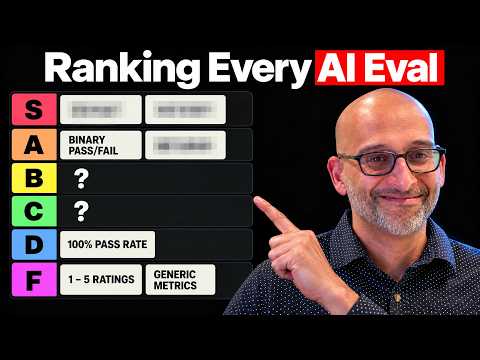
I Ranked Every AI Eval Concept From Worst to Best
Audio Summary
AI Summary
Here's a summary of the transcript, focusing on the key points and ranking of eval concepts:
**Key Eval Concepts Ranked:**
* **S Tier (Essential):**
* **Error Analysis:** A structured approach to reviewing data to identify application issues. Crucial for effective evaluation.
* **Custom Annotation Tool:** Building a dedicated tool to streamline data review, removing friction and improving clarity. This offers significant advantages over generic methods.
* **Reading Traces Yourself:** Directly examining your data is invaluable. There's no substitute for looking at the actual outputs.
* **Validating Judges Against Human Labels:** Essential for trusting any automated judge (like an LLM). Human labels are the benchmark for accuracy.
* **Domain Experts Writing Prompts:** Domain experts, not just developers, should be involved in crafting prompts to ensure relevance and accuracy for the specific product.
* **A Tier (Highly Recommended):**
* **Binary Pass/Fail Metrics:** Preferring binary outcomes (pass/fail) over scaled ratings (e.g., 1-5) simplifies decision-making and cuts through noise.
* **Running Always Passing Evals Less Often:** If an eval consistently passes, it may be losing its value. Re-evaluate its necessity to optimize resources.
* **Benevolent Dictator for Annotation:** Appointing a single trusted individual to make final annotation decisions reduces complexity and cost compared to committee-based annotation.
* **B Tier (Good Practice):**
* **Designing for Verification:** Structuring your application to easily show intermediate outputs to experts aids in evaluation and debugging.
* **C Tier (Acceptable, but not ideal):**
* **Writing Evals Before Building Anything:** Brainstorming potential failures upfront can be a starting point, but it's inefficient due to the vast number of possibilities. Data should guide prioritization.
* **Deciding on a Rubric Before Reading Data:** Similar to brainstorming, this top-down approach is less effective than analyzing actual data first.
* **D Tier (Suboptimal):**
* **Evals Always Passing 100%:** If evals consistently pass, they aren't challenging enough or revealing new issues. Evals should sometimes be difficult to pass.
* **Only Devs Annotate Data:** Unless building a coding agent, domain experts should annotate data, not developers.
* **Immediately Writing an Eval for Every Failure:** While it's good to capture critical failures, not every minor issue warrants an immediate, costly eval. Prioritize based on impact and fixability.
* **F Tier (Avoid):**
* **Generic Metrics:** Scores like "helpfulness" or "conciseness" from external tools are usually uninformative and a waste of time.
* **Off-the-Shelf LLM Judges:** Pre-built judges with generic prompts are rarely suitable for specific product needs.
* **Prompt Optimization Without Evals:** Optimizing prompts without clear eval criteria leads to unfocused improvements and potential "slop."
* **Public Benchmarks as a Substitute for Product Evals:** Public benchmarks are useful for model selection but don't reflect product-specific failures.
* **One Judge for Everything:** A single, broad judge prompt is too scoped and unlikely to be effective.
* **Eval Based Only on Brainstorm Failures:** Relying solely on brainstormed failures without data analysis is inefficient.
* **Off-the-Shelf Guardrails:** Using generic, pre-made guardrails is generally ineffective as they aren't tailored to your product.
* **One-to-Five Ratings:** Scaled ratings often hide complexity and hinder clear decision-making compared to binary outcomes.
* **Picking an Eval Vendor First:** Focus on process and data analysis before selecting tools.
* **Rugg and Bird Score for Answer Quality:** String similarity metrics are not suitable for evaluating AI answer quality.
* **Letting AI Do All Your Evals:** AI can assist, but it cannot catch all nuanced issues requiring human judgment.
The presenter offers a detailed eval guide at bit.ly/eval-guide for further information.