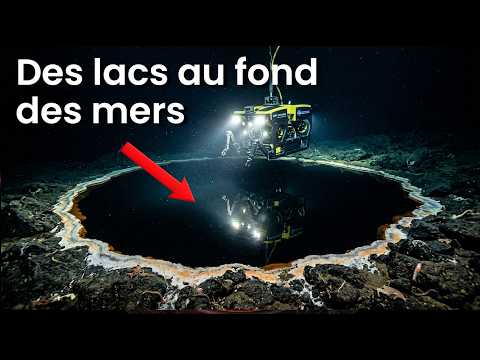
Ces lacs sous-marins qui ne devraient pas exister
AI Summary
Deep beneath the ocean surface, at depths ranging from 3,000 to 6,000 meters, lies the vast and largely unexplored world of the abyssal plains. Covering over 50% of the Earth's surface, these regions are often viewed as monotonous deserts, blanketed in a thick layer of "marine snow"—organic particles that drift down from the surface and accumulate at a rate of just one centimeter every thousand years. However, this silent, dark landscape is occasionally interrupted by extraordinary geological formations: underwater lakes, icy mounds, and strange volcanoes.
One of the most surreal discoveries in the abyss is the existence of brine lakes. These are pools of water so hypersaline—containing five to eight times more salt than regular seawater—that they become much denser than their surroundings. This density prevents the brine from mixing with the rest of the ocean, creating a distinct, shimmering surface that acts like a liquid mirror. While some are small puddles, the largest discovered cover 60 square kilometers. These lakes form over ancient salt deposits left behind by prehistoric seas that evaporated millions of years ago. When seawater seeps through fissures in the Earth's crust, it dissolves these salt layers and rises back to the seafloor, pooling into these natural basins.
For most marine life, these lakes are "tombs of the deep." Because the water is anoxic (lacking oxygen) and highly toxic, animals like crabs, fish, and amphipods that wander into them die almost instantly from cerebral hypoxia. Because the toxic environment prevents the growth of decay-causing microorganisms, the bodies of these creatures are preserved for decades. Some are even coated in minerals like barium sulfate, which crystallizes around them, turning the victims into well-preserved "statues." The famous "Jacuzzi of Despair" in the Gulf of Mexico is a prime example of such a graveyard, filled with the remains of animals preserved in a toxic mix of methane and hydrogen sulfide.
Yet, where there is toxicity, life has found a way to adapt. Around the borders of these poisonous pools, specialized bacteria thrive through a process called chemosynthesis. They produce energy from the chemicals leaking from the crust rather than from sunlight. These bacteria form the base of a unique food chain, supporting colonies of giant mussels and other fauna. These "oases of life" are remarkable because they do not depend on organic matter falling from the surface. However, these ecosystems are fragile; if the geological fissures feeding the lake become blocked, the energy source vanishes, and the entire community dies off.
In addition to brine lakes, the ocean floor features "cold seeps," first discovered in 1983. These are areas where fluids rich in methane, hydrogen sulfide, and hydrocarbons leak from the crust at temperatures between 2 and 10 degrees Celsius. These seeps support massive microbial mats that can be white, yellow, or even blue, sometimes covering areas as large as the city of Paris. In these environments, giant tube worms can grow up to three meters long and live for 400 years. These worms have no mouth or gut, relying entirely on symbiotic bacteria to process chemicals into food. Other residents include "Yeti crabs," which grow bacteria on the long hairs of their bodies to harvest as food.
A more concerning feature of the deep sea is the presence of methane hydrates. These are structures of "methane ice" where gas molecules are trapped inside cages of frozen water, stabilized by extreme pressure and cold. These hydrates represent a massive "climate bomb." The transcript notes that the total amount of methane trapped in these deep-sea sediments has a greater potential to warm the atmosphere than all known reserves of coal, oil, and gas combined. If the oceans warm sufficiently, these hydrates could destabilize and release their gas, potentially triggering a massive climate crisis. This may have happened 56 million years ago during the Paleocene-Eocene Thermal Maximum, when global temperatures rose by 5 to 8 degrees Celsius due to a sudden release of carbon.
The abyss also contains cold mud volcanoes and asphalt volcanoes. Mud volcanoes erupt thick clay and gas from deep within the crust, forming domes hundreds of meters high. Asphalt volcanoes, such as those found in the Gulf of Mexico, produce structures that look like frozen black flowers made of hardened bitumen. Even on these tar-like petals, bacteria have been found that can consume and process heavy hydrocarbons.
Beyond their alien beauty, these ecosystems offer immense scientific and medical potential. Organisms from these depths are being studied for new cancer treatments, and the venom from deep-sea mollusks may lead to painkillers significantly more powerful than morphine. The hemoglobin of tube worms could even be used to create universal artificial blood.
Ultimately, these deep-sea environments challenge our understanding of biology. The fact that complex life can flourish without light or oxygen in highly toxic conditions suggests that life could exist in similar environments elsewhere in the universe. Astrobiologists look to these terrestrial "extremes" as models for what might be found in the subsurface oceans of moons like Europa or the methane seas of Titan. These deep-sea formations are a testament to the resilience of life and its ability to invent new rules for survival in the most hostile corners of the planet.