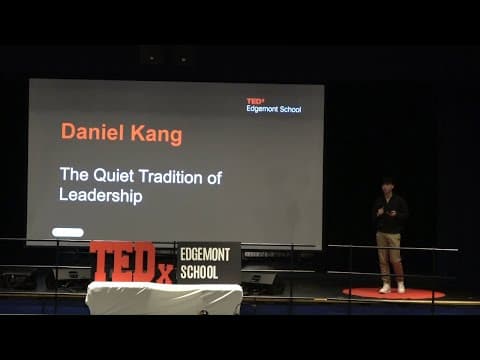
The Quiet Tradition of Leadership | Daniel Kang | TEDxEdgemont School
Audio Summary
AI Summary
The speaker begins by posing a rhetorical question: "What is a leader and what is leadership?" They challenge the common perception that leadership is defined by someone standing in front of people or by titles. Instead, they argue that leadership stems from people and their values, emphasizing that people live through their values and learn through their exchange. The speaker shares that their understanding of leadership was forged in an unconventional place: a wrestling room.
Wrestling, a sport where one trains with a team but competes alone on the mat, exposed the speaker to the true nature of leadership. There's no one to substitute or hide behind; victory and defeat are entirely personal. This environment revealed what it meant to be a leader. The speaker recounts a pivotal moment in 9th grade when they lost their first varsity match. The frustration and self-doubt that followed, questioning preparation, ability, and even character, highlight the profound impact of failure. Sitting in the locker room, feeling like an impostor, an older wrestler approached them. This interaction was not a cliché motivational speech but a direct, subtle conversation about what went wrong, what could be fixed, and future actions. While it didn't instantly transform the speaker's wrestling performance, it left a lasting subconscious impression.
Over time, the speaker observed similar acts of quiet leadership: encouragement during practice, support after tough matches, and prioritizing the team. They realized this was the purest form of leadership. As they grew older, they transitioned from being dependent on others to becoming a person others looked to for guidance. They recognized younger wrestlers experiencing the same doubts and struggles they once faced. In those moments, the speaker emulated the older wrestlers, sitting with them, discussing practices and matches, and sharing frustrations.
This experience fundamentally changed the speaker's understanding of leadership. They now believe that leadership is not created but inherited. No one develops in isolation; individuals are taught how to improve, how to encourage themselves, and are given examples to follow. Without these influences, many would quit prematurely. This perspective shifts leadership from being about recognition to being a responsibility. The logical response to having someone stand with you during your hardest moments is to do the same for others.
A significant challenge came in 10th grade when the speaker lost an important final match, feeling they had let their team down. They questioned their leadership, believing leaders should win by example. However, two younger wrestlers approached them, not to discuss the loss, but to talk about shared practices, lessons learned, and the help received that enabled them to place in the tournament. This unexpected interaction was a profound revelation: leadership isn't measured by wins, but by the influence left behind—the habits people adopt, the mindsets they embrace, and how they treat others based on how they were treated. Leadership, therefore, is about empowering others to stand on their own, not standing above them.
This concept extends beyond sports. Mentors, teachers, friends, and parents don't just provide information; they instill confidence, offer perspective, and provide belief. These pieces of leadership are carried forward. The speaker concludes that leadership is a chain, inherited by each generation and passed forward through actions. Helping someone grow not only benefits that individual but also shapes how they will treat those who come after them, creating an impact that travels far beyond what is immediately seen.
Today, the speaker defines leadership not by titles or public standing but by the people who stood beside them in times of need, and the responsibility that comes with that. Everyone will encounter someone younger, less experienced, or less confident who will observe their responses to failure and adversity. In these moments, whether consciously or not, individuals decide the kind of leadership they will pass on. Leadership is not something to be kept; it is something to be carried, inherited, and passed forward, trusting that future generations will continue this legacy.