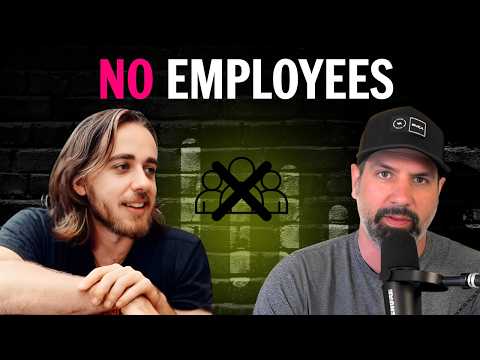
$1,000,000+ Recurring Revenue — No Employees!
AI Summary
Jesse Hanley, the founder of Bento, an AI-integrated email marketing platform, has built a business exceeding $1 million in annual recurring revenue as a solo operation based in Japan. This achievement embodies the podcast's philosophy of building a business on one's own terms, with Jesse even turning down a significant acquisition offer to maintain his lifestyle and autonomy. His approach emphasizes leveraging AI tools, smart thinking, and a specific mindset, including the "cockroach philosophy" and distinguishing between "main quest" and "side quest" activities.
Jesse's journey into the competitive email marketing space was not as a seasoned rockstar developer. He initially ran a marketing agency and desired to code. He hired a developer to build what became Bento, which, in its early stages, was too broad, trying to be "everything for everyone." After selling his agency during COVID, he focused intensely on Bento, realizing that the email marketing component was what truly resonated with users. This period involved an "obscene, disgusting amount of work" to establish the business, a grind he believes is necessary in the initial phase of entrepreneurship. However, once the business was established, he scaled back his hours to prioritize family life, particularly after the birth of his child.
A core tenet of Jesse's business model is his deliberate choice not to hire full-time employees, even with the budget to do so. He believes the business model itself is less important than how one chooses to operate it, especially in the current AI-driven landscape. His decision stems from past experiences with "people problems" in his agency, such as contractors disappearing due to personal issues. This led him to embrace the "cockroach philosophy," which prioritizes resilience and not dying as a business. By avoiding payroll, he reduces stress and ensures the business can remain profitable even in significant downturns, like a 50% or 66% revenue cut. He argues that building resilient businesses, even if it means doing most of the work oneself, is crucial in today's unpredictable environment. While he advocates against full-time hires, he sees immense value in part-time contractors, particularly those who are experts in their field and leverage AI to enhance their productivity. He cites an example of hiring a "speed shop" consultant on retainer who advises him, allowing him to implement solutions efficiently with AI, leading to substantial cost savings and increased MRR.
Jesse's daily life is structured around his personal priorities and a four-to-five-hour workday. He wakes early, trains at the gym while AI agents address overnight bugs and support tickets. He returns, makes pancakes for his child, takes her to school, and then works for a focused four hours before picking her up. This routine is possible because AI handles many routine tasks, such as fixing bugs and responding to common support queries, freeing up his time. He emphasizes that this level of control and work-life balance was his goal a decade ago, and he is now living it. He considers the $1 million annual revenue mark a significant milestone that provided the financial security and permission to breathe and limit his work hours. He notes that while $10,000 a month once felt like a secure target, the current economic landscape necessitates a more substantial revenue base for true stability.
The concept of "main quest" versus "side quest" is central to Jesse's work philosophy. Main quest work directly propels the business forward, while side quest work, often involving building internal tools or dabbling in non-core activities, can be a significant distraction. He observes that many founders, especially those in agencies, get sidetracked by side quests, leading to reduced sales, marketing, and client engagement, ultimately impacting revenue. His own main quest is not just about Bento's success but also funding his life and family. An example of a successful main quest activity was when he built an internal tool to improve Bento's email deliverability, saving thousands of dollars monthly. He then productized this tool, selling it to competitors who wouldn't buy Bento, generating additional MRR without diverting from his core business. This demonstrates how a main quest can have multiple benefits, including personal and financial ones.
Regarding customer acquisition, Jesse, despite his marketing background, doesn't claim to be excellent at lead generation. Instead, he focuses on serving existing customers well, encouraging reviews and referrals, and strategically buying ads on relevant podcasts. He acknowledges that his sales processes could be better, but he's content with his current approach and the self-imposed bandwidth limits that prioritize his family. He actively works to make Bento more self-serve, leveraging AI to resolve customer issues within the product itself, thereby reducing support tickets and improving user experience. For instance, he developed an AI chat-first workflow builder that allows users to describe their desired email automation, and the AI constructs it, leading to higher usage and lower churn.
Jesse highlights Jason Cohen's "Max MRR" article as a crucial resource for understanding business stagnation. The article posits that a business's maximum recurring revenue is determined by its net new revenue and its churn rate. By focusing on reducing churn, a business can significantly raise its revenue ceiling. For Bento, addressing onboarding churn is a primary focus, as it directly impacts revenue growth. He acknowledges that Bento is a complex product, and simplifying the onboarding process is key to retaining customers.
Pricing is another area where AI is proving invaluable. Jesse, having not updated Bento's pricing in over five years, is now using AI to research competitors, analyze data points from custom pricing agreements, and inform his strategy. He's considering lowering his base plan price to attract more sign-ups while maintaining his stance against free plans or plans under $15, as he believes free customers detract from his core user base. However, he cautions against "deferred thinking" to AI, emphasizing that founders must have a clear vision of who they want to serve and why, with AI acting as an assistant to that mission, not a decision-maker.
Bento's innovative use of "agentic options" for customers, allowing AI to interact with the platform programmatically via APIs, MCPs (Multi-Channel Platforms), and CLIs (Command Line Interfaces), reflects Jesse's forward-thinking approach. This enables users like Gail from Authority Hacker to automate newsletter drafting without logging into the app, integrating data from various sources. It also caters to users who prefer to interact with SaaS applications agentically, without direct human intervention. While not all users are this technically inclined, Jesse sees it as an "accessibility problem" for a new type of user, pushing him to make the product more navigable for AI agents. He advises other founders to evaluate if investing time in such AI integrations directly contributes to revenue before diving in, as the landscape of AI tools is rapidly evolving.
Jesse's daily routine, fueled by AI tools like Cursor and Open Code, allows him to manage all aspects of Bento, from product development to marketing, within his limited work hours. He uses these tools to build products, design marketing pages, and ensure code quality. He notes that December saw a significant shift in how developers, in particular, began leveraging these tools, with many now shipping entirely with agents and focusing on code reviews as the new bottleneck. This intense, AI-accelerated work can lead to burnout, and Jesse acknowledges the need for recovery. Ultimately, his vision for work is a four-to-five-hour day, a shift from traditional eight-hour corporate expectations, which he believes is achievable and desirable with the aid of current tools. He expresses gratitude for the entrepreneurial community, particularly the DC, for providing a supportive network where he can discuss his work with like-minded individuals, keeping him rooted in his main quest.