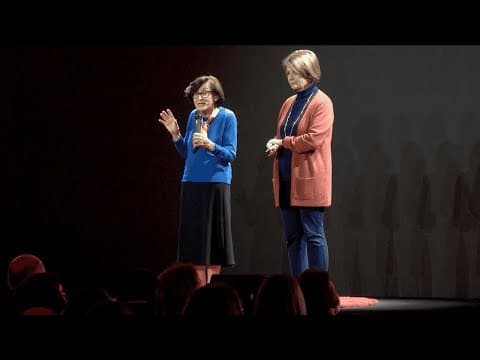
Escrever para formar leitores | Ana Maria Magalhães & Isabel Alçada | TEDxPorto
Audio Summary
AI Summary
The speakers, sisters and former mothers and teachers, chose children's literature due to their profound appreciation for reading and children. They believe reading silently stimulates thought, enriches the spirit, broadens horizons, and combats loneliness. Recognizing reading's crucial role for young children, they committed to fostering readers.
Their approach to writing for children emphasizes transparent, luminous, and clear text, allowing immediate visualization. Characters must possess a distinct presence, becoming like close friends. Storylines need to spark curiosity and be captivating, making children feel immersed. They initially chose adventure themes, as these are popular with children and align with their own interests, believing writers should focus on what they love.
A key aspect of their process involves visiting story locations firsthand to transmit their essence. Examples include exploring Porto's tunnels and Clérigos Tower, venturing into a haunted house at night, and experiencing the Amazon, Timor, the Sahara Desert, and Cape Verde. They aim to showcase their country and spark curiosity in exotic locales.
For conveying these experiences to children, they carefully select words, control narrative rhythm, and limit descriptions. They also developed a time-travel collection, using a 19th-century time machine to transport readers to different eras, witnessing events like the 1755 Lisbon earthquake, Vasco da Gama's voyage, and the abolition of slavery in Brazil.
Transitioning to grandmothers, they began writing for younger children, and their project gained recognition, leading to co-authoring a history of Portugal and creating various books. Their latest project, with reading scientists, focuses on short books for early readers, aiming to give children the satisfaction of completing a book. They emphasize that reading is a powerful, accessible force, and collaboration among authors, publishers, educators, and families is vital to cultivating a nation of readers.