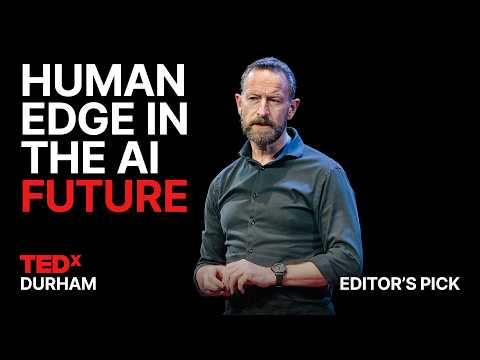
A Disney Imagineer's lessons on creativity | Duncan Wardle | TEDxDurham
Audio Summary
AI Summary
The speaker begins by asking the audience to raise their hands if they consider themselves creative. He notes that very few adults respond positively, contrasting this with an experiment where 30 six-year-olds enthusiastically declared themselves creative. This observation leads to the assertion that education is "killing the most employable skill sets of the next decade."
To illustrate this point, the speaker conducts an exercise called "Picasso," where participants are asked to draw their partner's face in 20 seconds without looking down at the paper, maintaining eye contact. After the exercise, more people raise their hands when asked if they can draw like Picasso, demonstrating that they are more creative than they initially believe.
The discussion then shifts to what children do better than adults. The audience suggests "not worrying about getting it wrong" and "imagination." The speaker elaborates on imagination by recalling a childhood memory of preferring the box a toy came in over the toy itself, turning it into a rocket ship or castle. He attributes the decline of imagination to "western education," which teaches children to "color in between the lines." He provides an example from Pixar, where early development for films like "Finding Nemo" and "Toy Story" involved discussions about childhood memories rather than data or AI. He shares anecdotes about cowboys and astronauts influencing "Buzz and Woody," and monsters under the bed inspiring "Monsters Incorporated," highlighting how childhood experiences fuel imagination.
Next, the speaker explores "telling the truth" and "curiosity." Children are naturally honest and constantly ask "why." This relentless questioning, he argues, leads to the "core consumer truth" or "insight for innovation," often found on the fifth or sixth "why," whereas data typically only goes to the first or second. He makes a provocative statement that a six-year-old child's insight is as valuable as current data. To demonstrate, he uses the example of Disney holidays. While data might suggest people visit for new attractions, a childlike inquiry into "why" reveals deeper motivations like personal memories and nostalgia, which are crucial for communication campaigns. He criticizes education again for stifling curiosity by teaching that there's only one right answer and discouraging further "why" questions.
The speaker then shares a personal experience in the Dharavi slum in Mumbai, where he was tasked with creating light without electricity or money. By acting "curious like a child," he observed how light refracted through a bottle. Through experimentation (taking off labels, lids, adjusting height) and a tip from a local (adding chlorine), he developed a simple solution: a bottle filled with water and chlorine inserted into a roof to light huts during the day. This curiosity-driven project, using discarded bottles, eventually lit one million huts.
The final skill children excel at is "playing." The speaker asks who is encouraged to be playful at work, noting few hands raised. He then asks where people get their best ideas, instructing them to shout out the first word that comes to mind. Common answers include "shower," "walking," "running," "driving," and "bed," but notably, no one says "at work." He explains that during an argument, the brain is in a "beta" state, defending itself, making it impossible to think clearly or come up with the "killer line" until after the argument. Similarly, at work, constant meetings, emails, and presentations keep the brain in "busy beta," where the "door" between the conscious (13% of brain capacity) and subconscious (87%) is closed, limiting access to creative solutions.
His job, he states, is to be playful and create "amazing alpha" brain states, like those experienced in the shower, where the subconscious door is open enough for big ideas and informed decisions. He mentions historical figures like Thomas Edison and Salvador Dalí, who used techniques to tap into this state as they drifted between wakefulness and sleep. The speaker advises giving colleagues time to access these creative states by briefing them in advance.
He introduces "empathy" as another crucial skill, defined as "listening with your heart." Storytellers excel at this. He cites examples from "Wall-E," where the mute robot's desire for love evokes empathy, and "The Incredibles," where the villain's past rejections make him relatable.
Finally, he discusses "intuition." He asks if anyone has ever stared at a stranger who then immediately turned around, acknowledging that this common experience points to intuition. He highlights that while the brain has 120 billion neurons, the gut also has 120 million neurons, influencing decisions. He recounts a project for Disneyland Paris, where data suggested building new attractions would increase visits, but intuition suggested something was missing. By spending a day with consumers, he discovered that parents, especially mothers, are less concerned about new attractions and more about making special memories with their children before they grow up. This insight led to a communication campaign focused on nostalgia and memory, rather than capital investment.
In conclusion, the speaker asserts that creativity, intuition, curiosity, empathy, and imagination are the most employable skill sets for the next 5 to 10 years, as they are the hardest to program or replicate in artificial intelligence. He believes these human qualities, which we are all born with, will be crucial as we integrate with AI through technologies like Neuralink, leading to a "superhuman race" where humans contribute creativity and empathy, and AI provides tech, data, and algorithms.