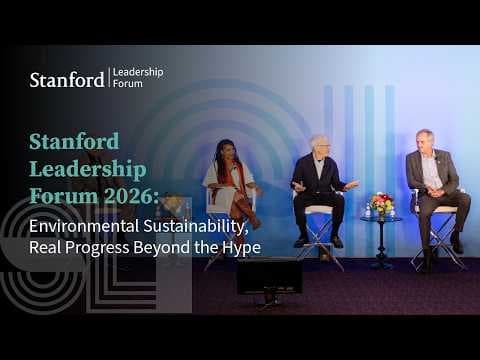
Stanford Leadership Forum 2026: Environmental Sustainability, Real Progress Beyond the Hype
Audio Summary
AI Summary
The discussion centers on the current state and future of environmental sustainability, particularly in the context of climate change and the energy transition. Bill Barnett, a professor at Stanford, opens by noting a recent low in public perception of environmental sustainability, contrasting it with a historical high during the Biden administration, partly due to achievements like the plastics treaty negotiated by panelist Maxine Burkett.
Maxine Burkett, Professor of Climate, Environment, and Society at Stanford, highlights three key factors shaping the current moment: disinformation, disservice, and global trends. She notes that the public discourse on climate is often mired in disinformation, making it difficult to address issues like biodiversity loss. She also points out a "disservice" by educational institutions that fail to adequately prepare students across various professional fields for the environmental realities they will face. Globally, while there are downward trends in environmental indicators, Burkett sees significant opportunities, and she emphasizes that despite the polluted communication environment, people still recognize the urgency of climate change and environmental justice.
Bob Litterman, Chair of the Climate-Related Financial and Macroeconomic Risk Initiative, emphasizes that while the problem of climate change and the necessary actions are well-known, progress is hindered by a lack of proper incentives, specifically the failure to price climate risk. As an economist and former risk manager, he views climate change as a risk management problem. He notes that while the US is currently playing defense, other countries, like China, are leading in clean energy investment. Litterman stresses the need for a price on emissions, stating that without it, "we're not even getting started." He points to positive signs like the "open coalition on compliance carbon markets" with 18 members, including Europe and China, as evidence that some nations are recognizing and acting on climate reality, warning that the US risks being left behind.
David Hochschild, Chair of the California Energy Commission, offers a more optimistic perspective, emphasizing the power of states to lead the energy transition. He highlights California's achievements: 67% of its electricity from clean sources, more EV charging plugs than gasoline nozzles, a quarter of new vehicle sales being EVs, and over 80% of new construction being all-electric. He details significant projects like the Darden battery storage project and milestones like reaching 100% clean energy on the grid for portions of the day. Hochschild frames California as a "postcard from the future," asserting that addressing climate change is beneficial for the economy, citing California's rise to the fourth-largest economy globally as it has cleaned up its grid. He believes these success stories need better communication and that the clean energy sector offers hope and exciting career paths, especially for young people. He also suggests that potential federal policies against EVs and renewables might be undermined by market forces and the inherent volatility of fossil fuel markets.
Responding to David Hochschild, Maxine Burkett acknowledges the beauty of possibility in addressing climate change but also reiterates the severe consequences of continuing on the current path. She finds it exciting that California's hypothesis about the economic benefits of clean energy is proving true. Bob Litterman, while acknowledging California's progress, maintains a more cautious stance, stating that "we haven't really gotten started" and reiterating the need for a carbon price of $100-$200 per ton, contrasting it with the current near-zero price in the US and existing fossil fuel subsidies.
Bill Barnett, reflecting on his research on industrial evolution, suggests that change often happens despite government intervention, driven by entrepreneurship, with policy later rationalizing these shifts. He believes all three panelists are correct in their assessments, noting that current government policies fall short of ideal designs. David Hochschild counters that while innovation is key, government policies are crucial. He points to the declining cost of solar energy and the rapid installation rates as evidence that market forces are powerful, even suggesting that some forces are larger than what a hostile administration can stop, though they can impede and slow the transition.
Nila Richardson, Chief Economist and ESG Officer for ADP, poses a question about the scorecard for corporate America, noting a focus on emission reduction goals alongside resource-intensive AI development. She asks what corporations can do to meet these goals and how they are performing, especially in the face of AI.
David Hochschild describes the corporate landscape as a "mixed bag," crediting companies with clean energy goals but expressing disappointment with the US auto sector for backing off EVs, which he sees as "industrial suicide" and ceding future markets to China. Bob Litterman agrees it's a mixed bag, attributing corporate behavior to incentives, or lack thereof. He argues that without a price on carbon, companies will prioritize profit, and highlights the vast subsidies for fossil fuels in the US compared to clean energy investments. Maxine Burkett is more critical, calling corporate activity "pretty poor." She attributes the pullback from promises to an anti-regulatory push and a systemic "rot" that incentivizes maximizing profit without broader consideration. She also emphasizes the interconnectedness of the climate and biodiversity crises, stating, "There is no economy without an environment."
Chad Sario, a PhD candidate, asks about building durable legislation and policy to signal seriousness about climate change to allies abroad and encourage long-term industry investment, questioning whether states need to take a larger role or if a national approach is needed. Maxine Burkett acknowledges the loss of credibility internationally and nationally, stressing the need to regain trust. She points to polling showing broad American support for environmental justice and intentional government action, suggesting that humans want to do the right thing. She emphasizes that durable policy often arises from community and grassroots efforts. Bob Litterman sees a positive opening in the weakening of global climate leadership, allowing coalitions of countries to move forward. He believes that countries will eventually adopt carbon pricing and tariffs, incentivizing others to join. He also highlights the importance of carbon accounting for actual pricing. David Hochschild discusses process innovation, like fast-tracking permits for renewable projects, and suggests lessons learned from the Inflation Reduction Act's slow deployment. He also touches on the "abundance" argument, finding it a welcome push for efficiency but noting that a long-term erosion of trust in the public good hinders progress.
Isaac Stlo, an undergraduate, asks about the practicality and realism of "greening all electricity and electrifying everything" and where progress stands. David Hochschild confirms this is the strategy, highlighting California's progress towards clean electricity goals and the rapid deployment of energy storage. He emphasizes the importance of electrifying end-uses, citing examples like electric cranes at ports and electric trucks, noting that some are already at cost parity. He stresses the need to better communicate these success stories and encourages individual actions. Maxine Burkett adds a caution, urging that as technical solutions are implemented, nature and human dignity must not be forgotten, warning about the impacts of drought and the importance of community needs in renewable energy projects. She also links compromised human dignity to environmental degradation.
Megan Guy, an alumna, questions if the focus on economic aspects of ESG has overshadowed crucial issues like oceans, biodiversity, indigenous knowledge, and redistributive impacts, asking about the business community's role beyond profitability. David Hochschild shares his positive experiences engaging with Native American tribes in California, highlighting successful dam removal for salmon restoration and condor reintroduction, seeing these as inspiring stories that go beyond economics. He acknowledges the need to elevate these dimensions, while also asserting that a habitable planet is in our national and economic interest. Bob Litterman reiterates that business will solve the problem but needs clear incentives, arguing that current subsidies for fossil fuels prevent this. He clarifies that "we" refers to government setting incentives. Maxine Burkett expands on "we," suggesting that in a democracy, citizens have a role in influencing government and businesses, and that the erosion of trust in the public good and challenges like Citizens United complicate collective action.
Claire Kylie, an alumna, asks about adaptation and extreme risk preparedness, which she feels is underfunded due to a lack of clear ROI. She inquires how to unlock funding for these areas through collaboration between philanthropy, government, and business. Maxine Burkett agrees that adaptation is critically important and has co-benefits with mitigation, but notes there are limits to adaptation and that both are needed. She suggests that damage and reactive measures are common, and better planning is required.
Stefan Sajansky, an MBA student, asks about the debate between "abundance" proponents and traditional climate advocates regarding permitting reform and the trade-offs between rapid deployment and environmental preservation. David Hochschild discusses fast-tracking permits for renewable projects and suggests that "making the perfect the enemy of the good" can hinder progress, advocating for faster deployment of funds. Maxine Burkett finds the "abundance" argument helpful for efficiency but notes that the erosion of trust in the public good is a deeper issue.
Maria Farhud, an MBA student, asks about the sentiment on carbon pricing in the US and, if unlikely, what alternative mechanisms exist to price products accurately. Bob Litterman firmly states that as an economist, pricing carbon is essential, allowing government to step back. He criticizes the Inflation Reduction Act for being overly prescriptive and argues that a simple carbon price is the most effective approach.
The session concludes with a plug for the Stanford Initiative on Business and Environmental Sustainability.