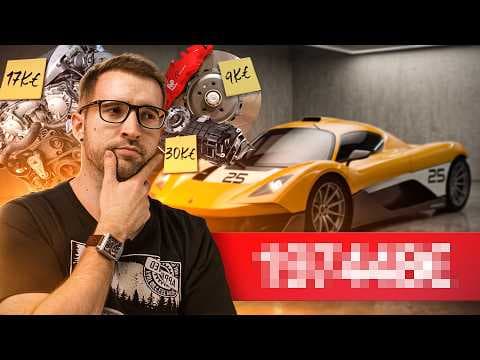
Fabriquer mon HYPERCAR : rentable ou ruine ?
AI Summary
The video details the costs and development processes involved in building custom cars, specifically comparing a replica Ford GT40 project with a current hypercar project.
The creator's first car build, a Ford GT40 replica, cost approximately €20,000 and took four years to complete. This was after a 3D design phase, utilizing an existing chassis and engine. The entire process was documented in over 75 video episodes. The current hypercar project is described as a significant step up, using more refined materials, a more mature design, and an industrial approach.
The speaker then briefly promotes "CarVertical," a service that provides vehicle history reports based on chassis or license plate numbers. These reports can reveal actual mileage, past damage, theft history, and registration details, helping buyers avoid purchasing problematic used cars. A discount code is offered for viewers.
Returning to the GT40 project, the initial challenge was to build a drivable car from scratch for under €15,000. While it ultimately cost €20,000 (after painting), the creator considers the goal achieved as it was functional at €15,000. The speaker contrasts this cost with the value of an original 1960s Ford GT40, which are extremely rare (around 130 examples) and can fetch millions of euros, with racing pedigree increasing the price significantly. Even finding one for sale is difficult. The focus then shifts to GT40 replicas, which are more common. These replicas can range from €100,000 to €500,000 depending on the level of finish and the builder's expertise, making the creator's €20,000 build exceptionally affordable, even cheaper than some replicas based on other car models.
A key insight highlighted is the value of development. While the physical materials for the GT40 (steel, fiberglass, aluminum, parts) cost around €2,500 for the chassis and €4,000 for the body, the creator emphasizes that the most significant investment was time. Approximately 4,000 hours were spent on 3D design and fabrication. Valuing these hours at a standard rate would amount to hundreds of thousands of euros, excluding further development processes. The creator notes that while these hours contribute to the car's value, the market value doesn't directly correlate with the hours spent. The GT40's inherent value far exceeds its €20,000 material cost, not to mention its sentimental value.
The industrial approach to car development is discussed. Mass-produced cars cost millions, even hundreds of millions, to develop. This is attributed to numerous international regulations, climate variations, and the need for extreme reliability to avoid costly recalls and lawsuits, as exemplified by issues faced by Toyota, Volkswagen, and Takata. Consequently, even basic city cars have highly robust and expensive development processes, with manufacturers optimizing every cent to maximize profit per sale. Luxury and race cars, however, can afford to use top-tier materials and techniques, simplifying development without the same cost pressures per unit due to lower production volumes. The Volkswagen Group, for instance, reportedly spent more on developing the Golf than the Chiron.
The physical cost of hypercars is also high due to expensive materials and components. Despite potentially lower development costs than mass-market cars, the limited production volume means development costs are not amortized. For example, if €500 million is spent on developing a car and only 500 units are sold, the development cost per car is €1 million, before even considering material costs. Manufacturers recoup these costs through limited editions, options, merchandise, and technology sales.
The breakdown of hypercar costs is estimated: 50% for development, 15% for profit and amortization of development, and the rest for manufacturing, marketing, logistics, taxes, and a small manufacturer margin (around 5%). Premium manufacturers have higher development costs (20-30%) but also significantly higher profit margins due to higher sales volumes, often attributed to brand value. Historically, the R&D for the original GT40 project in the 1960s to compete with Ferrari was estimated at over $500 million for the 127 cars produced, equating to about €4 million in development per car.
The creator's current hypercar project, "Hyper Pilote," began in 2021. Unlike the GT40, this is a completely original design from a blank slate. The goal is to elevate the build with higher quality components, a more industrial design, and lessons learned from the GT40 project. A crowdfunding campaign was launched, with the first tier set at €75,000 to validate and enable the project. This budget is significantly higher than the GT40's due to plans for a more powerful motorization and the need to fabricate all body parts from scratch, including masters and molds, unlike the GT40's pre-made fiberglass kit. The €75,000 also covers crowdfunding rewards and taxes. The creator expects to receive about 45% (€34,000) from this tier. A second tier of €200,000 was established for a carbon monocoque, with quotes obtained to ensure feasibility. The campaign ultimately raised €290,000, leaving approximately €140,000 for the car itself, securing the carbon monocoque. This funding primarily covers material and manufacturing costs, with R&D and labor being self-funded.
Initial expenses in January 2022 included around €250 for testing standard parts like wheel bearings and steering components. The strategy is to use readily available, standard parts where possible, as they are cost-effective due to mass production. These parts are scanned and modeled in 3D for the design process. Approximately 80% of these initial parts are expected to be used.
In late 2022, the project shifted to a 100% electric powertrain after the crowdfunding success. However, this direction was later abandoned. The initial plan for an electric car involved sourcing a brake booster from a Tesla, costing €300 and requiring extensive modeling, but this part was ultimately deemed unnecessary. Other standard parts like wiper motors and sensors were purchased, bringing the total for initial component testing and 3D design to around €1,000. The 3D design phase focused on the chassis and mechanical components, visualized within the car's overall design envelope. A windscreen from a Lotus Elise was acquired for €430 and scanned for integration into the 3D model.
By the end of 2022, the creator lost motivation with the electric direction, deeming it unsuitable for a pleasure car that should evoke emotion through sound and vibration. Furthermore, electric technology was considered expensive and potentially beyond the budget, with concerns about battery degradation from infrequent use.
The project reverted to a 100% thermal powertrain with the purchase of a used Nissan GTR VR38 engine for €16,000. Despite 80,000 km, its compression was good. However, transport damage led to a broken oil cooler, adding an unforeseen expense. This engine was acquired to be scanned and integrated into the 3D model, and its purchase helped reignite motivation. Hybrid turbos and injectors were also ordered for a 700+ horsepower setup, costing €4,000. The total engine and turbo costs reached €20,000. A deposit of €9,000 was paid for a new, custom-made, robotic sequential gearbox with a limited-slip differential, described as "very very violent."
Throughout 2023, the focus remained on 3D design, purchasing standard parts to complete the design before the fabrication phase in 2024. The total spent by this point was €34,000.
In 2024, fabrication began. The remaining balance for the gearbox was paid, an additional €20,000, bringing the total for this critical component to over €29,000. High-performance steel tubes (25 CD4S) and high-quality suspension components cost €1,300. Significant expenses were incurred for brakes and CNC machining of complex parts, totaling around €9,500, outsourced to specialists like Moss braking and DX Motorsport, although the creator contributed to the cost. The creator notes the high cost of individual components, stating that at this level of automotive engineering, prices are discussed in kilograms. The cumulative cost of parts alone by this point was approximately €32,000 for 2024, adding to the overall project expenditure.
Looking at 2025, custom-made parts include a steering rack and pinion costing €1,500. The creator emphasizes that standard parts should always be prioritized when available due to their significantly lower cost. The custom rack is necessary due to the central cockpit design and specific kinematic requirements. Standard parts, previously purchased in single units for modeling, were re-purchased in appropriate quantities (four for the car) from reputable, high-end manufacturers. This includes wheel bearings, ball joints, rods, and drive shafts. The total spent on parts for the hypercar to date is around €80,000, excluding the cost of machinery like the CNC machine purchased two years prior for €20,000, which is considered a tool for multiple projects.
Future expenses include the carbon monocoque, with raw carbon fiber material alone estimated at over €10,000 for multiple layers needed for structural integrity. The monocoque fabrication will be outsourced to an artisan due to the material's value and the critical nature of the component. The artisan will also produce the molds, estimated at tens of thousands of euros. The creator will provide the "masters" for mold creation, which also requires significant work and cost.
For the bodywork, the creator will personally produce the masters for components like hoods and doors using a CNC machine. While the €20,000 CNC machine is not solely for this project, it represents a significant investment. Machining these masters was quoted at up to €100,000, so doing it in-house saves considerable expense and retains the machine. The creator plans to use fiberglass and polyester for most body panels, reserving carbon fiber for visible carbon elements if the budget allows, prioritizing parts that won't be painted.
Engine preparation is expected to yield 700-750 horsepower without internal engine modifications. Additional costs for silicone hoses, brake and fuel lines, and the fuel system will add several thousand euros. The creator addresses comments about using more expensive, higher-quality parts, explaining that prioritizing optional upgrades like €6,000 wheels would be imprudent when the car is not yet finished and essential components are still needed. The strategy is to complete the car with functional, albeit perhaps less premium, components, maintaining a budget buffer for unforeseen issues, which in automotive projects can easily amount to thousands of euros.
In summary, €100,000 has been invested in the project, with an estimated €40,000-€50,000 still needed to finish the "Hyper Pilote," bringing the total to approximately €140,000-€150,000 for materials, parts, and some outsourced labor. This figure excludes the creator's R&D and personal labor, which is estimated at 4,000+ hours since 2021, potentially valuing between €200,000 and €500,000. The project is presented not just as a car build but as a shared journey with the audience through videos, documenting challenges and progress. The creator encourages viewers to subscribe to follow the remaining stages, including monocoque fabrication, assembly, finishing, and testing.