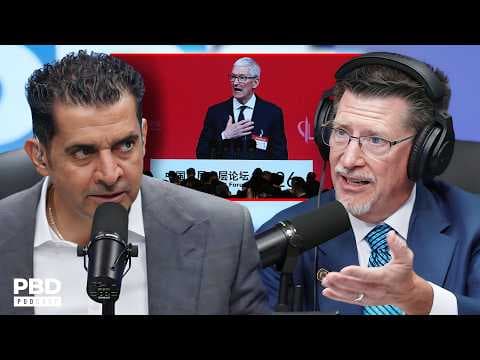
“The Apple Cult” - Tim Cook STEPS DOWN In SURPRISE Exit
Audio Summary
AI Summary
The discussion begins with a report that Tim Cook is stepping down as Apple CEO, with John Turner named as his successor. The hosts ponder whether this is a positive or negative development for the company. One host suggests it's likely a good thing, citing a common sentiment that under Tim Cook's leadership, Apple hasn't introduced a truly "next big product." While new iPhone models have been released regularly, the perceived difference between recent generations is minimal. The host recalls Steve Jobs's dramatic product reveals, such as sliding a MacBook Air out of an envelope, and notes that Tim Cook hasn't had a similar defining product launch, though the Apple Watch has thrived.
Tim Cook is characterized not as a "product guy" but as an incredibly efficient operator who has driven the company's success. The incoming CEO, John Turner, is described as a "product guy," specifically a senior vice president of hardware engineering. This shift in leadership suggests Apple is looking for its next major product and a stronger play in the burgeoning field of AI, which have been significant questions surrounding the company. Despite these criticisms, Apple's financial success under Tim Cook is undeniable, but the hosts emphasize that no company maintains perpetual momentum and Apple needs to define its next chapter, especially in an era of rapid AI-driven change within the app environment.
Another perspective is offered, suggesting that a company's success isn't solely dependent on one person at the top but on the entire organization. Apple is viewed as a high-end consumer gadget company with a powerful brand and a "cult" following. While acknowledging that they are an Apple user, one host admits to not chasing every new release, buying products a few years after their initial launch to get them cheaper. This highlights Apple's mastery of planned obsolescence and its ability to capitalize on consumer psychology.
The conversation then draws a parallel between Tim Cook's background as an operations guy (VP of operations, COO, then CEO) and Disney's choice of a parks manager to replace Bob Iger. The hosts note that Apple is now taking a different route by choosing a "product guy" as CEO, which is a departure from the traditional path. A key question arises about John Turner's public speaking ability and stage presence, wondering if he can captivate an audience like Steve Jobs did during product launches. A short audio clip of John Turner speaking is played, revealing a more charismatic delivery compared to Tim Cook's often monotone and serious demeanor.
The hosts speculate that with a "product guy" at the helm, Apple might see the introduction of new, innovative products, potentially encouraging more spending from consumers. The discussion then shifts to a broader question about leadership: could a variety of capable individuals have achieved similar success to Tim Cook, or was there something unique about his approach in building a "moat" around Apple? It's suggested that after the "crazy psycho" Steve Jobs, Apple might have opted for a "safe and boring" leader in Tim Cook, someone conservative and capable of handling quarterly calls without scaring investors. The comparison is made to when Steve Jobs brought in John Scully from Pepsi. While Tim Cook amassed a fortune of $3 billion during his tenure, the new CEO, John Turner, is expected to become a billionaire in a few years if he succeeds.
The latter part of the transcript transitions into a promotional segment for the Vault Conference. It is highlighted that the podcast does not feature major sponsorships but rather focuses on internal investments and the conference. The Vault Conference is described as a large event for business owners, with 12,000 attendees expected this year at the MGM Grand Arena in Las Vegas. The hosts present a pitch deck for potential sponsors, showcasing various opportunities for brand visibility, including logo placement at the MGM, presence on stage, video ads, inclusion in the event app, and a manual distributed to attendees.
A video clip promoting the Vault Conference details its growth from 420 attendees in 2019 to an anticipated 12,000 in 2026. It emphasizes that over 6,000 attendees are decision-makers running companies with valuations from $25 million to over $500 million, and over 2,000 CEOs lead teams of 75+ employees. The conference boasts high engagement rates, with 85% of attendees interacting with sponsors on-site and 71% actively opting to connect directly through the official event app. Sponsorship packages offer extensive brand visibility, including custom booths, advertising on the Las Vegas Strip (reaching 38 million+ weekly impressions), logo placement on attendee badges, stage moments, and ad plays on screens. Past sponsors include industry leaders like PayPal and Tony Robbins. The hosts encourage interested companies to learn more and secure their spot, emphasizing that sponsoring the conference is an investment in scaling their business and a valuable networking opportunity.