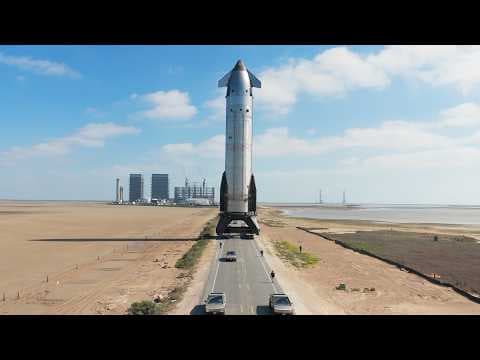
Starship - Test Like You Fly
Audio Summary
AI Summary
Here's a summary of the provided transcript:
Key Points and Main Takeaways:
* **Starship V3 Booster and Static Fire Testing:** The first V3 booster, Booster 19, underwent a 10-engine static fire test, which was the highest chamber pressure ever seen on a SpaceX vehicle. This limited engine test was chosen to mitigate potential issues, as it was the first V3 booster at the pad.
* **Star Factory and Production:** Star Factory is a nearly one million square foot facility dedicated to producing both the Starship and its booster. The Starship system is a fully reusable, two-stage rocket, with the booster accelerating the ship towards orbit, and the ship then going into orbit with people or payload.
* **Evolution of SpaceX Rockets:** The Starship program evolved from earlier SpaceX projects like Falcon 1, Falcon 9, Dragon (cargo and crew), and Falcon Heavy. These were foundational steps that allowed SpaceX to learn rocket technology in a new way, different from the traditional aerospace industry.
* **Starship V3 Design and Capabilities:** Version 3 is considered the foundational design for Starship Booster and the launch pad, offering new capabilities for future missions, including returning humans to the moon and establishing a city on Mars. Its large scale is intentional, not for records, to achieve ambitious goals.
* **Ship V3: A Clean Sheet Design:** Ship 39 is the first V3 rocket, representing a clean-sheet redesign incorporating lessons from V1 and V2 to address performance and reliability issues. It can reach orbit, stay for 48 hours, meet with other ships, and perform propellant transfers, a core technology for unlocking solar system access.
* **Challenges of Ship V3 Development:** Building Ship V3 involves bringing the rocket to life for the first time, encountering unique challenges as only simulations and fluid models have existed previously. Safety is paramount, followed by vehicle integrity, and then schedule adherence.
* **Booster Development and Challenges:** While SpaceX had experience with reusable boosters (Falcon 9), the Starship booster proved more challenging than anticipated. It's described as the most ambitious vehicle design personally worked on by the team.
* **Rapid Integrated Testing Philosophy:** The Version 1 flight test campaign exemplified SpaceX's rapid integrated test style. It took five flights to successfully catch a booster using "chopsticks," with each flight providing valuable lessons for improvements.
* **Booster 18 Anomaly and Safety:** Booster 18, the first V3 booster, experienced an explosion during its initial test campaign due to a nitrogen system issue. However, the test was designed for safety, with no propellants or reactive materials on board, resulting in minimal site damage and no injuries. This highlights the importance of safe testing procedures.
* **Cryo-Proof Testing:** Cryo-proof is the first time propellants are loaded onto the vehicle. This is a lengthy, multi-test process involving very cold liquid propellants (around 80 Kelvin) to simulate flight conditions.
* **Raptor 3 Engine Advances:** The Raptor 3 engine is a high-performance, reusable, and highly reliable boost engine. It represents a significant simplification and integration compared to the Raptor 2, leading to higher reliability, lower cost, faster manufacturing, and a lighter, better rocket overall. Achieving full reusability for such an engine is a groundbreaking accomplishment.
* **Overcoming Perceived Impossibility:** SpaceX believes that "impossible" is only determined by breaking laws of physics. Their approach is to leverage physics as effectively as possible to achieve goals that seem beyond previous accomplishments.
* **First 10-Engine Static Fire Attempt (Booster 19):** This test was the culmination of the engineering process, aiming to light 10 engines to gain confidence for flight. Despite successfully lighting all 10 engines and ramping to power, a pad-side abort was triggered by a sensor, leading to a fast shutdown. Ten engines were salvageable, but about half showed mechanical damage from the shutdown.
* **Second 33-Engine Static Fire Attempt (Booster 19):** After troubleshooting and replacing engines, Booster 19 attempted a full 33-engine static fire. This also resulted in an abort at T+1.88 seconds due to sensor loss on a ramp manifold, indicating lower-than-expected pressure. Testing the diverter's performance under actual engine firing conditions is difficult beforehand.
* **Learning from Setbacks:** Every test, even those with aborts, is considered a success because it provides crucial findings on ground systems, vehicle, and engines. The philosophy "only the paranoid survive" emphasizes the importance of analyzing data for clues to prevent future failures.
* **Ship 36 Anomaly and Infrastructure Resilience:** Ten months prior, Ship 36 experienced a CFPV explosion that destroyed the rocket and significant test site infrastructure. This led to a focus on making the pad more resilient to future anomalies, as repairing infrastructure takes months, unlike replacing rockets from the production line.
* **Massey's Pad Rebuild and First Integrated Test:** The Massey's test site was rebuilt from scratch, including new pad and vehicle systems. The goal was to ensure all these new components worked together during a 60-second static fire on the ship, assessing thermals and general vehicle performance.
* **Vision for Starship:** The ultimate goal of Starship is to give humans access to the solar system and beyond. The team believes the impact of this rocket on the world is immense and not yet fully comprehended, pushing boundaries of what's considered possible.