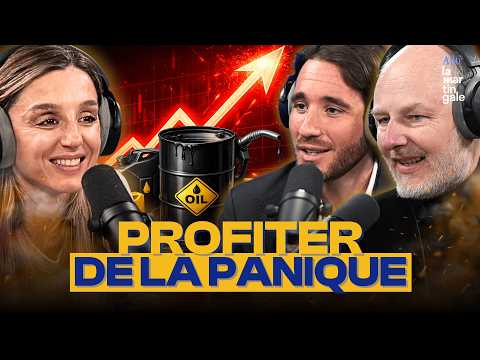
Panique à la pompe : comment en profiter ?- Allo La Martingale #52
AI Summary
This episode of "Allô la Martin Galale" features Karine interviewing two experts, Cédric Kurtil, a venture capital fund manager specializing in tech, and Ellie, a financial advisor with over a decade of experience managing investments. The discussion centers on navigating financial markets and investment opportunities amidst current geopolitical and economic uncertainties, particularly focusing on energy prices and future trends.
The conversation begins by addressing an listener's concern about rising fuel prices. Ellie expresses skepticism about the French government's ability to significantly lower oil prices in the short term, citing the high cost of past price shields and the government's current financial limitations. She emphasizes that current price fluctuations are largely tied to geopolitical events, and France alone cannot unilaterally dictate oil prices. Cédric concurs, noting that the government's financial capacity for price shields is diminished compared to previous years. He also points out that the current season (spring) is more favorable for renewable energy sources like solar, and nuclear power plants are largely operational, offering some mitigating factors.
Cédric elaborates on his role as a venture capital fund manager, investing in young, tech-focused companies. He highlights that his fund, based within the Centrale Supélec ecosystem, focuses on innovative solutions, including those in energy management. He mentions an AI solution that helps energy-intensive factories optimize production based on prices and carbon emissions.
The discussion then shifts to the broader economic context. Cédric describes the current crisis as more "mature" than previous ones, suggesting a greater understanding and adaptation to the situation. He notes that despite concerns, the immediate panic at gas stations hasn't been as severe as anticipated, partly due to existing fuel reserves. However, he provides data indicating a significant reduction in oil imports from the Persian Gulf, which will impact supply and likely lead to price increases. He stresses the importance of securing alternative energy sources and managing temporary price hikes.
Ellie addresses investor sentiment, acknowledging concerns amplified by fluctuating international political statements. However, she advises against outright panic, reiterating that there are sufficient reserves and that the situation is manageable. She points out that certain investment products, like structured products and some euro funds, offer protection against market downturns. She also suggests that, in every crisis, there are opportunities to profit, emphasizing the need to identify them rather than falling into traps.
Regarding specific investment opportunities, Ellie strongly advises against investing in oil at its current elevated price, deeming it too late to capitalize on the war premium. Instead, she recommends uranium, highlighting a significant disconnect between oil prices (up 43%) and uranium prices (down 23%). She explains that uranium is essential for nuclear power, which is crucial for energy production without hydrocarbons, especially with the ongoing push for electrification. She forecasts a deficit in uranium supply versus increasing demand over the next 2-5 years, making it a potentially strong investment for the decade. Cédric adds that uranium is sourced from mines and its use is tied to the construction and operation of nuclear power plants, particularly new ones like the EPRs in China and Europe. He also contrasts uranium's energy density with that of coal, favoring uranium as a cleaner alternative.
Cédric further discusses the concept of the "energy transition" as an economic reality, not just an idealistic notion. He stresses the need to secure energy supplies and views this as a fundamental aspect of business strategy, shifting the focus from pure margins to flexibility and resilience. He mentions companies involved in CCUS (Carbon Capture, Utilization, and Storage) as examples of innovative infrastructure solutions.
Ellie then brings up copper as another potential investment opportunity. She explains that the global electrification effort will require an estimated 100 million kilometers of electrical cables, each demanding 40 tons of copper. With copper prices also at a low point (around -23% to -24%), she sees structural drivers for increased demand and insufficient supply, presenting a good entry point for investors.
Cédric elaborates on investment strategies, emphasizing the importance of looking at companies that are building the necessary infrastructure for the future. He highlights companies involved in grid innovation, construction of energy infrastructure, and software solutions for supply chain optimization. He provides examples of startups in his portfolio, such as those developing AI for energy price management in factories, digital twins for industrial processes, and supply chain mapping. He explains how these companies help businesses manage price volatility and optimize energy consumption, even leveraging negative electricity prices.
Regarding geographical investment, Cédric acknowledges China's leadership in renewable energy production but cautions against unreserved investment due to its continued reliance on coal and geopolitical risks. He notes that while China is a dominant producer of solar panels, its opacity and past regulatory interventions with companies like Alibaba make it a volatile market.
The conversation touches upon the role of defense in investment. Ellie suggests that European defense micro-caps and nano-caps represent a compelling, albeit risky, investment opportunity, citing companies like KNDS with strong order books. She argues that defense is crucial for national sovereignty and democracy, challenging the traditional ESG hesitations around this sector. Cédric agrees that defense is becoming increasingly essential for sovereignty and security, noting that it accounts for a significant portion of GDP.
The experts also discuss investment vehicles. Cédric explains that his venture capital fund is restricted to professional investors due to regulatory requirements and high minimum investment thresholds, making direct investment in his portfolio inaccessible to the average individual investor. He suggests alternative avenues like crowdfunding platforms for exposure to such investments, but reiterates the high risk and the need for professional guidance and diversification.
Ellie provides specific investment recommendations for a listener seeking stable, long-term growth:
* **Uranium:** Recommended for its strong structural drivers and current low entry point (5% of portfolio).
* **Copper:** Also recommended for electrification needs and its low current price (3-5% of portfolio).
* **NG (Engie):** Suggested for its stability and diversified energy sources, including nuclear and LNG, not solely relying on oil (5% allocation).
* **Midstream:** The infrastructure for energy supply, storage, and delivery, is also highlighted as a strong area.
* **European Defense Micro/Nano-caps:** For a more dynamic, higher-risk, higher-reward segment (5% allocation, with a 10-15 year horizon).
She explicitly advises against investing in oil at the present moment and suggests caution regarding automotive stocks due to the uncertain transition between thermal and electric vehicles, favoring a complementary approach.
Cédric shares insights into the types of companies his fund invests in, including AI for health diagnostics, DNA testing platforms, AI assistants for educators, autonomous container guidance systems for ports, and innovative satellite-sharing platforms. He emphasizes that his investment decisions are driven by the team's understanding of future trends and their ability to translate them into viable products. He also stresses that venture capital investing is inherently risky, with a significant chance of losing capital, and that diversification is crucial.
The episode concludes with a discussion on the importance of knowledge and scientific progress as valuable assets, with Cédric humorously suggesting burying hard drives filled with scientific data as a long-term investment on a deserted island. Both experts reiterate the importance of professional guidance and responsible investing, especially when venturing into high-risk areas like venture capital, crypto, and individual trading. They encourage listeners to stay informed and to manage their finances wisely.