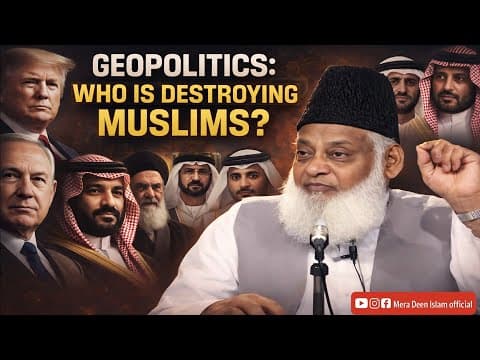
Muslim Countries Kyun Barbaad Ho Rahi Hain? Geopolitics Exposed | Dr Israr Ahmed bayan
Audio Summary
AI Summary
The transcript touches on various themes, including the historical context of Islamic powers, the concept of a united India and world, and the challenges faced by Muslim communities. The speaker references a poet who "destroyed our dreams of United India" and a united world, suggesting a lament over divisions. There's a mention of a "subaryngeal injection" and a poet who "destroyed our dreams of a united world." The conversation shifts to the idea of a "Muslim nation" and the establishment of Pakistan, with gratitude expressed to Iqbal for his vision. The speaker emphasizes that East Pakistan, too, became a Muslim country.
The discussion then moves to the concept of accepting "our" identity and the idea of Islam being built in a context of repression. There's a call to "confirm the system" and to confront "the enemy of God." The year 1976 is mentioned in relation to a "glory" and a promise to "return." The speaker also brings up the idea of individual freedom and financial struggles, noting instances of significant financial loss and the need to "borrow life."
A recurring theme is the importance of understanding and embracing one's identity as a Muslim. The speaker suggests that Muslims should not be passive but should actively engage and "conquer." There's a strong emphasis on the principles of Islam, including justice and social welfare. The concept of "Allah's passion" and the idea that "every person has a good quality" are highlighted. The speaker contrasts the current state of Muslim nations, which are fragmented, with the historical unity under the Caliphate.
The transcript delves into the idea of a "real self" that is often obscured by material possessions and ignorance. This "real self" is described as something lifted, not bound by the physical. The speaker then critiques the current global systems, particularly the US system, and emphasizes the need for local solutions and intelligence. The concept of "khilafat" (caliphate) is presented as a crucial aspect of Islamic governance, asserting that "man is not the ruler," but rather "Allah is the owner of the heavens and the earth."
Democracy is discussed, with the speaker noting that "democracy is a popular sovereignty" and that "Allah is the owner." The conversation highlights the social welfare aspects of Islam, comparing it to Scandinavian countries' charity and insurance programs. The speaker stresses that "there is no difference in this potential" among people, implying equality.
The transcript also touches on economic exploitation and social injustice. The speaker uses powerful imagery to describe the plight of laborers and farmers, whose "blood and sweat" are exploited by landlords and feudal lords. This exploitation is presented as a "revolutionary" issue, with calls for "Inqlaab" (revolution).
The speaker then brings in the ideas of Iqbal and the Quran, emphasizing the profound connection between them. The concept of "Shahadat Meknub o Meksood Mumin" is introduced, suggesting a process of revolution. The speaker also discusses the concept of "human," distinguishing between "refined animals" and "human beings" who possess a "ruh" (soul). This soul is described as originating from a higher realm and being nourished by "Allah's word."
The transcript also touches on the idea of not forgetting Allah, referencing a Quranic verse about those who forget Allah and are then made to forget themselves. The speaker questions whether humans forget their "animal existence." The discussion further explores the concept of "khudi" (selfhood) as named by Allama Iqbal, suggesting a deeper understanding of one's inner self.
The speaker concludes by reiterating the importance of Islam's principles, particularly justice and social welfare, and the need for Muslims to reclaim their identity and overcome the challenges they face. The transcript is a rich tapestry of historical, philosophical, and social commentary, all centered around the identity and role of Muslims in the world.