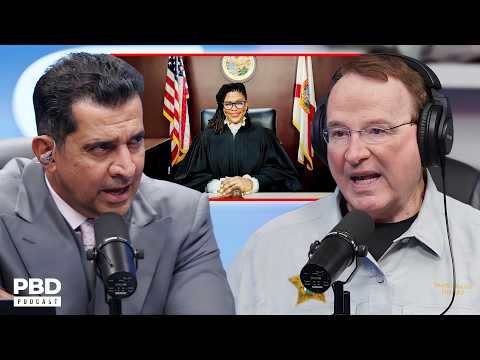
"That Child Would Be Alive Today" - Sheriff Judd TORCHES Woke Judge Who FREED Child Rapist
Audio Summary
AI Summary
The discussion centers on the accountability of judges and the effectiveness of criminal justice systems, particularly in light of a specific case in Florida. Governor DeSantis has called for the impeachment of Judge Tiffany Baker for releasing a man on bail who was subsequently found to have raped, tortured, and killed a five-year-old girl. The governor argues that this action demonstrates a failure to hold judges accountable, leading them to favor criminals, and that the legislature has the power to impeach.
The speaker expresses outrage at the judge's decision, emphasizing that she had the authority to detain the individual until sentencing, and that her failure to do so resulted in a tragic loss of life. The speaker praises Governor DeSantis for his efforts to make Florida a safer state, attributing the state's low crime rates to his policies. It's suggested that if impeachment fails, the public can remove the judge from office by voting against her in the next election.
The conversation then broadens to the broader issue of judges who may be perceived as too lenient with criminals. The speaker recounts their experience in law enforcement, recalling a time in the 1970s and 80s when Florida was perceived as being controlled by criminals, with rising crime rates. This situation, characterized by a lack of legislative action, only changed when it became an economic issue, with a significant number of tourist murders and a travel warning issued by Europe in the late 1980s. This spurred the legislature to implement stricter sentencing laws, including mandatory minimums, which led to a dramatic decrease in crime. Florida is now cited as having crime rates at a 50-year low, with the speaker's county at a 54-year low, crediting this to prioritizing law-abiding citizens over criminals.
Regarding the judge's actions in the child rape case, the speaker dismisses any possibility of a rational argument for her decision, stating that the individual had already been found guilty and was known to be dangerous. The speaker contrasts this with the approach in Polk County and other parts of Florida, where such an individual would have been remanded into custody, potentially saving the child's life.
The discussion then touches upon the concept of second chances. While acknowledging the existence of programs like veterans court, mental health court, diversion programs, and drug rehab in Florida's criminal justice system, the speaker draws a line when it comes to violent offenders. For those who demonstrate a propensity for violence or a pattern of rule-breaking, their chances are considered over, and they face imprisonment. This approach is contrasted with the perceived leniency in other states like California, New York, and Washington D.C., where the speaker claims criminals "own" the states and that permissive policies lead to increased crime and a "me too" mentality among offenders.
A recent incident involving illegal immigrants who allegedly beat down New York City police officers is used as an example of what the speaker views as a breakdown in law and order. The fact that these individuals were reportedly released without bail, despite their illegal status and the violent assault on officers, is deemed "insanity." The speaker laments the inability of New York State to even inform ICE about these individuals, leading to their release and unknown whereabouts.
The segment concludes with a call to action for viewers to subscribe to the channel, highlighting its growth and the need for continued support to produce more content. The speaker expresses gratitude for the audience's support and directs them to other videos and the full podcast.