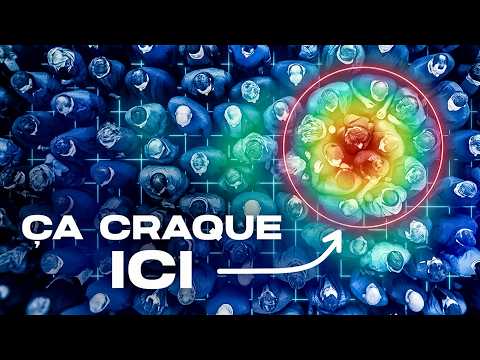
Cet algorithme prédit les mouvements de foule meurtriers | ft. Fouloscopie
AI Summary
The video discusses the scientific discipline of "phosocopy," which involves understanding and predicting crowd behavior, originating from early work on simulating bird flocks and evolving into applications for saving human lives.
The genesis of this field is attributed to Craig Reynolds, a computer scientist and graphic artist in the late 1970s and early 1980s. Working at Symbolics, he was tasked with creating realistic bird flight simulations. At the time, simulating flocks involved tedious manual animation, tracing individual bird trajectories, or using fluid dynamics models that didn't account for individual components. Reynolds, inspired by the nascent field of artificial life, aimed to create autonomous "agents" that could mimic bird behavior. He developed a simple model based on three rules for each bird, acting within a defined radius:
1. **Separation:** Avoid crowding neighbors (repulsion).
2. **Alignment:** Steer towards the average heading of neighbors.
3. **Cohesion:** Steer towards the average position of neighbors.
By giving these simple rules to numerous simulated birds, Reynolds observed emergent, lifelike flocking behavior. He famously developed a functional prototype in just half a day, demonstrating the power of agent-based modeling.
The immediate impact of Reynolds' work was not in academia, which is often slow to adopt new ideas, but in industry, particularly the film industry. In the 1970s and 80s, creating realistic crowd scenes was a significant challenge. A prime example is the film "Gandhi," which required 300,000 extras for Gandhi's funeral procession, a logistical nightmare to organize.
Reynolds' breakthrough in 1986 quickly caught the attention of filmmakers. Steven Spielberg, working on "Jurassic Park" (1993), contacted Reynolds. Spielberg needed to depict herds of dinosaurs, a task impossible with the special effects of the era. Reynolds suggested adapting his bird simulation by simply changing the "bird" visual to "dinosaur." This led to the iconic stampede scenes in "Jurassic Park," where individual dinosaurs, though simulated, interacted locally to create a believable herd dynamic. This approach, termed multi-agent simulation, allowed for autonomous agents whose collective behavior was unpredictable but visually stunning.
The success of "Jurassic Park" paved the way for further advancements. Peter Jackson, while making "The Lord of the Rings," faced the challenge of animating hordes of Orcs. He developed a sophisticated simulation software called "Massive." This software went beyond Reynolds' basic rules, incorporating a richer behavioral repertoire for each agent. Orcs were given rules like "if an enemy is in front, attack," "if attacked, fall down," or "if a comrade is nearby, move behind them." These rules, often with a degree of randomness (stochasticity), created more complex and visually convincing combat scenarios. Massive became a leading software in the film industry. Another notable example is the French company Golem, which created animations for "Game of Thrones," including the Dothraki and Unsullied armies, earning an award for their work.
Beyond visual effects, Reynolds' model also resonated with scientists studying animal behavior. For decades, naturalists were puzzled by the synchronized movements of fish schools and bird flocks, speculating about leadership or telepathy. Reynolds' model offered a simpler explanation: emergent behavior arising from local interactions. Researchers, notably Yan Cousine in 2001, systematically analyzed Reynolds' three-parameter model (the radii of the interaction circles). They discovered that variations in these parameters could produce different collective behaviors, such as vortex formations, vacuole patterns, or linear arrangements, all of which corresponded to observed natural phenomena. This demonstrated that complex group behaviors could emerge from simple, individual-level rules, influenced by factors like the perceived presence of predators (leading to tighter formations). This concept of emergent behavior is also seen in ant colonies, where complex foraging patterns arise not from a queen's direct command, but from individual ants depositing pheromones, reinforcing successful paths.
The field then turned its attention to human crowds, a more direct application of this research. Before agent-based modeling, crowd dynamics were often treated with fluid mechanics, which proved inadequate for situations like bidirectional pedestrian flow. Researchers, including the speaker, began conducting laboratory experiments, filming people as they navigated simulated environments to understand their real-time interactions. This data is used to calibrate multi-agent models.
The most critical application of crowd simulation is in public safety. For decades, deadly crowd crushes have occurred at large gatherings, such as the Hajj pilgrimage in Mecca. Urban planners struggled to anticipate crowd behavior and design safe infrastructure. Agent-based models offer a way to simulate crowd movement, identify risk zones, and test mitigation strategies. A key risk factor identified is narrowing passageways, which increase density and can lead to dangerous compression and suffocation.
The Hajj pilgrimage provides a stark example. Following a fatal crush in 2006, researchers, including the speaker's thesis advisor, Dirk Helbing, collaborated with Saudi organizers. They used data from the 2006 incident to calibrate their "social force" model, which accounts for both social and physical forces in dense crowds. Since then, significant improvements have been made, drastically reducing fatalities. These improvements include strict crowd control, one-way pedestrian flows, scheduled passage times, and avoiding bottlenecks.
Counter-intuitive findings have emerged from crowd simulations. For instance, simulations show that in an evacuation scenario, people walking calmly exit faster than those who panic and run. This is known as the "faster is slower" phenomenon, where individual attempts to speed up can lead to collective congestion. This has practical implications for evacuation protocols, emphasizing calm movement. Another counter-intuitive finding, observed in grain silo simulations and subsequently applied to crowd exits, is that placing a small obstruction (like a post) a short distance before an exit can actually improve flow by dividing the crowd and preventing a single, overwhelming surge.
Looking ahead, the principles of multi-agent simulation are being applied to robotics. Instead of relying on single, complex, expensive robots, researchers are exploring "swarm robotics," where large numbers of simple, inexpensive robots interact to achieve a collective goal. Examples include drone swarms for search and rescue operations after disasters, where decentralized exploration and local recruitment of nearby drones mimic ant-like foraging behavior. This approach is also being considered for space exploration (e.g., Mars rovers) and medical applications, such as nanobots searching for and destroying cancer cells within the human body. The ongoing research focuses on optimizing the balance between exploration and exploitation – knowing when to search for new information and when to capitalize on existing discoveries.