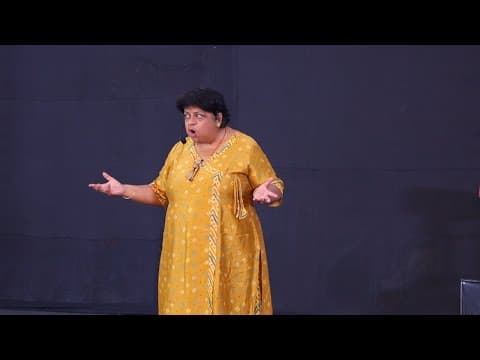
Leading through disruption:Self discovery in times of Uncertainty | Dr Debjani Roy | TEDxMPEC Kanpur
Audio Summary
AI Summary
The speaker begins by addressing the audience as "leaders of tomorrow," setting a tone of encouragement and future orientation. They emphasize that disruption has been a constant theme throughout their life, starting from a young age within their family. As an only child, the speaker felt they were enough for their parents, but the first significant disruption came when they chose to study humanities (history, economics, English, and geography) despite their family's background in medicine and molecular biology. This decision was met with disapproval, and the speaker felt their family was ready to "boycott" them. However, this experience was also the first realization of their capacity to take control of their own decisions, planting the seed of leadership within them.
The speaker clarifies that leadership, in their view, isn't about quotes or grand theories but about the courage to take risks. They recall a time before smartphones and the internet, when information was scarce and communication relied on landline telephones. Despite these limitations, in their 11th standard at Delhi Public School, RK Puram, they were chosen as head girl. This was followed by a second disruption: becoming the Students' Union President. In this role, the speaker led the first-ever strike in the school's history. The issue was the school's reliance on old, dilapidated DTC buses for student transport, which had led to several accidents. The students, under the speaker's leadership, boycotted classes for two days until the school invested in its own fleet. This successful protest resulted in the purchase of 27 buses, a change that endures to this day.
The speaker describes college as the "final test" where their risk-taking ability and passion for pushing issues forward truly surfaced. They recount their involvement as a student leader in the agitation against the Mandal Commission's introduction of reservations in India. During this protest, which involved creating a human chain around Parliament and facing water cannons, the speaker was arrested, and an FIR was filed against them. This posed a significant challenge because having a police case registered disqualified individuals from qualifying for the civil services, an exam the speaker had already passed the written part of, with only the interview remaining.
Despite this major setback, the speaker emphasizes that they did not step back. They learned that life doesn't end when you take charge of your decisions and choose to do things differently. This led them to the concept of the "adaptability circle," which they consider a crucial competence in the age of disruption. This cycle involves "learning, unlearning, and relearning." By embracing this adaptability, one can overcome any problem and win any "war." The speaker believes this is why they are standing before the audience today, having forgone a potentially celebrated life as a civil servant.
With 32 years in the industry, the speaker highlights their successes, attributing them to passion rather than just hard work. They share an anecdote about leading an HR function for Southeast Asia and participating in a team-building exercise on the Great Wall of China. Their team of four, including themselves, won the competition, climbing a challenging section of the wall to reach the "hero's peak" and earning an 18-carat gold medal. This experience reinforces their belief that true leadership is not about power or authority, but about purpose, inspiration, and leaving a legacy.
The speaker outlines three key aspects of leadership:
1. **The ability to take risks.**
2. **The vision to elevate one's work, profession, and personal life to a level that inspires admiration.**
3. **The courage to break the mold, challenge the status quo, and create newness that inspires positive disruption.**
They reiterate the importance of the adaptability cycle: learn, unlearn, and relearn, stating that "the sky is the limit."
The speaker then mentions several inspirational leaders and figures, including Elon Musk, Steve Jobs, and Reed Hastings, who have significantly impacted their respective fields. They also introduce less universally known but equally impactful individuals: Dr. Kazuo Anemoro, owner of Kyocera, known for his "amoeba management theory" which involves dividing the company into smaller, digitally interconnected units, and Dara Kiroshahi, who transformed Uber into a dynamic and operationally efficient organization. These figures, the speaker notes, were not driven by a desire for power, which came as a byproduct, but by the ambition to leave a legacy.
In conclusion, the speaker emphasizes that true leadership is not solely about personal beliefs but about inspiring others to follow and to remember you even when you are no longer present. They thank the audience for their patient listening.