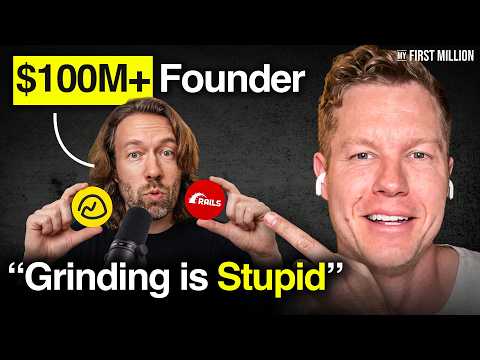
DHH on how f*ck you money changed every decision he made.
AI Summary
This summary explores the business philosophy, technical insights, and contrarian perspectives of David Heinemeier Hansson (DHH), co-founder of 37signals and creator of Ruby on Rails. Based on the provided transcript, the discussion covers his views on the advantages of private ownership, the role of intuition over data, and his recent evolution regarding artificial intelligence.
**The Privilege of Privacy and the Power of Beliefs**
DHH highlights that 37signals has never disclosed full revenues or profits, calling this a "great privilege" of being a private company. This secrecy allowed the firm to operate in the project management software category for a decade before competitors realized how profitable the niche was. Rather than leading with product features, 37signals markets itself through a "manifesto" of deeply held beliefs. DHH argues that because he and his partner, Jason Fried, never raised venture capital, they were forced to "out-teach" rather than out-spend the competition. This constraint birthed a marketing strategy based on being "ruthlessly honest," which DHH believes is more interesting than padded business advice found in airport bookstores.
**The Value of Ignorance and Constraints**
Reflecting on his early career, DHH defends the "hubris" of his 20s. He posits that ignorance is often a benefit when solving a certain class of problems because it allows a founder to start from a clean slate, unburdened by established paradigms. He cites the creation of Ruby on Rails as a direct result of these constraints. If 37signals had raised $20 million and hired 100 people, DHH believes they would have used the same bloated technology as everyone else. Because he was working alone and lacked resources, he had to invent a framework that maximized individual productivity.
DHH also discusses the biological reality of "liquid intelligence," which peaks in one's 20s. He notes that while young people may lack "crystallized intelligence"—the ability to make broad connections—they possess the speed and ignorance necessary to change the world. He embraces the idea that one can be "ignorant and correct" simultaneously.
**The Facebook Prediction and "Resulting"**
The conversation addresses a famous 2010 blog post where DHH claimed Facebook was not worth $33 billion. While the valuation eventually skyrocketed, DHH defends his underlying logic. He explains the poker concept of "resulting," which is the error of evaluating a decision based solely on its outcome rather than the odds at the time. When he made the prediction, Facebook had "trash traffic" without a clear monetization strategy. He failed to foresee the "alchemy" of surveillance capitalism, which turned eyeball time into gold by targeting users based on who they were rather than what they were searching for. He maintains that while he was wrong about the outcome, the analysis of the risks at that moment was sound.
**Intuition Over Data Science**
At 37signals, the operating philosophy prioritizes "the luxury of margins" over squeezing every last drop of profit. DHH reveals that the company enjoyed such high net margins that they never felt the need to run "minutiae AB tests" to optimize conversion rates by fractions of a percent. He expresses a deep skepticism of the "grind" culture, stating that life is too interesting to waste on boring optimizations.
Interestingly, DHH admits that for over a decade, 37signals employed a data scientist, yet he and Fried almost never followed what the numbers suggested. They would do what they wanted regardless; if the data supported them, they praised the numbers, and if it didn’t, they dismissed it as incomplete. He argues that statistical analysis often becomes "hocus pocus" because it cannot account for unknown variables like word-of-mouth or long-term brand building.
**Insights from the Shopify Board**
DHH serves on the board of Shopify, a company he describes as operating in a "different universe" of scale. He notes the "compounding determinism" of founder Toby Lütke, who has remained a "computer nerd" at heart while building a company responsible for a significant share of global e-commerce. DHH observes that even at Shopify’s massive scale, there is a level of mystery to their success—such as growing 30% year-over-year in their 22nd year. He concludes that "nobody knows anything" for certain, and success often comes from chipping away at a simple mission for decades.
**The AI Pivot**
One of the most significant shifts in DHH’s thinking involves AI. Initially a skeptic of AI-generated code due to its lack of "aesthetics," he became "thoroughly pilled" in late 2023. He describes the jump in model intelligence as a "mental churn" that has radically changed his workflow. He no longer views AI as a mere autocomplete tool but as an "agent" that gives him "18 arms and 7 more brains." He admits he was wrong about how quickly AI would change the programming profession, noting that it has made his work "incredibly addictive."
**The Battle with Apple and the Move to Linux**
DHH recounts the "shakedown" by Apple during the launch of the email service HEY. Apple demanded a 30% cut of revenues, threatening to destroy the business if HEY didn’t implement in-app purchases. DHH and Fried refused to comply, leading to a public skirmish that eventually forced Apple to rewrite its rules. This experience reinforced DHH’s commitment to "no-permission platforms." It led him to abandon the "walled garden" of Apple for the world of Linux and open-source hardware, driven by a "fierce Viking blood" indignation against corporate gatekeeping.
**Longevity and the Meaning of Work**
Ultimately, DHH defines success as ensuring 37signals remains his favorite place to work. He avoids the "Protestant work ethic" that equates hours spent with value provided, instead focusing on the "meaningful burden" of building products he cares about. Having reached financial "escape velocity" early in his career, he views his current work as "overtime" and "gravy," allowing him to operate with an "instrumental detachment" that ironically makes him a better businessman.