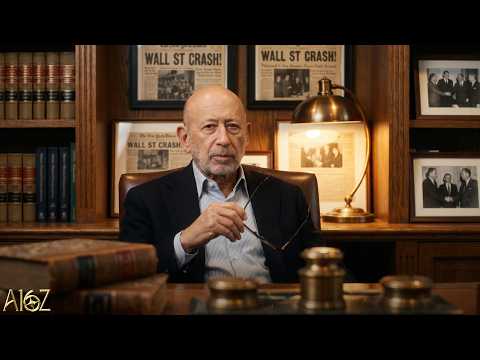
Goldman Sachs Chairman on AI and the Future of Finance | The a16z Show
AI Summary
Investing involves both making money and managing risk. Predicting the future is difficult; instead, risk management relies heavily on contingency planning. When a crisis occurs, the ability to react quickly and effectively is crucial, often giving the impression of foresight. This comes from having a plan and being prepared to act the moment a trigger is detected.
The speaker, having grown up in public housing in New York, emphasizes that a modest upbringing without the burden of high expectations can be an advantage. He notes that he didn't know much about the world or travel before college, which meant he wasn't constrained by preconceived notions. His ambition was simply to go to an out-of-town college to escape Brooklyn.
His career at Goldman Sachs began unexpectedly. After law school, he struggled to find a job on Wall Street, eventually being hired by J. Aron & Company, a small commodity trading firm he had never heard of, as a precious metals salesperson. J. Aron was subsequently acquired by Goldman Sachs, bringing him into the larger firm. This acquisition was initially considered a "disaster" but ultimately proved beneficial, introducing an entrepreneurial culture to Goldman Sachs. J. Aron had a different culture, recruiting people from diverse backgrounds, with the entry-level job often being a driver for traders, a stark contrast to Goldman's Ivy League, MBA-focused recruitment.
Risk management at Goldman Sachs involved a dual approach: taking calculated risks to generate returns and actively managing those risks. This meant constantly evaluating diversification, commitment levels, and potential adverse consequences. The key was not to predict the future, but to plan for contingencies, asking "What will you do if it does happen?" and "What can you do today to mitigate the consequences?" This proactive approach, like buying insurance in the off-season, is far cheaper and more effective than reacting during a crisis. The speaker reveals a personal inclination towards risk management, always looking for what could go wrong, while also possessing an appetite for living in risky situations without "shriveling up."
A crucial aspect of effective management, especially in risk-laden environments, is understanding the distinction between being wrong and being stupid. Smart people can be wrong, and it's vital not to treat someone who makes a mistake as if they are stupid. Managers often err by letting "after-acquired information" influence their judgment of past decisions, failing to appreciate the "fog" of uncertainty in which decisions were originally made.
The speaker highlights the importance of information gathering within an organization. He made himself approachable and never dismissed any information by saying "I already know about it," even if it was redundant. This ensured that no one would self-censor or hesitate to share insights, regardless of their position.
Technology played a critical role in Goldman Sachs' evolution. In finance, technology often leads to a "winner-take-all" scenario, where milliseconds can determine success. Goldman Sachs continuously invested in and tested new technologies, often running old and new systems in parallel until the new system proved reliable. This approach, though initially augmenting costs, ultimately led to greater efficiency and a significant technological advantage in areas like risk systems. The firm’s proprietary risk management system, SEC DB, was exceptionally flexible and durable, remaining at the core of their operations for decades.
The transition from a private partnership to a public company was a major challenge for Goldman Sachs. The fear was losing the "partnership culture," which fostered a deep sense of ownership among senior employees. Partners cared about the entire enterprise, not just their individual silos, expected transparency, influence, and input into major decisions. This culture, characterized by slower decision-making and a willingness to socialize ideas, led to a more stable and committed organization. The firm's treatment of its alumni, maintaining an alumni office and fostering connections decades after departure, is another testament to this enduring culture of loyalty and commitment.
Going public was a necessity for Goldman Sachs to grow its balance sheet and compete as lenders after the repeal of Glass-Steagall. The challenge was maintaining the partnership ethos while adapting to the demands of public ownership, such as the need for smoother, less volatile earnings. This led to a shift of some risk-taking activities to off-balance sheet vehicles, allowing the firm to maintain its risk-taking culture while achieving higher P/E ratios and returns on equity. This culture of being "principals" and "partners" with clients, rather than mere "supplicants," was crucial for Goldman Sachs' competitive edge.
The firm's success during the 2008 financial crisis is attributed to its strong risk management culture, rigorous mark-to-market practices, and a lack of a large consumer business (though this also made them an easy target for public backlash due to their anonymity among the general public). Goldman Sachs strictly marked down assets, even those considered AAA, and maintained collateral agreements with entities like AIG, which proved crucial. The firm's long-term orientation and commitment to relationships, encapsulated in the phrase "long-term greedy," meant honoring commitments even in difficult times, understanding that reputation and future business depended on it.
Looking ahead, the speaker believes that technology companies, particularly AI labs, will face similar public scrutiny and backlash that financial institutions once experienced. His advice to leaders in this space is to proactively communicate their value and societal function, rather than remaining anonymous or defensive. He emphasizes that being modest and understated carries disadvantages, and it's crucial to explain the important role these companies play in the market before a crisis forces them to.
Regarding AI, the speaker views it as a transformative technology, akin to electricity or the internet, though its ultimate impact is unknown. He notes that the major hyperscalers driving AI are often led by founding shareholders, whose personal convictions and capital are deeply invested. He cautions against the tendency to judge past decisions with "after-acquired information" and acknowledges that while some "stupid stuff" will inevitably be done, the overall trajectory is one of immense importance.
He highlights risks associated with AI, such as unreliability in critical applications and the loss of human intuition due to opaque thought processes in large language models. The leverage inherent in these technologies means mistakes could cost billions, unlike in previous eras. Regulatory intervention may be necessary, not because AI is smarter than humans, but because of the inability to fully test and understand its complex behaviors. Despite these apprehensions, he believes it's impossible to "unlearn" these technologies and that humanity will adapt, finding new goods, services, and ways of working, potentially leading to more leisure time.
Finally, for young people starting their careers, the speaker advises becoming "complete people" through a range of activities and learning, including humanities and history. This makes them more resilient, interesting, and ultimately more successful in both their personal and professional lives. He dismisses the notion that political or social polarization is unprecedented, reminding listeners of past crises like the Civil War, the late 1960s, and the Cuban Missile Crisis, suggesting that if previous generations navigated such challenges, the current one can too. He encourages a long-term perspective on career development, emphasizing that productive years extend far beyond early adulthood.