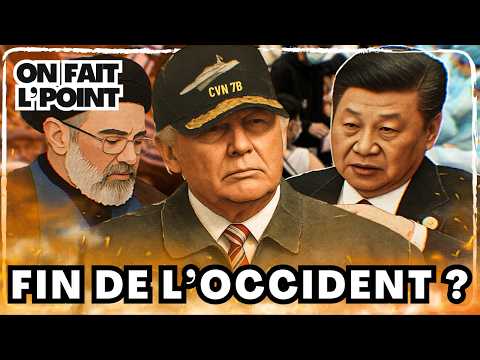
La FIN de l'OCCIDENT ? 5 ANALYSES sur la GUERRE en IRAN !
Audio Summary
AI Summary
The video explores the war in Iran, questioning why it's not portrayed in the mainstream media as a Nazi-like aggression and highlighting the role of alternative media in countering propaganda. It proposes five new theories regarding the war, emphasizing its economic underpinnings and the geopolitical struggle between the United States and China.
The first theory posits that the war serves as a diversion for Trump from domestic issues like inflation and the Epstein affair, where his alleged involvement in crimes is mentioned. Beyond Trump's personal troubles, the war is seen as an American strategy to dismantle a regional power in the Middle East, thereby clearing the path for Israel and its Gulf allies. Iran's significant oil supply is also a target, aiming to weaken China's reliance on oil imports and disrupt its commercial exports. The Strait of Hormuz is identified as a strategically vital chokepoint; US control over it would grant significant leverage, particularly concerning gas exports to Europe and oil to Asia. Iran's current control over the strait inflates oil prices globally, creating a lucrative opportunity for major oil-exporting nations, including the US, which can then leverage this situation for new negotiations. Despite a temporary ceasefire, the underlying contradictions remain unresolved, suggesting the conflict is fundamentally economic, driven by an imperialist struggle between US military might and Chinese trade.
The second analysis challenges the notion of a Western decline, particularly against China, Russia, and a supposed Eastern bloc. Instead, it suggests a bipolar world dominated by the US and China, with emerging powers focusing on future markets and resource exploitation in the Global South. Europe is viewed as a secondary player, with leaders like Macron struggling to assert influence. The analysis re-frames the situation not as a decline but as a confrontation between superpowers. It notes that despite facing setbacks in Syria, Lebanon, and Venezuela, and enduring attacks on its cadres and infrastructure, Iran remains a resilient power. The military situation in Ukraine is described as not glorious, and the potential for a future conflict with China over Taiwan is acknowledged.
The third analysis delves into the US strategy of making itself indispensable through conflict. The video argues that the US has historically thrived on war, using it to conquer territories, overthrow opponents, and impose its corporations. This has led to a vast military-industrial complex, consuming half of the world's military expenditure. While China's imperialism is characterized as primarily industrial and diplomatic, the US relies on commerce, sanctions, and ultimately, military force. This fundamental difference in their imperialistic approaches creates a stark opposition, as they require different global environments to prosper. China needs a peaceful, open world governed by diplomacy to maximize trade, a vision embodied by the BRICS economic bloc, which Iran was set to join. Conversely, the US thrives in a world of conflict, using military interventions to forge alliances, redirect energy flows to its advantage, and maintain its military-industrial complex. The US aims to position itself as the "world's gendarme," a role that necessitates chaos and conflict.
The fourth analysis focuses on the potential impact of the war on China's economy. While China possesses significant oil reserves and has alternative suppliers, the war does impact its refineries. However, the Chinese economy is deemed capable of withstanding such shocks for an extended period. The analysis highlights China's investment in renewable energy, making it less dependent on oil flowing through the Strait of Hormuz. Goldman Sachs predicts a more severe economic downturn for the US than for China due to the war. The video questions whether rising oil prices will boost or hinder Chinese exports. Historically, inflation has reduced Chinese export volumes, but this could be offset by its leadership in renewable energy. The economic impact on China is considered real but minimal compared to the consequences for the European economy. The US is seen as having initiated an economic war against China too late, as China's economy is too complex and diversified to be easily disrupted.
The fifth and final analysis examines the cycle of armament. The COVID-19 pandemic and the post-Ukraine war inflation are presented as examples of economic shocks that disrupt production chains and necessitate renewal. The video suggests that global capitalism orchestrates these shocks every three years to eliminate fragile companies and drive investment into more profitable and productive lines, particularly with the rise of artificial intelligence. Historically, war has served as a catalyst for capitalism to renew its production mechanisms. The concurrent rise of the AI bubble and the strengthening of military industries globally is viewed as suspect. The US's substantial military spending is interpreted as a state-driven economic stimulus to prepare for an impending crisis. The video anticipates a violent inflationary wave as oil prices ripple through the global economy, necessitating capitalist industries to secure production and employment through their war industries.
In conclusion, the video reiterates that the US seeks to be the world's enforcer, orchestrating chaos to create a world that turns towards its military and energy power. The economic counter-attack, initiated after October 7th and following a historical sequence of Chinese diplomacy, appears to be weathering the storm due to China's economic diversification. The war, meanwhile, fuels the military-industrial complex, generating profits and salaries amidst an ongoing economic crisis. The creators pledge to remain vigilant in analyzing the war's economic consequences to provide critical and unique insights, funded independently of state and billionaire influence. They encourage viewers to support their work and share the video to combat war propaganda.