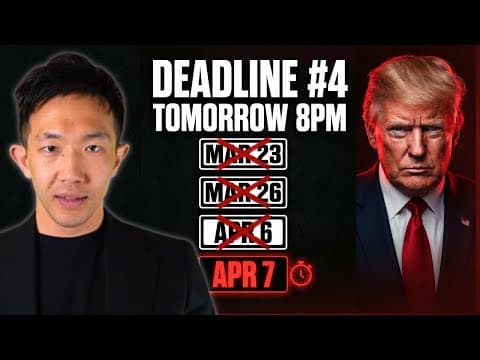
Trump's 4th Deadline for Iran is Tomorrow. When will It Actually End?
Audio Summary
AI Summary
Bitcoin is at $70,000, but there's ongoing uncertainty due to a series of extended deadlines from Trump regarding the Iran conflict. Trump announced a "final deadline" for Iran at 8 PM Eastern on Tuesday, stating that if Iran does not meet his demands, military action will escalate. This is the fourth such deadline, raising questions about its finality.
The current situation is complex, with a recent US military rescue mission in Iran for two F-15 pilots shot down on Easter Friday. Approximately 300 troops were deployed, and both pilots were successfully rescued. Trump's press conference today covered this operation and the new deadline for Iran. He also addressed questions regarding the oil situation and the Strait of Hormuz.
There are four potential scenarios after the Tuesday 8 PM deadline, though only three are considered likely. The first scenario, and arguably the most probable, is another extension of the deadline. This pattern has been observed multiple times, starting with a "hard deadline" on March 23rd, which was then extended by five days, then another ten days, and now a further two days. This suggests Trump's preference to avoid continued fighting and instead achieve the opening of the Strait of Hormuz and troop withdrawal. Prediction markets align with this view, giving a very low chance (3%) of a ceasefire by tomorrow and only a 15% chance within the next week. Another extension would mean continued market uncertainty and volatility.
Scenario B, a major escalation, is also considered decently likely. If Iran does not respond and Trump decides to act on his recent strong rhetoric (e.g., a Truth Social post threatening to hit power plants and bridges and demanding the opening of the Strait of Hormuz), the US could strike Iranian power plants, bridges, and nuclear facilities, potentially deploying ground troops to Kharg Island. None of these actions have occurred yet.
Scenario C, where the Iranian side folds and Trump gets all his demands, is considered the least likely. Trump's demands are extensive, including a new regime in Iran, taking their oil, and "free traffic" through the Strait of Hormuz, with NATO's help, without any compromise from the US side. The market's 3% chance for a ceasefire reflects the unlikelihood of this outcome. A 45-day ceasefire deal has been proposed by various powers, including Pakistan, which would offer a diplomatic window and market certainty, but its immediate implementation is highly improbable.
The overall assessment is that another extension is the most likely outcome. Despite the US military's capability to strike Iran at any time, Trump's repeated extensions, even after a rescue mission involving significant risk, suggest an unwillingness to engage in direct conflict. As a "markets guy," Trump likely wants market stability, and markets generally react negatively to war and uncertainty. This implies a desire to show strength while avoiding escalation, leading to more extensions rather than a resolution.
The frequent deadline extensions can cause confusion, with some still referencing older news. It's crucial to understand that there hasn't been any official escalation since March 23rd; it has only been a series of delays. Oil prices serve as a key indicator of the situation. As long as Brent crude remains above $100 but below $115, it signifies continued extensions and delays. Prices above $115 would indicate escalation, while sustained prices below $100 would suggest de-escalation.
Regarding market implications, in this period of ongoing uncertainty and delays, gold is considered the safest asset. It tends to perform well during escalation or sustained uncertainty, as it acts as a hedge against risk-off environments and inflation. The S&P, NASDAQ, and Dow Jones are not seen as good buys, as they are likely to face rejection from their 200-day Simple Moving Averages.
Bitcoin, while riskier than gold or the broader stock market, is considered "cheap" due to its current position in a deep bear market, close to its 200-week SMA. Some analysts, like Jurian Timmer from Fidelity, suggest a rotation of investor flows from gold to Bitcoin, indicating a perception shift where Bitcoin is increasingly seen as a store of value. The Bitcoin-to-gold ratio is currently at levels seen in October 2023, suggesting Bitcoin is undervalued compared to the average entry points of major long-term funds. However, the Bitcoin bear market is not yet considered over, with a projected bottom around November this year and the need to reach the 200-week SMA.
The S&P is unlikely to recover to pre-conflict levels easily. If there are more extensions without a ceasefire, the Strait of Hormuz will remain closed, leading to rising oil prices. This will create long-term inflationary pressure, impacting the upcoming FOMC minutes, PCE, and CPI numbers. Higher inflation will put pressure on the Fed to maintain or even hike rates, leading to a hawkish stance, which is negative for the stock market and risk-on assets like Bitcoin.
Key economic events to watch this week include the March FOMC meeting minutes on Wednesday, the Core PCE print on April 9th (for February data), and the CPI number on April 10th (for March data). The CPI, reflecting some of March's conflict impact, is expected to be higher, potentially leading to increased hawkishness from the Fed.
Finally, progress on the Clarity Act is anticipated this week, with Coinbase's chief legal officer indicating updates within the next 48 hours. This bill needs to reach the Senate for markup by the end of the month to avoid further multi-year delays, making this a crucial period for its passage.
In summary, the most likely scenario is continued extensions in the Iran conflict, leading to prolonged market chop and uncertainty. Rising oil prices due to the closed Strait of Hormuz will fuel inflation, pressuring the Fed and negatively impacting the stock market and Bitcoin. Gold remains the safest hedge, while Bitcoin, despite its risk, is seen as a cheap, high-reward bet for those with a longer investment horizon. Investors should monitor oil prices and key economic data closely.