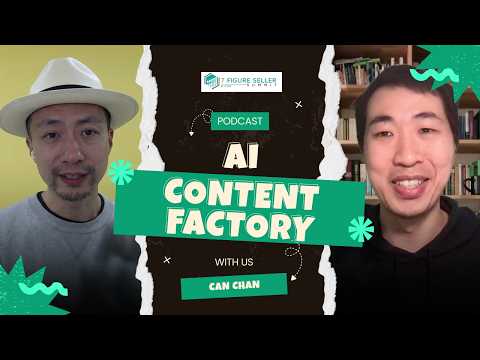
How to Get Amazon Rufus to Recommend YOUR Product (AI Framework Revealed)
AI Summary
This summary explores the rapid adoption of AI in the e-commerce sector, specifically focusing on the "AI hype" in China’s Silicon Valley, Shenzhen, and practical applications for global Amazon and TikTok sellers. Based on a conversation between Gary and Ken, an on-the-ground expert in China, the transcript highlights how AI has shifted from a simple chatbot to essential business infrastructure.
### The Cultural Shift: AI as Infrastructure
In Shenzhen, the adoption of AI—specifically a tool referred to as "Open Claw"—has reached a fever pitch. People of all ages, from 77-year-old grandfathers to primary school students, are lining up to install these AI systems on their devices. Unlike in the United States, where public sentiment toward AI is often colored by fears of job displacement, the prevailing attitude in China’s tech hubs is one of total embrace.
Ken notes that AI is no longer viewed as just a tool but as foundational infrastructure, comparable to the rise of computers and smartphones decades ago. For entrepreneurs, this means every student now has access to a postgraduate-level professor for research, and every business owner has access to high-level executive support. The focus is not on whether AI will take jobs, but on how quickly it can be integrated into daily workflows to increase efficiency.
### The Content Factory: Scaling Social Media
One of the most significant breakthroughs discussed is the "Content Factory" workflow. For sellers on platforms like TikTok and YouTube, content creation is a constant bottleneck. By using "Open Claw" and mixed AI models, sellers can automate the entire lifecycle of content production.
The workflow begins with "intelligent idea mining," where the AI scrapes TikTok, YouTube, and Reddit to identify trending topics and viral hooks within a specific niche. Once a trend is identified, the system generates video scripts, designs thumbnails, and drafts captions. Ken explains that while visual generation still requires some human oversight, the goal is to wake up to a week’s worth of content ready for review.
A key insight here is the use of "mixed models." To manage costs and token consumption, Ken recommends using high-end models like Claude Opus for complex reasoning and strategy, while delegating simpler tasks—like web scrolling or basic text formatting—to cheaper, open-source Chinese models like Kim. This balanced approach prevents the "burning of tokens" and keeps operational costs low while maintaining high-quality output.
### Listing Optimization and Amazon’s Rufus
AI has revolutionized how sellers manage Amazon product listings. Ken reports that his team updated 80% of their listings using an AI framework. The strategy is to have a "human brain" set the principles—using data from tools like Helium 10—and let the AI handle the heavy lifting of execution.
The primary goal of this optimization is to trigger recommendations by "Rufus," Amazon’s AI-powered shopping assistant. By training the AI on specific conversion principles and hero image hooks, sellers can achieve a "95-point" quality score that would take a human much longer to produce. However, Ken emphasizes that this is not a "set and forget" system. Sellers must still utilize A/B testing and monitor data closely to ensure the AI’s output translates into actual sales.
### Web Design and Technical Problem Solving
The transcript provides a compelling example of AI outperforming professional human services in web development. Ken describes building a landing page for an upcoming summit using Google’s AI tools (referred to as Google Canvas). By providing the AI with the structure and core concepts, he was able to generate a professional-grade website in minutes.
This process saved between $1,000 and $2,000 in design fees and eliminated two weeks of back-and-forth communication. The AI provided instant feedback "without emotion or delay," allowing for rapid iterations that amazed even professional designers.
Gary shares a similar success story regarding technical troubleshooting. When his website was hit by malware and taken offline, two professional developers failed to fix the issue over several months. Gary used "Claude Code" (the Opus model) to enter the server’s file structure via the terminal. By describing the error messages to the AI, he was able to identify the corrupted files, recover missing backups, and restore the site. This highlights AI’s ability to handle high-level coding tasks that are often outside the expertise of general developers.
### The Rise of AI Agents
The conversation concludes with the concept of "AI Agents" or "sub-agents." Gary describes building a team of specialized bots to handle different facets of an e-commerce business:
* **Chief of Staff (Winston):** A high-intelligence agent used for overall strategy.
* **PPC Agent:** Analyzes advertising spend and optimizes campaigns.
* **Inventory Management Agent:** Tracks production levels, monitors shipping logistics (such as AGL or fast boat options), and alerts the owner to potential long-term storage fees.
### Conclusion: The Human-in-the-Loop
The overarching conclusion from both experts is that while AI can handle the "dirty work" and repetitive tasks, the "Human-in-the-Loop" remains essential. AI is prone to hallucinations and may not always understand the nuances of conversion and brand voice. The most successful sellers are those who build the "SOPs" (Standard Operating Procedures) and frameworks, using AI as a high-level execution arm rather than a total replacement for human judgment. As demonstrated by the upcoming Top Tier Discovery Commerce Summit in Los Angeles, the future of e-commerce lies in the intersection of AI automation and human creator relationships.