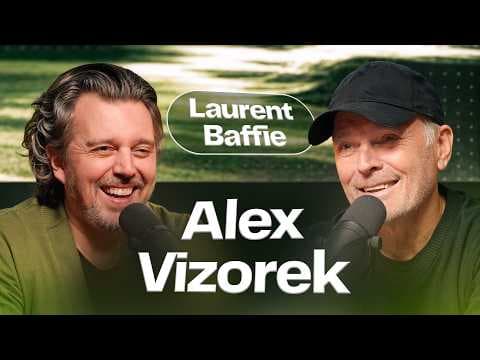
Coloscopie avec Alex Vizorek
Audio Summary
AI Summary
The podcast features an interview with Alex Misor, a Belgian comedian and author, hosted by Laurent Buffi. They begin by discussing their friendship and Alex's early admiration for Laurent. Alex was born in Brussels on September 21, 1980, sharing a birthday with notable figures like Professor Choron and François Cluzet. His father was a singer who adapted "No Milk Today," and his mother's family owned a shoe factory, leading Alex to grow up partly surrounded by the shoe industry.
Alex admits he wasn't a particularly good student but was fascinated by celebrity from a young age, watching TV shows like "Drucker" and "La Chance aux chansons," which exposed him to an older generation's culture. He wasn't sure what he wanted to do professionally, feeling he wasn't skilled in painting, drawing, or playing instruments. He humorously recounts his father's reaction to his collection of "Harakiri" magazine, which was considered quite provocative.
He pursued studies in management and then journalism, seeing it as a way to be known and have an interesting job. He also attended the Cours Florent acting school for three years, where he learned the difficulty of becoming a great actor but discovered a talent for writing during a one-man show class. He mentions that some notable actors like Pierre Lottin were in his class. He realized his writing skills were a significant asset, particularly for comedy.
Alex gained recognition at the Montreux Comedy Festival in 2009, the same festival he would later host. He became a familiar face in show business, doing various things, including commentating on football matches and hosting segments on radio stations like France Inter. He met his partner, Florence, while working with Thierry Ardisson, describing their meeting as a whirlwind romance.
The conversation then shifts to Alex's book, "De la première à la dernière œuvre" (From the First to the Last Work), which explores the lives and creative processes of 30 influential artists from Leonardo da Vinci to Johnny Hallyday. Alex explains his fascination with how artists achieve greatness. He chose a diverse range of figures, including painters, writers, musicians, and filmmakers.
He discusses Leonardo da Vinci, calling him a "polymat procrastinator," highlighting his multifaceted genius in art, science, and engineering. Alex notes how artists of that era often delegated parts of their work, a practice he likens to modern collaboration. He then moves to Molière, questioning the extent to which he wrote his own plays, while acknowledging his genius as a performer and entrepreneur. Jean de La Fontaine is presented as the first true sketch artist, adapting fables with remarkable wit and style.
Mozart is described as a prodigy with absolute pitch, but also as someone with a crude and scatological correspondence, humanizing his genius. He contrasts this with the common perception of Mozart. Alex touches upon the myth surrounding Mozart's remains and the practice of grave robbing.
Honoré de Balzac is presented as a masterful storyteller who understood human nature, despite his own financial struggles and prolific output. Alex suggests that Balzac's early life experiences provided him with the insight to create "La Comédie humaine." He also discusses Jules Verne, who, despite dreaming of being like Alexandre Dumas, became more widely translated and influential.
Gustave Eiffel is highlighted for his engineering prowess, with Alex noting the controversy surrounding the Eiffel Tower's conception, suggesting Eiffel may have adapted an idea from others. He also mentions Eiffel's German heritage and how his name became synonymous with France. The construction of the tower, its initial short lifespan, and its salvation by radio transmission are discussed.
Vincent van Gogh is presented as an artist who sold only one painting during his lifetime, yet produced an immense body of work. Alex emphasizes that Van Gogh's art was his only viable path, a common thread among many artists. He touches on the impact of absinthe on Van Gogh's perception of color.
Arthur Rimbaud is discussed as a poet who invented words and later transitioned to a life as an arms dealer, showcasing a dramatic shift in his career. Marcel Duchamp is presented as an artist who challenged artistic conventions, with Alex highlighting his Dadaist creations and the concept of found objects.
Alphonse Allais is celebrated for his humor and absurdist inventions, with Alex emphasizing his ability to make people laugh and think. He shares an anecdote about Allais's invented "tasse à rance" for left-handed people and the humorous, often overlooked, nature of his work.
Marcel Proust, known for his "In Search of Lost Time," is presented as a writer who began his major work late in life, offering reassurance to aspiring artists. Alex describes the complexity and beauty of Proust's prose. Colette is recognized for her candid exploration of taboo subjects, including sexuality, and her initial struggle for recognition as her husband received much of the credit for her early work.
Picasso is labeled "infréquentable" due to his alleged mistreatment of women, raising the question of separating the artist from the man. Alex acknowledges Picasso's genius and his ability to reinvent himself through different artistic periods, while admitting he's not a personal fan of his later work.
Alfred Hitchcock is discussed as a director who overcame early failures and whose fears, like oophobia, influenced his filmmaking. Alex highlights the idea that failure is part of the artistic journey. Salvador Dalí is noted for his self-promotion and surrealist art, with Alex admiring his museum and the profound impact of his childhood experiences.
The discussion then touches on Frida Kahlo, whose art was profoundly shaped by her physical suffering and accidents. It also briefly mentions Johnny Hallyday and the complexities of his legacy.
The latter part of the podcast delves into Alex's personal experiences and preferences, particularly his anosmia (lack of smell). He discusses how he has normalized this condition, though acknowledges it as a handicap. He recounts an anecdote where he remained unaffected by a strong odor that cleared a beach, jokingly calling it a superpower. He shares his desire to smell his wife's neck and reminisces about the smell of grilled bread and cooking onions, which he can only appreciate through others' reactions. He also discusses his approach to personal hygiene, including washing his feet, and his habit of leaving the bathroom door open due to his anosmia.
The conversation moves to hypothetical choices, such as preferring to present the Molières awards annually over attending a funeral every week, and choosing between witnessing vulgar acts or experiencing personal violation. He also discusses his preference for Mozart's flatulence over Beethoven's silent passing and his choice to watch Chantal Akerman's film "Jeanne Dielman" daily, despite its challenging nature. He opts to exhume and dissect bodies over cutting off his ear like Van Gogh, and to endure facial paralysis over losing a leg like Frida Kahlo. He chooses to manage Johnny Hallyday's estate over Dalí's, and his sexual preferences are humorously explored.
Finally, Alex discusses his driving habits, a car accident at 18 that made him a cautious driver, and his enjoyment of strong-flavored foods like endouillette, which he can appreciate due to his lack of smell compensating for the lack of odor. The interview concludes with a reflection on the book, its appeal to non-readers, and Alex's pride in its reception.