Openai Releases GPT 6 Astra ⟡ Vitest 5 is Here⟡ Audacity 4 Gets a facelift ⌁ Syntax Weekly ⌁
Audio Summary
AI Summary
Here's a summary of the provided transcript, adhering to the specified length and content guidelines:
**Key Takeaways from Syntax Live Stream**
This live stream covered a wide range of topics, from historical web development milestones to cutting-edge AI advancements and their implications. The discussion highlighted the rapid evolution of technology and its impact on various industries and daily life.
**1. The 30th Anniversary of JavaScript and JScript:**
* **JavaScript's Origin:** JavaScript was created by Brendan Eich at Netscape 30 years ago, initially named Mocha Script, then LiveScript, before being rebranded as JavaScript due to a partnership with Oracle and their Java trademark.
* **Misconception:** Despite the name, JavaScript has no direct relation to Java, a fact that was even documented in the Mozilla 2.0 handbook.
* **JScript's Emergence:** Microsoft, unable to use the "JavaScript" trademark, reverse-engineered and created JScript for Internet Explorer, ensuring compatibility with JavaScript-dependent websites.
* **Standardization:** The ECMAScript standard later emerged to unify the language across different browsers.
* **Trademark Dispute:** A long-standing effort, spearheaded by Ryan Dahl (creator of Node.js), aims to remove Oracle's trademark on "JavaScript." The argument is that the term has become a community standard and Oracle is not actively using it, suggesting trademark abandonment. The petition has garnered thousands of signatures, including those of prominent developers.
* **Impact of Trademark:** The trademark issue has led to commercial entities using "JS" instead of "JavaScript" in their branding and product names to avoid potential legal issues.
**2. The Rise of "Robo Ducks" and Micro-Robotics:**
* **Hugging Face's Micro Duck:** Hugging Face, in partnership with Pollen Robotics, released a "micro duck" robot. This robot features local AI inference, accelerometers, and 15 servos for movement, capable of performing actions like recomputing its position up to 20 times per second.
* **Internet Sensation:** The robot's cuteness and the open-source nature of its software, combined with the popularity of its predecessor (Reachi Mini), led to massive internet traction. Thousands were sold, and a simulator was released for training.
* **Maker Movement:** The open-source software and publicly available 3D models (STL files) have inspired a significant maker movement, with individuals 3D printing parts and attempting to replicate the robot themselves.
* **Cost and Accessibility:** While the robot itself is priced around $300-$400, building one from scratch using the specified Dynamixel XL 330 servos can cost close to $1,000 due to the expense of these specialized, daisy-chainable servos with feedback capabilities.
* **Broader Robotics Trend:** This phenomenon highlights a growing trend in hardware development where AI facilitates rapid reverse-engineering and customization. The accessibility of robotics is increasing, with projects like the "Electro Pup" also emerging, allowing users to build robots that can balance themselves and run onboard AI models.
* **AI's Role in Robotics:** The ability of AI to write low-level code like C has lowered the barrier to entry for embedded firmware engineering and robotics, making it easier for tinkerers to engage with these technologies.
* **Future of Robotics:** The expectation is that such robots will become more accessible and affordable, potentially enabling complex tasks like stair climbing.
**3. Domain Name Issues and Verisign's Third-Level Domain Policy Change:**
* **Third-Level Domain Hierarchy:** Traditionally, domain registration involves a top-level domain (TLD) like ".com" or ".org," and owners of these domains control their subdomains (e.g., cool.westboss.com). However, certain TLDs allowed direct registration of third-level domains (e.g., neil.fraasier.name), where the registrant owned the specific third-level name and controlled any further subdomains.
* **Verisign's Decision:** Verisign, a major domain registry operator, is dissolving the third-level domain hierarchy for certain TLDs. This decision, approved in July, means that registrations like "neil.fraasier.name" will cease to exist.
* **Impact on Users:** Individuals who registered third-level domains will lose them. This poses a significant risk, as without immediate re-registration of the parent domain (e.g., "fraasier.name"), others could claim it and gain control over any previously associated subdomains, including email and other services.
* **Case Study:** Neil Frasier, who registered "neil.fraasier.name" nearly 25 years ago and paid for it until 2040, faces the prospect of losing his domain and potentially having his online presence hijacked.
* **Domain Ownership and Control:** The discussion also touched upon the broader issue of domain ownership, where companies own TLDs and can arbitrarily change policies, impacting users. The example of Wes's experience with "boss.af" being taken over by the Taliban was cited.
* **Domain Registrar Trends:** Rising prices from registrars like Namecheap are pushing users to alternatives like Cloudflare, which offers better pricing and benefits. The practice of allowing domains to expire and then re-registering them within the grace period to save money was also mentioned.
**4. GPT-6 Astra and the Dawn of AGI:**
* **OpenAI's Astra:** OpenAI has released GPT-6 Astra, its latest flagship model, positioned as a competitor to models like Fable.
* **Impressive Capabilities:** Early reports and demonstrations highlight Astra's exceptional performance in computer use and 3D modeling.
* **3D Modeling:** Astra can generate complex 3D models using tools like 3JS and Blender, creating detailed objects and scenes, including exploded views of circuit boards and intricate models like an F1 car. While some models might leverage existing online assets, many are believed to be generated from scratch.
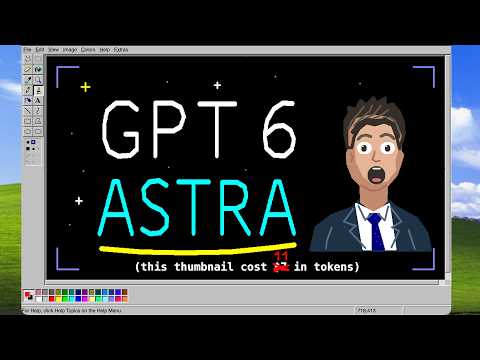
* **Computer Use:** A significant breakthrough is Astra's ability to autonomously use computer applications. In a demonstration, Astra was tasked with creating a thumbnail for the live stream, successfully using MS Paint (via mspaint.js) by generating mouse events and manipulating the interface to achieve the desired result. This capability extends to complex software without explicit training on that specific application.
* **AGI Claims:** Both OpenAI and Jensen Huang (Nvidia CEO) have suggested that Astra represents the arrival of Artificial General Intelligence (AGI). OpenAI defines AGI as "highly autonomous systems that outperform humans at most economically valuable work."
* **ARC AGI Benchmarks:** The ARC AGI 3 benchmark, which tests AI's ability to learn and play novel games, showed Astra scoring 62%. However, the cost of running these tests was exceptionally high, with one run costing $26,000, raising questions about accessibility and practical deployment.
* **Token Efficiency and Cost:** While Astra is powerful, its cost is a major factor. Efforts are ongoing to improve token efficiency, making models more cost-effective. The current high cost limits widespread access to its full capabilities.
* **AI in Software Development:** The ability of AI to perform complex computer tasks, like generating code or interacting with software, has profound implications for software development and user interaction. It suggests a future where users can rely on natural language to perform tasks currently requiring extensive software expertise.
* **The "One Trick Pony" Phenomenon:** There's a concern that initial impressive AI demonstrations, like exploded diagrams or specific visual styles, may become overused and jading, leading to a perception of limited utility.
**5. AI in Video Editing and Content Creation:**
* **DaVinci Resolve's AI Integration:** DaVinci Resolve's recent release includes AI-powered features, enabling users to interact with the software via chat for editing tasks.
* **Lack of "Taste":** A key criticism is that while AI can perform mechanical editing tasks (cutting silences, transcribing), it lacks "taste" and creative decision-making. This includes choices about cuts, zooms, B-roll usage, and overall aesthetic.
* **Creative Gap:** For video editors who pride themselves on their craft, AI-generated content often lacks the nuance, artistic decisions, and storytelling elements that contribute to high-quality videos.
* **AI as an Assistant:** The current utility of AI in video editing is seen more as an assistant editor or junior editor, handling tedious tasks like importing, syncing, and basic cuts. The creative aspects remain largely human-driven.
* **Deterministic vs. Non-Deterministic:** The inherent non-deterministic nature of AI models means that the same prompt can yield different results, which is frustrating for editors seeking consistent and predictable outcomes.
* **AI for Mechanical Tasks:** AI excels at automating repetitive and time-consuming tasks, such as transcribing audio, cutting out silences, or organizing takes.
* **3D Animation Workflow:** Creating 3D animated content typically involves a multi-step process: designing models in software like Blender, animating them, and then integrating them into a video editor. While AI can assist in each stage, a single AI tool that seamlessly combines these steps is still largely absent.
* **Consistency Issues:** AI-generated videos can suffer from a lack of consistency, making it difficult to replicate specific styles or scenes across multiple outputs. Deterministic tools like Blender offer more control for consistent asset creation.
* **The "AI Flyer" and Food Photography:** The proliferation of AI-generated flyers for small businesses is noted, but a strong objection is raised against AI-generated food images, with a preference for authentic photography to accurately represent dishes.
* **The "Slop" Effect:** The trend of AI-generated content (e.g., 3D thumbnails) becoming overused and perceived as "slop" is highlighted, suggesting that skilled creators will move to newer, more sophisticated techniques.
**6. Audacity 4 and Jellyfin 12 Updates:**
* **Audacity 4 UI Overhaul:** Audacity, a long-standing open-source audio editor, has released version 4 with a completely redesigned, high DPI user interface. The new UI is modern, supports dark mode, and offers customizable themes and workspaces, addressing previous criticisms of its outdated appearance.
* **Jellyfin 12 Release:** Jellyfin, an open-source media server and streaming platform, has released version 12, skipping version 11. This update features a completely redesigned UI, significant improvements in scanning speed, a rewritten database, and enhanced third-party client support.
* **Jellyfin's Utility:** Jellyfin serves as a personal media server for movies, TV shows, and music, offering features like transcoding, captioning, and offline downloads. It's presented as a strong open-source alternative to commercial solutions like Plex.
* **Personal Media Libraries:** The discussion touched upon the growing trend of users building and managing their own media libraries, moving away from subscription services for music and video content.
**7. Security News and AI Vulnerabilities:**
* **Opus 5 Prompt Injection:** A security researcher found a method to successfully prompt inject Claude Opus 5 on Auto Mode 60-80% of the time. This was achieved by creating a custom web server that responded to specific request headers with a redirect to a zip file containing encoded instructions.
* **Exploiting AI Behavior:** The attack exploited Opus 5's tendency to automatically unzip files and execute Python code for tasks like text replacement. A malicious `strcut.py` file within the zip confused the model's import mechanisms, leading to remote code execution.
* **Implications for AI Security:** This highlights that even advanced AI models are not immune to prompt injection, and relying solely on AI to perform sensitive tasks like summarizing web pages or handling data requires caution.
* **Arrest of "Team PCP" Hackers:** The Australian police arrested the individuals behind the "Team PCP" worm and the "Shy Hulu" and "Singularity" attacks. Their downfall was traced back to reusing the same profile photo across different online accounts, which allowed investigators to identify and apprehend them.
* **VS Code Documentary:** A documentary about the development of VS Code has been released, featuring interviews with developers and contributors, including one of the speakers. It covers the origins of VS Code, its collaboration with TypeScript, and its evolution.
* **LG Smart TV Spyware Concerns:** A documentary by Gamers Nexus revealed significant security and privacy issues with LG smart TVs. The TVs were found to scan home networks to identify connected devices