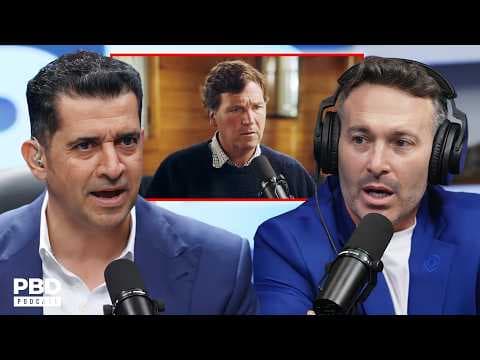
"Trump Is The Anti-Christ" - Tucker Carlson CORNERED In Explosive NYT Interview
Audio Summary
AI Summary
The discussion centers on Tucker Carlson's recent interview with the New York Times, particularly a viral clip where he was questioned about calling Donald Trump the Antichrist. The interviewer cited specific instances where Carlson had seemingly implied this on his show, including a segment about Trump not placing his hand on the Bible during his swearing-in and another where Carlson questioned if Trump, "mocking the gods of his ancestors, mocking the God of gods, and exalting himself above them," could be the Antichrist.
Carlson denied explicitly saying "could this be the Antichrist," claiming he didn't fully understand the concept of the Antichrist and might have only stated that "some are asking that." He maintained that those words never left his lips.
The panel vehemently disagreed with Carlson's denial. One speaker, Vinnie, argued that such a bold claim would be memorable and deliberate, not a "random throwaway line." He suggested Carlson was walking back his statements or had thrown them out for "clicks" and was now unwilling to deal with the "blowback." Vinnie highlighted the hypocrisy, noting that Carlson had criticized Trump for lying about portraying himself as a doctor around Easter, only for Carlson to then deny his own similar controversial statements. He urged Carlson to "man up" and admit what he said, rather than claim ignorance or that his words were "out of context."
Adam characterized Tucker Carlson as a "jackass" in the sense that he would do "anything for attention," comparing him to the show "Jackass" where participants sought views and clicks. He accused Carlson of making these statements not out of belief, but to "get eyeballs" and focus solely on attention. Adam cited Victor David Hanson's breakdown of Carlson's content, claiming 80% of it mentions Israel, suggesting it's for sensationalism rather than genuine interest. He argued that if this were a court of law, Carlson would be "found guilty" based on the recorded evidence, dismissing his denial as a "shaggy defense." Adam asserted that Carlson's past reputation as a respected conservative journalist is no longer accurate, pointing to a significant drop in his approval among the GOP from +54 to +7.
The panel questioned if Carlson genuinely couldn't remember making such a significant statement less than a month prior. Tom suggested that Carlson's denial was an attempt to avoid accountability, especially when the evidence was "on tape." He acknowledged Carlson's willingness to do the interview but found it implausible that Carlson wouldn't anticipate being questioned about such controversial remarks, especially by the New York Times. Another speaker highlighted that Carlson's phrasing, "Could this be the Antichrist? Who knows?" was a deliberate "couching" to float an idea without definitively stating it, thereby prompting discussion.
The conversation then shifted to the motive behind Carlson's actions. It was suggested that Carlson's denial was a "default" response when pushed into a corner, akin to someone feigning ignorance. The speaker emphasized that given Carlson's intelligence and ability to retain information, it was highly unlikely he wouldn't remember such a statement. The panel urged Carlson to "say what you believe in and let the market decide," contrasting his approach with Trump's more direct communication style.
The discussion also touched upon other aspects of Carlson's interview, including his regret over interviewing Nick Fuentes and his comments on JD Vance. Carlson stated he regretted interviewing Fuentes, but the panel believed such interviews were necessary for the public to understand people's positions. The segment on JD Vance was deemed the "most sensitive topic," where Carlson accused "neoconservatives" around Marco Rubio of "non-stop treachery" against Vance. When pressed for specific names, Carlson claimed he didn't know. The panel found this denial of specific knowledge questionable, especially when making such serious accusations. They noted Carlson's evasiveness on how often he spoke to Vance, contrasting it with his openness about texting Erica Krook.
The conversation then broadened to the political landscape leading into 2028, particularly the influence of figures and organizations like Charlie Kirk and TPUSA. The speaker shared a recent private conversation with a TPUSA board member, expressing criticism that TPUSA might be "losing the PR campaign" and needs to adjust its strategy.
The speaker then underscored the unique position of their own platform, ValueTainment (VT), emphasizing that they don't rely on external funding or sponsorships, which grants them independence in expressing opinions. This allows them to "risk our own money" and maintain authenticity, unlike those beholden to advertisers or political interests.
Finally, the discussion shifted to an announcement about a survey being conducted by ValueTainment to gather feedback from their audience. Listeners are encouraged to text "PBD" to 310-341-132 or visit survey.vt.com to complete the survey. As an incentive, everyone who completes the survey will receive a $25 gift card to vtmerch.com. The speaker stressed the importance of public feedback to improve content and value, recalling the humble beginnings of ValueTainment to illustrate their journey and commitment to their audience. They emphasized the desire to hear from everyone, regardless of their background, to continuously enhance the PBD podcast.