Lebanon’s Last Stand: A Nation Fighting For Its Survival
Audio Summary
AI Summary
Tripoli, the poorest city in northern Lebanon, reflects the country's severe economic crisis. Shops are mostly closed, and the gold market, once bustling, is deserted. Residents are selling their last possessions, like jewelry, to afford basic necessities. A pensioner sold her husband's wedding ring for $155 to buy food for her four children. Food prices have skyrocketed, with chicken legs and fish fillet costing 15 times more than two years ago, while wages remain static. This makes daily meals a challenge for many. For instance, a bag of rice that once cost 2,500 pounds now costs seven times that amount.
The discontent, simmering for years, erupted on October 17, 2019, when a broad cross-section of Lebanese society protested against the corrupt government. Lebanon, once known as the "Switzerland of the Middle East" with a strong economy, saw its banking system collapse in 2019. Investors and dollars fled, and inflation soared to over 140%, the highest in the world at the time. The Lebanese pound lost 90% of its value, plunging a large portion of the population into poverty. Electricity is supplied for only a few hours daily, and the country has also absorbed 1.5 million refugees from Syria over the past decade. Many Lebanese blame the government for the bankruptcy and corruption, leading many to seek a future outside the country.
Father Gabriel, a Catholic Jesuit in Beirut's Christian district of Ashrafieh, witnesses the crisis firsthand. He incorporates politically charged statements into his sermons, urging politicians to return stolen money and leave. Weekly, he travels to Bekaa, a mountainous region, where he observes the exorbitant price of gasoline, which has increased six-fold in a year. Twenty liters of gas now cost half the monthly minimum income, severely limiting mobility. The middle class is particularly affected, becoming the "nouveau pauvre" or new poor. In Zachle, a Christian city, Father Gabriel assists a local charity that provides meals to over 200 families. He helps individuals like Sabuwa, a retired teacher whose lump sum pension of 300 euros is insufficient for her medical needs, with a single eye injection costing the equivalent of 50 euros. Another family, with a jobless painter father, struggles to find food and relies on charity, highlighting the extreme poverty affecting 36% of the population, nearly five times more than two years ago. Communities across Lebanon, regardless of faith, depend on local charity to survive.
In a southern suburb of Beirut, grocery store owner Riyad exemplifies the struggle. Due to daily fluctuations in the dollar exchange rate, which has risen to 21,000 pounds per dollar (15 times more than two years ago), he constantly adjusts prices and faces challenges in sourcing products. With only one to two hours of daily electricity, he has reduced his freezer usage and product selection to prevent spoilage. Riyad has not made a proper profit in over a year.
Beirut, once a vibrant nightlife capital, is now a shadow of its former self, with its city center resembling a ghost town. Rebecca, a 24-year-old legal consultant, and her friends, all under 30, discuss the daily changing exchange rate. A simple salad, once 11,000 pounds, now costs 194,000 pounds. A restaurant bill for her group totaled 1.2 million Lebanese pounds, twice the minimum wage. The dollar has become a scarce commodity since foreign investors left in 2019, leading to the financial collapse and banks imposing severe withdrawal limits on dollar accounts. Rebecca has been unable to access her more than $10,000 in a bank account since 2019. A distinction has emerged between "fresh dollars" (transferred from outside after 2019 and accessible) and "stuck dollars" (pre-2019 deposits that cannot be withdrawn).
Joseph, a sales representative for an international pharmaceutical company, receives his salary in "fresh dollars," allowing him and his wife Romy to live comfortably. Their monthly salary of $3,000 (60 million Lebanese pounds) enables them to buy groceries without looking at prices. Their bill of 685,000 pounds ($30) is equivalent to the minimum monthly wage, which has plummeted by a factor of 15 in two years, now lower than in Afghanistan. Joseph and Romy also benefited from the currency collapse when building their house, paying off a 50 million Lebanese pound mortgage, taken out in 2017, with only $2,500 in two months. They host friends, many of whom are paid in Lebanese pounds and struggle with expenses like a $6 bottle of wine. Rami, a public servant, earns about $80-$85 a month, a significant drop from his previous $1,200. Only about 13% of Lebanese are paid in dollars, leaving the majority to bear the brunt of the crisis.
Rebecca is suing her bank for illegally withholding her dollars, but legal proceedings are stalled. The banking sector is described as a "Ponzi scheme" where a political and business elite, including politicians, bankers, and the central bank governor Riyad Salameh, are accused of massive capital flight and enriching themselves. A 2016 study revealed that 90% of majority shareholders in Lebanese banks were relatives of politicians.
The devastating consequences of this corruption and negligence were tragically evident on August 4, 2020, when 2,750 tons of ammonium nitrate exploded in Beirut's port, killing 218 and injuring over 6,500. The subsequent investigation by Judge Tarek Bitar has been repeatedly suspended due to obstruction by government members. Investigative journalist Riyad Kobayisi claims that several government members knew about the ammonium nitrate for years and that the port is a "black hole of corruption" run by mafias who pay for appointments. He estimates that without corruption, the port's annual income could be $25 billion instead of $200 million. Kobayisi faces risks for his work, using multiple cameras in his car for protection. He published evidence online, including a 2014 letter from Colonel Joseph Scaff warning about the dangerous cargo. Scaff later died under suspicious circumstances.
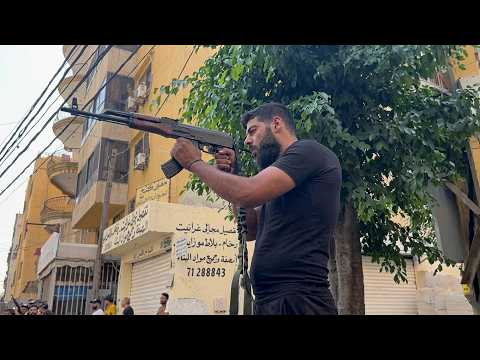
In October 2021, sectarian tensions reignited when Shia Amal movement followers protested the investigation of Judge Bitar, accusing him of targeting Shia politicians. This led to street battles between Christians and Shias, resulting in seven deaths. Ali, a militiaman with the Amal party, views the events as a defensive response, while a resident whose apartment was riddled with bullets describes the terror of hiding with her family. Despite the fear of renewed civil war, many families, like the resident's, send their children to Christian schools and promote interfaith harmony. However, Ali's readiness for war underscores the lingering threat of sectarianism.
Father Gabriel, teaching at a private Christian-affiliated university in Saida, observes that his students, from all faiths, envision a future outside Lebanon. They overwhelmingly believe that secularism is necessary to overcome the sectarianism that led to civil war.
Public services have collapsed, with the healthcare system, construction, and electrical grid failing. The country's two main power plants are poorly maintained. A private, illegal but tolerated network of electricity generators has emerged to compensate for the severe power outages. These "generator mafias" charge three times the public sector price, with average households spending 2 million pounds ($80) monthly. Owners claim they are not profitable, yet their lifestyle suggests otherwise. Energy researcher Mark Ahub explains that the government, diesel importers, and private generator operators form a cartel that benefits from the power grid failure, with politicians often owning or being connected to diesel import companies.
Mohammed, a 35-year-old former tour guide in Tripoli, lives in a two-room apartment with his mother, sisters, and four children. In October 2021, he and his son Hossam attempted to reach Europe illegally by sea but were arrested by the Turkish coast guard and jailed for 29 days. Despite the traumatic experience, Mohammed remains determined to leave Lebanon with his children, believing it is the only way to escape the daily struggles and find a better life.