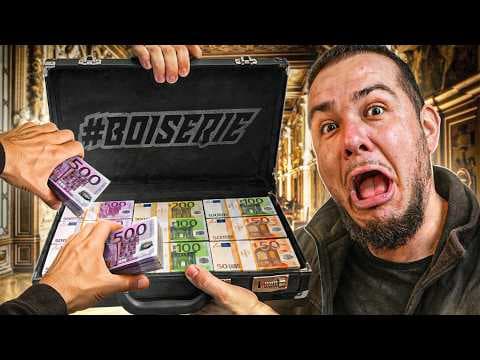
Comment payer moins d’impôts (légalement) ?
Audio Summary
AI Summary
The speaker begins by acknowledging the topic of taxes, framing it within the context of his motorcycle shop, Emopo. He explains that he's been documenting the business's journey, including its challenging early phases and eventual recovery. The core philosophy for building a business, he emphasizes, is not to rely on personal wealth to cover deficits, but to create an entity that is self-sustaining, profitable, and capable of generating value. This includes paying staff, covering operational costs like rent and inventory, and repaying any initial capital injections, such as “comptes courants” (current accounts) which represent loans from the owner to the company.
He contrasts the typical startup approach of starting small and gradually expanding with his own experience of being able to inject significant capital thanks to prior success on YouTube. He illustrates this with the example of the shop’s black paint costing €30,000, and the need to purchase stock without supplier credit, requiring substantial upfront funding. Instead of a bank loan, he utilized his holding company, MIRE, to finance MX Shop, with the understanding that the loan would be repaid once the shop became profitable.
The video then delves into the difficulties of a business operating at a loss. The inability to repay loans can lead to judicial liquidation. While his situation was less dire as it was an internal loan from his holding company, the need to “redress the slope” was critical. He proudly states that within a year, they managed to turn the business around, improving its financial trajectory by approximately €230,000. This turnaround was attributed to various strategies implemented with his team, emphasizing the collective effort.
Now that the shop is no longer losing money and is beginning to generate modest profits, he plans to initiate repayments on the “comptes courants” to his holding company. This process involves gradually reimbursing the initial investments made for stock, painting, and other setup costs, with the goal of making the company fully independent. He highlights that this challenge was about building something from scratch that now manages its own debts.
He addresses the perception that his success is solely due to his YouTube following or internet presence. He stresses that while his community’s trust is valuable, and he ensures authenticity in his ventures (like genuine contest prizes or ensuring bikes aren't stolen), the business itself is built on genuine operations, not just online visibility. He contrasts this with projects that might only last a short time for the sake of content. His approach is long-term, citing his airsoft business as another example that has overcome difficulties. He acknowledges that it’s not always easy, and despite his online reach, businesses can still struggle. Attracting a serious clientele, particularly in the motorcycle sector, requires more than just online popularity; it demands seriousness, fair pricing, and a positive customer experience.
He then transitions to discussing the financial year-end and the prospect of generating profits for the first time, having fully repaid the company’s debt. He reiterates that this turnaround was achieved solely through the company's own cash flow, as if it were an independent entity, without additional group funding. However, he also touches upon the advantages of having multiple companies and a holding structure, which can allow for certain tax optimizations within legal boundaries. For instance, the holding company, which employs his accounting team, might charge its client companies for accounting management services. The goal, he explains, is to maximize cash flow into the holding company, which can be taxed at a lower rate. This involves charging slightly higher fees for services rendered by the holding to the operating companies, especially those with healthy profit margins.
He emphasizes that this is far from the typical perception of overnight success and requires hard work. He has nothing to sell or prove, and while others might have franchised his motorcycle shop or opened many more locations, he prefers to build a solid, transparent, and well-structured business with a loyal customer base before considering franchising. He dismisses the idea of franchising the motorcycle business due to low margins, which would necessitate him being the primary supplier, making it a less viable model. He also acknowledges the existence of both honest and dishonest franchise models, where some enrich themselves at the expense of franchisees. He expresses respect for entrepreneurs who successfully build empires through franchising or dealership systems.
He then shifts to showcasing the motorcycles in his shop, highlighting vintage models that have been restored. He differentiates between unique vintage bikes with custom colors and those meticulously restored to full originality, which he considers highly valuable. He expresses his commitment to transparency, sharing both successes and failures, and aims to help others learn from his experiences.
He draws attention to specific rare motorcycles, like the Honda QR 50s, clarifying that they were not purchased from a specific YouTuber known for importing bikes. He also mentions a 2013 CRF 50, an evolution of the QR. He briefly mentions other YouTubers he admires, like TCQR, for their passion and genuine content.
The video then tours the workshop, showcasing the custom-built furniture and storage solutions provided by Sodiz, designed to facilitate the work done there, including engine repairs. He reiterates that internet presence doesn’t guarantee ease of business and expresses satisfaction in turning the shop around legally and authentically. He credits his community for their initial trust and purchases, which helped establish the business, leading to customers who visit without prior knowledge of his online persona. This diversification of clientele is a source of satisfaction, demonstrating that the business isn't solely reliant on his YouTube audience.
He then discusses his ongoing efforts to learn and optimize his businesses, mentioning recent consultations with experts for external perspectives. He asks viewers if they would be interested in a detailed financial report on Emopo's turnaround.
The conversation then moves to the topic of taxes, acknowledging that while paying taxes is part of running a business, it can be frustrating, especially when dealing with significant sums. He frames it as a privilege to be able to undertake entrepreneurial activities in his country, but also notes that high taxes often correlate with high earnings. However, he points out that tax burdens can sometimes be disproportionate, especially for businesses with high margins but complex legal structures that hinder optimization. The goal, he explains, is to reduce the taxable base regardless of the company’s size. He uses the analogy of a baker, whose primary focus is on quality and customer loyalty, contrasting this with larger corporations that might employ sophisticated tax strategies.
He emphasizes that tax situations are highly individual, depending on legal structure, personal circumstances, and group affiliations. He states that it's impossible to accurately estimate someone's income or taxes based solely on their YouTube views or general business activity. He uses his own situation as an example, admitting he cannot predict his exact tax liability for the following year due to the complexity of his business structure.
He further elaborates on the baker example, suggesting that while some artisans struggle, others thrive by focusing on their craft and customer relationships, even amidst competition. He touches upon mandatory contributions like retirement funds and training fees, noting that while he pays these for his employees, his personal retirement plan is self-funded. He acknowledges his privileged position, not due to inheritance, but due to his success with YouTube, which allowed him to build wealth and achieve financial independence, enabling him to work on his own terms.
He then broadens the discussion to societal issues, expressing frustration with certain agricultural import policies that he believes unfairly disadvantage local farmers. He questions how it’s possible for farmers to face stringent regulations while imported goods with different standards are allowed.
Returning to tax optimization, he explains that while starting a YouTube channel and focusing on content creation is one aspect, understanding legal and fiscal structures becomes crucial as a business grows. He argues that simply creating content isn't enough; one must also consider tax implications, including corporate tax, income tax, property tax, and various other levies. He stresses the importance of legal tax optimization, not evasion, and emphasizes that his strategies are fully compliant with tax laws.
He outlines key areas for personal income tax optimization, assisted by his accountants. These include professional expenses (mileage, meals), optimizing deductions for family situations (foyer fiscal), and exploring tax reduction solutions. He also touches upon non-salary income like investments in stocks or real estate.
A significant portion of the discussion focuses on real estate investment, particularly the concept of “déficit foncier.” He explains how planned renovations and improvements on a rental property can offset rental income, potentially leading to zero taxable income from that source, or even absorbing other income taxes. He suggests this is particularly beneficial for individuals in higher tax brackets who can strategically invest in properties to create these deficits. He contrasts this with lower-income earners who are already meticulously managing their finances. He also discusses the different tax implications of owning property personally versus through a “Société Civile Immobilière” (SCI) – a type of civil real estate company – and the choice between being taxed at the individual income tax rate (IR) or corporate tax rate (IS). He advises consulting with an accountant to navigate these complexities.
He then details various tax credits and reductions available, such as those for energy transition work in primary residences, childcare expenses, schooling, and donations to charities. He clarifies that while tax benefits are a factor, donations should primarily be driven by a genuine desire to support a cause. He shares a personal example of a large donation that resulted in a significant tax reduction, but stresses that the primary motivation was philanthropic.
The speaker also mentions tax credits for installing EV charging stations and retirement savings plans (PEE, PER) offered by companies, highlighting employer matching contributions that benefit employees. He discusses investment schemes like the Pinel law, which offers tax reductions for rental properties but comes with specific obligations.
Finally, he addresses the “flat tax” on dividends, explaining how it can be more advantageous than salary for high earners in certain situations. He describes his own approach of receiving dividends from his holding company rather than a substantial salary, primarily for insurance and healthcare coverage.
He concludes by emphasizing that the core lesson is the importance of continuous learning and seeking professional advice, particularly from accountants, to optimize finances. He plans to release another video focusing on fundamental entrepreneurial principles. He acknowledges that while entrepreneurship can be challenging and involve periods of hardship, the rewards of building something and achieving financial independence are significant. He encourages viewers to research and optimize their finances, whether as employees or business owners, to achieve their financial goals and enjoy life. He reiterates the importance of seeking professional guidance from an accountant for personalized tax optimization strategies.