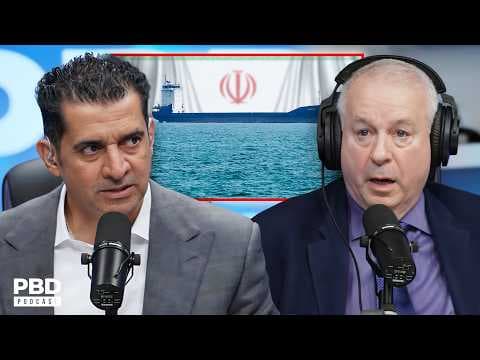
“Iran BROKE The Ceasefire” - Two Ships SEIZED at Strait of Hormuz By Iran
Audio Summary
AI Summary
This morning, Iran attacked three ships near the Strait of Hormuz, seizing two of them: a Panamanian-flagged vessel and a Greek ship. Oil prices saw a slight increase, but there hasn't been a significant negative market reaction yet. The president announced that American strikes would not resume for the time being, allowing peace negotiations to continue indefinitely, though no specific end date was provided. This decision was reportedly made out of respect for Pakistani mediators and as a final push for peace for the Iranian people, giving Iran's regime more time to coordinate internally.
There's a prevailing sentiment that the president is employing a strategy of uncertainty, keeping Iran off balance while trying to secure a deal. Some reports indicate that the ceasefire extension is short-lived and contingent on a quick agreement. While public negotiations are discussed, significant developments are happening behind closed doors. A previous public statement about the next negotiation, which would have involved all parties at the table, has been seemingly pulled back, and a key negotiator, Vance, has also been withdrawn.
A key question is who the Americans are actually negotiating with in Iran, as it's believed the hardline IRGC, rather than the clerics, are in charge. The bombing campaign is seen by some as over, with the president likely paying attention to the stock market and public opinion, noting a potential decline in support for the war among his base. This suggests he's looking for an "off-ramp." The situation is characterized as an age of disinformation, with conflicting messages from various sources, making it difficult to ascertain the true trajectory.
The core issue remains the lack of overlap between Iranian and U.S. demands. The transcript highlights that Iran has demonstrated its ability to control global oil supply through the Strait of Hormuz, a fact that has become evident on a larger scale. The attack on the ships, even within a supposed ceasefire, is seen by some as a demonstration of Iran's continued control and a challenge to the U.S. blockade. The definition of what constitutes a ceasefire violation appears to be very loose, with actions by groups like Hezbollah also not clearly breaking it.
The consensus is that the president desires an off-ramp, but the identity of his negotiating partners in Iran and the nature of any potential deal remain unclear. A significant obstacle is how to proceed when Iran retains enriched uranium and pursues nuclear ambitions. There's a concern that the situation might revert to a similar state as the 2015 deal.
The current conflict is framed not as a territorial dispute but as one rooted in radical ideology and fanaticism, involving actors perceived as irrational and valuing human life minimally. A historical parallel is drawn to the Iran-Iraq War (1980-1988), where Iran's refusal to accept a truce led to prolonged conflict and massive casualties. This suggests the potential for a long and damaging situation if the current issues are not resolved effectively.
The deadline for negotiations appears to have passed without a clear timeline, indicating a lack of urgency or direction. Some participants advocate for a more assertive approach, akin to John Bolton's stance, emphasizing the need to finish what was started. There's a critique that while the president might claim regime change as an achievement, the resulting regime might be worse.
A central argument for achieving the ultimate goal of preventing Iran from obtaining nuclear weapons and ending its nuclear ambitions is the need for a new, more peaceful regime. However, this is considered nearly impossible to achieve from the outside. The spark for change is identified as popular uprisings, but the fear of reprisal from the Guard has suppressed further action.
The strategy for achieving regime change is debated, with the idea that it must come from within. This involves incentivizing the regular Iranian army, which numbers around a million, to turn against the current regime. Historical examples of successful revolutions where the army shifted allegiance are cited. The possibility of back channels and communication with this regular army is a key question.
The idea of providing weapons to groups like the Kurds has been discussed, but concerns exist about unintended consequences and the creation of political vacuums. The challenge lies in incentivizing both the people and the army to oppose the clerics. Actions like bombing infrastructure or blockading essential supplies are seen as potentially violating international law, though Iran has also been accused of numerous violations.
The discussion returns to the pressure on the president due to domestic politics and upcoming elections. There's a radical notion of incentivizing the Iranian people into another uprising, despite the fear of the Guard. Involvement of external intelligence agencies like Mossad or the IDF is considered, but under tight control. The fundamental belief expressed is that without regime change, nothing will fundamentally alter. The question of how to achieve this, potentially through significant boots on the ground, is raised.
An alternative approach suggested is an "Iran-Contra model," involving rebel groups and militias organized and armed by external agencies like the CIA or Mossad. However, the lack of organized rebel groups within Iran makes this difficult. The IRGC's control over military weapons, with 31% of the military reportedly part of it, is highlighted as a significant factor.
The immediate situation involves Iran's actions, which some view as a breach of the ceasefire, while Iran claims to be enforcing its laws. This highlights a lack of ethical negotiation from Iran's perspective. The president's focus on the market is seen as a driving factor for seeking an exit, as renewed conflict could negatively impact market performance.
The conversation then shifts to a promotional segment about the "Vault Conference," detailing its growth, expected attendance of over 12,000 entrepreneurs and business leaders in Las Vegas, and opportunities for sponsors to gain visibility and connect with decision-makers. Sponsorship packages are described as comprehensive, offering branding on-site, in the event app, and through various media channels. Past sponsors include notable companies and figures. The segment concludes with information on how to learn more about sponsoring the event.