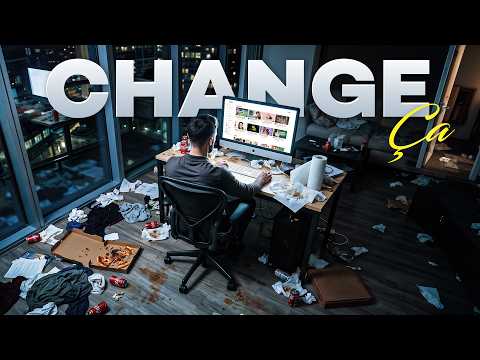
Si vous êtes ambitieux mais paresseux, regardez cette vidéo
AI Summary
Many people seek advice on productivity, often feeling ambitious but lacking the energy to act on their goals. This video aims to provide systems that enable even the laziest version of oneself to make progress, rather than advocating for strict discipline or early mornings. The core idea is that laziness isn't the enemy, but rather a signal that can be leveraged to one's advantage if understood.
The first concept to deconstruct is the idea that laziness is the main problem. Instead, it's often "decision fatigue." A 2011 study on Israeli parole judges, published in PNAS, showed that judges granted parole in 65% of cases immediately after a break, meal, or snack. However, this rate dropped to nearly 0% at the end of a session, just before the next break. This wasn't due to the prisoners' merits, but because the judges' brains were depleted. When the decision-making reservoir is empty, the brain defaults to inaction, leading to procrastination. This applies to everyday life; hundreds of micro-decisions—what to eat, what to wear, which email to send first—gradually deplete cognitive resources. By the time it's time to work on important tasks, there's nothing left. This isn't laziness but cognitive exhaustion.
A second pitfall is the paradox of choice, as described by psychologist Barry Schwarz in "The Paradox of Choice." The more options available, the less likely one is to act. Shina Iyengar's 2000 jam study demonstrated this: offering 24 varieties led to only 3% of purchases, while offering 6 varieties resulted in 30% of purchases—ten times more action with fewer choices. Your extensive to-do list, with its numerous items, acts like these 24 jam varieties, overwhelming the brain and leading to inaction, often in favor of distractions like Netflix. The solution isn't more discipline, but fewer choices.
With the problem understood, five actionable systems are proposed, starting tonight:
1. **Three Tasks Per Day:** Discard your long to-do list and each morning, choose only three tasks. Not 10, not 7, just three. If these three are completed by day's end, it's a victory, and anything else is a bonus. Research shows 41% of to-do list items are never completed, and 85% of actually accomplished tasks weren't on the list to begin. This renders traditional to-do lists doubly useless: they don't help and they paralyze. In 1918, a consultant named Ivy Lee proposed a method to Charles Schwab: each evening, write down the six most important things for tomorrow, ranked by priority. The next day, start with the first, and don't move on until it's finished. Schwab found this so effective he paid Lee $25,000 (equivalent to about €400,000 today). For ambitious but lazy individuals, simplifying this further to just three tasks is even more effective.
2. **The 2-Minute Rule:** David Allen, creator of the Getting Things Done method, suggests that if a task takes less than 2 minutes, do it immediately. Don't write it down or plan it. This applies to replying to a message, filing a document, sending an email, or paying a bill. The cost of noting, planning, thinking about, and finally doing the task is far greater than simply doing it right away. Unfinished small tasks accumulate in the mind like open browser tabs, consuming mental RAM and causing cognitive overload. By doing 2-minute tasks immediately, you "close the tab" and free up mental resources.
3. **Design Your Environment:** This is arguably the most powerful system, mastered by intelligent lazy people. The idea is to stop relying on willpower and instead design your environment so that even the laziest version of you does the right things. Harvard researcher Shahar calls this the 20-second rule: reducing the friction for a good habit by just 20 seconds massively increases its likelihood, while increasing friction for a bad habit by 20 seconds effectively kills it. For example, to go to the gym in the morning, sleep in your workout clothes with shoes by the bed, reducing friction to zero. To curb phone use, place it in another room while working, adding 20 seconds of friction. To eat healthier, put fruit on the counter and cookies in a hard-to-reach cupboard. Willpower is limited; environment is permanent. Disciplined people aren't inherently better; they just have better environments. Interruptions, like notifications, take an average of 23 minutes and 15 seconds to recover from. Putting your phone in a drawer is a highly underestimated productivity hack.
4. **Work with Your Energy, Not Against It:** Manage your energy, not just your time. Your brain doesn't operate in a constant mode. Researcher Nathaniel Kleitman identified ultradian cycles, where the brain alternates between 90-minute high-performance phases and 20-minute dips. A 2014 study by Desk Time found that the most productive employees work in 52-minute blocks followed by 17-minute breaks (true breaks, not phone scrolling). NASA also found a 26-minute nap improves vigilance by 54% and performance by 34%. Identify your 2-3 hours of high energy (often mornings for most people) and protect them like a vault: zero emails, meetings, or notifications. Use these hours for your three critical tasks. The rest of the day can be for mechanical tasks like emails and administrative work that don't require 100% cognitive engagement. The intelligent lazy person doesn't work more; they work at the right time.
5. **Eliminate Before Optimizing:** This is the most counterintuitive system. Instead of asking how to do more in less time, ask what you can stop doing. Tim Ferriss, in "The 4-Hour Workweek," recounted how 5% of his clients generated 95% of his revenue, while the other 95% generated 5% of revenue and 95% of problems. By eliminating the latter, his income doubled, and stress decreased tenfold. This is the Pareto principle pushed to the extreme: 80% of your results come from 20% of your actions, meaning 80% of what you do is nearly useless. Parkinson's Law (1955) states that work expands to fill the time available. If you give yourself a week for a project, it will take a week; if you give yourself two days, it will take two days, often with identical results. The ambitious lazy person applies three filters:
* **Does it need to be done?** If not, delete it.
* **Does it need to be done by me?** If someone else can do it at 80% of your level, delegate or use AI. The saying goes: give a difficult job to a lazy person, and they will find an easy way to do it.
* **Does it need to be done now?** If it's urgent and important, yes. Otherwise, it goes into tomorrow's three tasks, or never. Saying no to ten mediocre things allows you to say yes to one excellent thing. This is the productivity of a lazy person.
In summary, the five systems are: 1) three tasks per day, 2) the 2-minute rule, 3) designing your environment, 4) working with your energy, and 5) eliminating before optimizing. The speaker admits to being lazy and a procrastinator. The difference between his past and present self isn't discipline, but building systems that make discipline unnecessary. Discipline forces you to do things you don't want to do, while a good system makes good habits so easy and obvious that you do them without thinking. Disciplined people aren't better; they just have better systems. Build yours, and the lazy version of you will become the most productive person in the room.