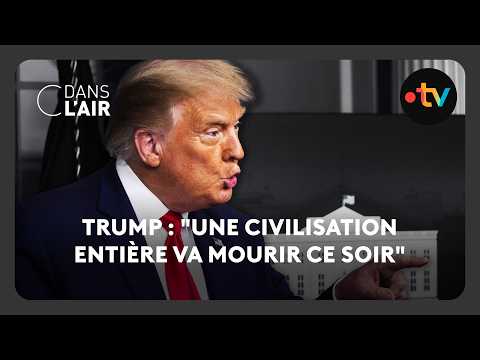
Trump : "une civilisation entière va mourir ce soir"
Audio Summary
AI Summary
The program "C dans l'air" discusses a chilling declaration by D. Trump, who warned that "an entire civilization will die tonight," promising to raze everything in Iran within four hours, including infrastructure and bridges, regardless of international law. This comes as the island of Kharg has already been targeted, and Israel has struck Iranian bridges and railways. Tehran, however, refuses to yield, urging its population to act as human shields. The Qatari Foreign Ministry spokesman believes the situation is on the verge of a tipping point, with Gulf petro-monarchies fearing the worst. The only positive news of the day was the liberation of two French hostages, J. Paris and C. Kohler, held for three and a half years in Iran.
J.-P. Paloméros, former supreme commander of NATO transformation, L. Menget, international relations specialist, D. Minoui, Middle East specialist, and P. Allémonière, former Jerusalem correspondent, are guests on the show.
The liberation of the French hostages is a relief, though it could also signal an impending escalation, with the aim of getting them out before a storm. France had exerted maximum pressure for their release, and the Iranian willingness to release them might be an attempt to divide the European front or to give France a reason to be more lenient. Alternatively, it could free France's hands to be tougher.
D. Trump's declaration about an entire civilization dying is deeply disturbing, evoking parallels with the darkest hours of World War II. It's incredibly pessimistic and violent, especially when referring to the Persian civilization, which has contributed so much to human knowledge. This raises questions about understanding the leader of the world's most powerful nation and the future of alliances, particularly NATO, which is founded on values of loyalty and fidelity. Such rhetoric threatens to dismantle the foundations of peace and security built since World War II. Looking ahead, a strong European dimension and maintaining alliances are crucial.
The concern extends to Gulf petro-monarchies, which are on the front line in case of Iranian retaliation. D. Trump's use of the word "civilization" in this context is new; he previously used more military, warlike language. His current rhetoric is seen as obscene and delusional, especially when threatening to destroy an entire civilization. While some might dismiss his words, the problem is that they are followed by actions, leading to civilian deaths in Iran and Lebanon. Reports from within Iran indicate shock and a feeling of betrayal among the population, who previously heard promises of liberation from Trump. They feel as if "the sky is falling on their heads."
The experts agree that while they are often told not to overreact to Trump's statements, the current situation involves war and civilian lives. His disregard for international law and his dehumanizing language ("animals who lead the country") are deeply concerning. The fact that his actions follow his words, with strikes on Kharg Island, makes the situation grave. Some of Trump's advisors are reportedly worried, describing him as a "rabid dog thirsty for blood."
The military objectives described by Trump, including razing everything in four hours and targeting energy infrastructure, are alarming. Iran has warned that the US and its allies could be deprived of oil and gas from the region for years. The Gulf states are increasingly fearful, with Bahrain and Saudi Arabia closing their bridge as a precaution. The UN has emphasized the urgency of protecting civilians, reminding that even if civilian infrastructure were considered military targets, international humanitarian law would prohibit attacks causing excessive collateral damage to civilians. Trump, however, dismisses war crimes, equating them with possessing nuclear weapons or allowing a "sick country" to have them.
The possibility of using nuclear weapons in Iran has been denied by the US, though the initial panic underscores the international tension. While Trump has previously delayed ultimatums, his current stance suggests he intends to follow through this time. The feasibility of destroying all strategic infrastructure in Iran in four hours is questioned, as energy infrastructures are protected. Despite Trump's rhetoric, there is hope that military actions by the US and Israel will be targeted to limit impact on the Iranian population, unlike some past campaigns that went awry.
However, schools and universities, including Sharif University, have already been hit, and military infrastructures are often located in civilian areas, leading to "collateral" damage. The Iranian regime is using propaganda, calling on the population to form human shields, but many civilians are focused on preparing for blackouts and seeking refuge, as they are not safe anywhere.
Trump's strategy aims to cripple the country and force regime change. However, historical precedents like the fall of Saddam Hussein and the rise of ISIS suggest that such actions don't guarantee a better outcome. The current Iranian regime is composed of hardliners who are unlikely to yield and have historically shown disregard for their own people, even mobilizing children as young as 12 for checkpoints.
The international community's ability to influence Trump is limited. While European nations have managed to intervene in the dialogue between Trump and Putin regarding Ukraine, the Gulf monarchies, with their significant financial ties to Trump, might be the only ones who can curb his aggression. Qatar, in particular, is warning of a global tipping point. Some Gulf countries, initially supporting a decisive end to the conflict, are now realizing the immense danger of Trump's proposed method, as a wounded Iran could still retaliate with missiles against vulnerable Gulf states.
The conflict's economic repercussions are severe, leading to what the International Energy Agency director F. Birol calls "the most serious energy crisis in our history." He predicts a "black April," with daily oil losses exceeding those of the 1973 and 1979 oil shocks combined. This could lead to shortages of jet fuel and diesel in Europe. Birol stresses the urgent need to reopen the Strait of Hormuz, as alternative pipelines have limited capacity. To mitigate the crisis, countries are drawing from strategic oil reserves and recommending measures like increased teleworking and using electricity instead of gas for cooking. In the long term, diversification of energy sources and strategic autonomy are crucial.
The current situation is not just about oil but the entire economy, affecting helium for chips, aluminum for cars, and hospitals, leading to global inflation. The Chinese are already investing in strategic autonomy, such as solar power.
If Iran retaliates strongly, it could target desalination plants and refineries in the Gulf states, causing a major humanitarian and health crisis. The precision of Iranian targeting, aided by Russia and China, has become "incredible." Unlike Trump, who is seen as a tactician, the Iranians are strategists, thinking long-term and aiming to prolong and expand the conflict, using economic leverage through control of straits.
Despite the dire situation, Iranians are holding onto hope, understanding that there will be a clear winner and loser. They fear that if the bombing stops and the regime remains, conditions will worsen. Executions and arrests continue, with the regime cracking down on dissent and even targeting VPN sellers. While some initially hoped the war would bring democracy, they are now realizing the harsh reality of conflict, remembering past wars where bombs did not lead to democracy.
Trump's direct appeals to the Iranian people to rise up, claiming they want the bombing to continue for freedom, are seen as incoherent and arrogant, especially after previous unfulfilled promises of help. The Iranian opposition, though present, is not actively mobilizing under the current bombardment. The regime continues its repression, with terrible conditions in detention centers and the use of child soldiers.
The possibility of Iran using "dirty" weapons is questioned, as their ability to strike Gulf countries with conventional weapons is already significant. The general hopes that military leaders will act responsibly and not unleash unbridled violence, despite Trump's aggressive rhetoric. The release of French hostages is seen as a signal from the Iranian regime, perhaps to France, to stay out of the conflict. However, large-scale destruction would inevitably lead to war crimes, a concern Trump dismisses. Iran's ballistic capabilities are significant and resilient, surprising many, including Trump, with their endurance.