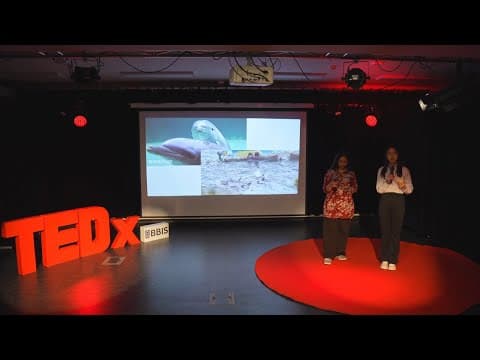
Wildlife Presevation is the Test for Human Self Control | Chloe Hu & Jyoti Saini | TEDxBBIS Youth
Audio Summary
AI Summary
Self-control is presented as the crucial element for wildlife preservation, emphasizing that awareness and talk about climate change and animal rights are insufficient without corresponding actions. Humans are identified as the cause of environmental problems, with the planet bearing the consequences. The transcript highlights the extinction of species like the Pinta giant tortoise due to habitat destruction and the stellar sea cow due to overhunting, questioning why humans, despite their intelligence, struggle with self-control.
The concept of the "homo economicus," a rational economic man driven by self-interest, money, and a love for luxury, is introduced. While this model is acknowledged as influential, especially in economics education, it's argued that humans are not solely self-interested; they also care, cooperate, and value nature. However, learning these self-interested economic models can negatively influence actions.
A consequence of this self-interested mindset is the plight of pangolins, the most trafficked mammal. Their scales and fetuses are sought after for supposed medicinal benefits with no scientific basis, and their use in soups for fertility is similarly unsubstantiated. Pangolins play a vital role in controlling termite populations, and their exploitation creates "negative externalities"—spillover effects where buyers and sellers gain immediate benefits, while society suffers delayed costs like biodiversity loss and endangered species.
The persistence of such behavior, even with awareness of environmental damage and lack of scientific evidence, is attributed to "temporal discounting." This psychological phenomenon means humans prioritize immediate gains over long-term benefits. The profits from selling pangolin products are tangible and immediate, while species extinction is abstract and distant. The brain's reward system, driven by dopamine, reinforces these behaviors, making immediate economic gains and psychological rewards difficult to resist, thus moving the issue beyond rational decision-making to a question of self-control.
The Taiji dolphin hunt in Japan serves as another example. Fishermen use boats and methods to herd dolphins into a bay, where some are sold to marine parks and others are killed for meat. This practice, viewed by participants as a tradition and economic necessity, exploits a shared resource—the ocean. This relates to the "tragedy of the commons," where common pool resources, being non-excludable but rivalrous, are overexploited without regulation or collective self-control. The private benefits of dolphin hunting outweigh the social costs, leading to ecosystem damage and biodiversity loss.
This situation is further explained by the "diffusion of responsibility." In a group setting, individuals feel less personal accountability, assuming others will act. Similarly, fishermen might believe that if they don't hunt dolphins, someone else will, diminishing their sense of responsibility for the shared resource and making it easier to focus on short-term gains. This highlights the need for individuals to understand that their actions matter, even within a group, to overcome the temptation of conformity.
The case of Nauru Island illustrates the consequences of prioritizing short-term gains. The island's 20th-century wealth from phosphate mining destroyed 80% of its land, leaving it barren and forcing its population to relocate. Once the phosphate reserves were depleted, the country faced severe economic hardship. This serves as a stark reminder that seemingly beneficial short-term choices can lead to irreversible and devastating long-term consequences.
In conclusion, the transcript reiterates that treating wildlife and natural resources requires self-control. While immediate benefits like money are tempting, the delayed and initially invisible costs of environmental damage—climate change, biodiversity loss, and resource scarcity—will eventually become apparent. Humans are not separate from the environment but are an integral part of it. The core challenge is whether humans can learn to think beyond immediate rewards and exercise the self-control necessary to protect the planet.