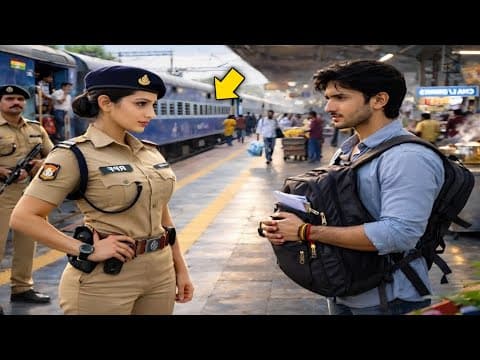
SLUM BOY BECOMES IAS—POLICE STOP HIM, WHAT HAPPENS NEXT! | STORY TIME | VOICE OF TASBIH
Audio Summary
AI Summary
In Delhi, amidst the stark contrast of powerful leaders and impoverished communities, lived Vikas, a young man from a slum by the railway tracks, with his mother, Sushila Devi. Despite their poverty, Vikas harbored a grand dream of becoming an IAS officer, a goal he reaffirmed daily by looking at a paper on his wall that read "IAS 2026." He excelled in his government school studies, foregoing private tuition and acquiring books from second-hand markets or libraries, often studying under street lamps due to a lack of electricity at home. His mother, who worked as a dish washer, constantly encouraged him, reminding him that while they might be poor, their goals should never be.
The long-awaited day of his UPSC mains exam finally arrived. Vikas had painstakingly saved for a sleeper class train ticket, booked months in advance, and his mother had even pawned her silver anklets to cover his travel and stay expenses. Early in the morning, his mother prepared dry rotis for his journey, blessed him, and reminded him to always be a good human being, regardless of the exam's outcome. Vikas, filled with a mix of fear and hope, set off for the station.
Upon reaching the crowded station, Vikas settled in a corner to review his notes. Suddenly, an RPF woman officer approached him, her stern demeanor and neat uniform commanding attention. She ordered him to open his bag, drawing the attention of bystanders. Inside, she found books, clothes, and his admit card. When Vikas explained he was going to take the UPSC exam, some people in the crowd scoffed. The officer then asked for his ticket, which Vikas frantically searched for but could not find. Panic set in as he realized it was gone, possibly pickpocketed. The officer, however, remained unmoved, accusing him of attempting to travel without a ticket. Vikas pleaded, explaining the importance of the exam and his mother's sacrifices, but the officer insisted he come to the office, stating that rules were rules.
As the train pulled into the platform, Vikas felt his dreams slipping away. He was taken to the small RPF office, where the ticking clock amplified his distress. The sound of his train departing shattered his hopes, and tears streamed down his face. The officer, still firm, questioned him about the missing ticket. Vikas tearfully recounted how his mother had saved money for the sleeper class ticket. The officer, after learning his name, Vikas Yadav, and his deceased father's name, Ramkishore Yadav, asked about his residence in the slum behind Parliament House. A brief flicker of an old memory crossed her face before she inquired about his mother, Sushila Devi, and her work as a dish washer and cleaner.
Silence filled the room as Vikas felt his year and dreams were over. The officer then asked what he had with him, and Vikas produced crumpled notes, totaling 180 rupees, along with his admit card. The officer sighed, emphasizing that the UPSC exam required honesty and courage, not just education. Vikas, for the first time, looked at her directly, affirming his honesty and expressing his fear of his mother's heartbreak, mentioning her pawned anklets.
The officer looked at the admit card, noting the exam details. It was 6:30 AM, and the exam was at 9 AM. She then asked if he could truly change something if given a chance. Vikas, without hesitation, promised that if he became an officer, he would work to ensure no child was denied education due to lack of money, and no mother had to pawn her jewelry. His eyes now held determination.
The officer then revealed a startling connection. She asked if his mother, Sushila Devi, had once worked in a government quarter near Parliament House. Vikas confirmed this, recalling it was many years ago when his father was alive. Tears welled in the officer's eyes as she shared her story: about fifteen years ago, her father, a railway clerk, was falsely accused, leading to his death from a heart attack. Her family was abandoned, and they faced extreme poverty. It was Vikas's mother, Sushila Devi, who had selflessly helped them, bringing food and paying for her school fees, even cutting down on food in her own home. The officer revealed, "That little girl was me."
Vikas was stunned, unaware of his mother's profound kindness. The officer, regaining her composure, reiterated that traveling without a ticket was an offense but then stated, "humanity is greater than the law." She informed him that his train had left, but another was due in an hour. To Vikas's disbelief, she took out her wallet, called the counter, and booked him a sleeper ticket on the next train, stating it was a repayment of his mother's debt. Vikas, overwhelmed, knelt, calling her God. She lifted him, reminding him to never look at a poor person with suspicion when he became an officer.
As the new train was announced, hope rekindled in Vikas's heart. He remained in the office, his face no longer broken, but filled with gratitude. The officer shared more details of her past, the struggles after her father's death, and her mother's perseverance. She recounted how Sushila Devi had encouraged her education and supported them when no one else would. Vikas, listening intently, realized the depth of his mother's selflessness. The officer then showed him an old photograph of herself as a little girl with Sushila Devi, explaining that after joining the RPF, she had tried to find Sushila Devi but couldn't. She felt meeting Vikas was a divine opportunity.
Vikas, overcome, wept, acknowledging his mother's nobility. The officer comforted him, saying all mothers are noble. As the train arrived, she imparted a final piece of advice: never let power turn into arrogance, and always remember his responsibility to help others. She then surprised him by saying he would travel in an AC coach, a blessing from his mother.
Outside, the same people who had mocked him now watched silently as the officer saw him off. Vikas touched her feet, promising to return one day in uniform. As the train departed, he held the old photograph, understanding the true meaning of wealth. He resolved to fight not just for himself, but for all those who had been looked at with suspicion. The officer, watching him leave, looked to the sky, feeling her father's honesty and humanity were still alive.
The journey transformed Vikas. At the exam center, he wrote his papers with honesty and confidence, driven by his mother's hard work and the officer's hope. Back in the slum, he taught children for free, encouraging them to dream big. When the results were announced, the entire slum erupted in joy as Vikas Yadav's name appeared as "Selected." His mother hugged him, crying tears of pride.
Months later, as an officer, Vikas returned to the same railway station. He saluted the RPF woman officer, who, after a moment, recognized him, her eyes filling with tears. Vikas thanked her, acknowledging that her humanity, alongside the law, had allowed him to achieve his dream. He pledged to dedicate a part of his salary annually to educate children who give up their dreams due to poverty.
That evening, Vikas brought his mother to the station. She recognized the officer, and they shared a poignant moment, acknowledging the enduring impact of Sushila Devi's kindness. The story, the narrator concludes, teaches that humanity is never in vain, poverty is not a weakness, and while law is necessary, the heart is greater. It prompts reflection on whether we recognize the "Vikases" around us and choose to help rather than judge.