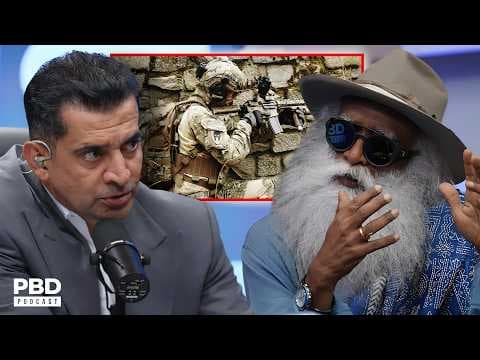
“World Peace Is IMPOSSIBLE” - Sadhguru REDEFINES Where Peace Truly Begins
AI Summary
The speaker addresses the question of what one should dedicate their life to, suggesting that the fundamental drive for any being is its own well-being and the pursuit of becoming a "full-fledged life." This drive for becoming is observed across all life forms, from plants fighting for growth to insects, birds, animals, and humans. However, human potential is unique in its undefined nature, leaving it up to individuals to determine how far they wish to develop.
The speaker posits that if we focus solely on physical pursuits, conflict is inevitable. This is because every individual inherently desires to be "something more" than they currently are. This desire for more is insatiable; even achieving ultimate power, like becoming king of the planet or possessing the moon, would not bring lasting contentment. Humans possess an innate characteristic that resists boundaries, a longing to expand limitlessly.
This inherent desire to expand, when pursued physically, naturally leads to conflict. The speaker uses the analogy of trying to occupy an entire room; if one person attempts to take up all the space, conflict arises with others who have the same desire. Therefore, realizing that the fundamental goal is limitless expansion is a crucial step. The speaker argues that this limitless expansion cannot be achieved physically because the physical realm is defined by boundaries. Anything considered physical has a defined boundary, and if these boundaries are removed, physicality ceases to exist.
The speaker clarifies that this is not about ambition in a conventional sense. Instead, it is about the fundamental nature of consciousness, which naturally seeks limitless expansion. What is perceived as ambition is described as a "constipated condition" or a "constipated expression" of this consciousness, where the desire to expand is parceled out "little by little" because it is understood only through a physical, limited lens.
The physical self is then examined, with the speaker explaining that everything physical about us – the food we eat, the water we drink – originates from the planet. We are, in essence, temporary accumulations of planetary matter. This leads to the idea that our physical identity is transient, as the components of our bodies are constantly being replaced by what we consume.
The discussion then shifts to the concept of peace, particularly in the context of global conflicts and peace conferences. The speaker expresses skepticism about the effectiveness of traditional peace initiatives, citing personal experiences at large conferences where attendees appeared disengaged and even asleep during speeches. This leads to the critical question: if individuals cannot achieve peace within their own minds, how can they possibly bring peace to the world?
The speaker highlights that the pursuit of peace through external means, such as alcohol or other substances, is a flawed approach. These methods merely "knock out your brains" or "remove half your brain," leading to a superficial and temporary state of peace, rather than addressing the root cause. The fundamental problem, according to the speaker, is that humans, with their complex intelligence, do not know how to handle it. If humans possessed the simpler brain of an earthworm, they would likely be inherently peaceful and eco-friendly.
The transcript concludes with a direct address to the viewers, urging them to subscribe to the channel to support its growth and enable the production of more content. The speaker emphasizes that viewer support is crucial for hiring more staff, conducting bigger interviews, and improving the overall product delivered to the audience.