Stories that the mind tells us. | Soumya Upadhyay | TEDxSMShettyInternationalSchool
Audio Summary
AI Summary
The video suggests that our minds are not inherently designed to support us but rather to demotivate us. Our brains create negative stories, like "I'm not enough," "I can't do it," or "I'm not capable," which are unconsciously written and dictate our reality. These are presented as a script that we live within, with our brain as the director.
Several examples illustrate this point. If two people glance at each other after you speak in a room, your immediate thought might be that they are judging you. If someone doesn't reply to a text for ten minutes, you might assume they don't value you or are ignoring you. Seeing someone score higher than you on an exam can lead to thoughts of inadequacy. Not getting expected views or likes on Instagram can make you feel uncool or out of touch. The common pre-exam thought of "I'm cooked" also fits this pattern, potentially reducing performance.
Memory research, specifically by Elizabeth Loftus, indicates that our memory is not a perfect recording device but is reconstructive. When we replay memories, our brain edits them. Negative thoughts, when replayed repeatedly, become more negative, which is dangerous because, according to psychologist Dan McAdams, these stories can become our "narrative identity." If you repeatedly think "I'm not confident," this can solidify into your identity, leading to a crumbling of your self-worth.
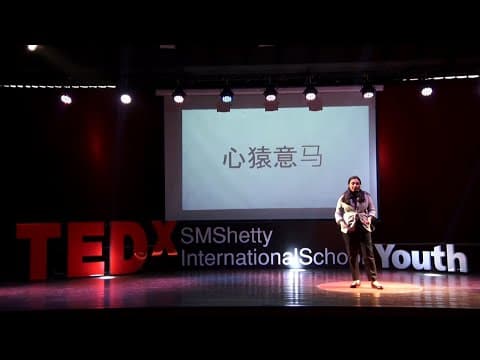
This constant negative thought process can lead to escapism, where we try to avoid discomfort rather than confront it. The video introduces a Chinese phrase, "Xin Yuan," which describes the mind as a restless monkey jumping from thought to thought and the heart as a wild horse running towards emotional reactions. Our brain, like the monkey, creates these stories restlessly.
Neuroscience offers a solution through neuroplasticity, the concept that our brains are changeable. Negative thoughts occupy specific pathways in the brain, and repeating them strengthens these pathways, making them part of our identity. Neuroplasticity allows us to change these negative pathways into new, more positive ones.
Drawing on a quote from a Chinese war general, "If you know the enemy and know yourself, you need not fear the result of a hundred battles," the video applies this to our internal struggles. The "enemy" is not necessarily our brain, but the unquestioned script it creates. The key to conquering this is "knowing yourself."
To understand and change these neural pathways, three steps are proposed:
1. **Remind yourself that one thought does not define your entire character.** When an identity like "I'm not confident" becomes ingrained, we may avoid situations that challenge it. Recognizing that a single thought is not your whole being is the first step.
2. **Separate the raw footage from the edit.** The raw footage is the event itself (e.g., not passing an audition), while the edit is the negative story your mind creates (e.g., "I'm not enough"). It's crucial to distinguish between the two. Conquering these thoughts doesn't come from simply thinking positively or silencing your mind. Escaping the discomfort only postpones the issue; you remain within the script. Instead, you need to actively participate and change the script yourself because, as the director, you have the power to do so.
3. **Find motivation.** An ideal motivation might be excelling in an exam. However, if that's not feasible, a "ridiculous motivation" can be used, such as rewarding yourself with favorite series or ice cream for stepping out of your comfort zone.
Ultimately, the video emphasizes that our brain is a constant narrator producing daily narratives about us. To change these narratives, we must change the script ourselves. As the director of our own mental movie, we have the total power to "say cut and action."