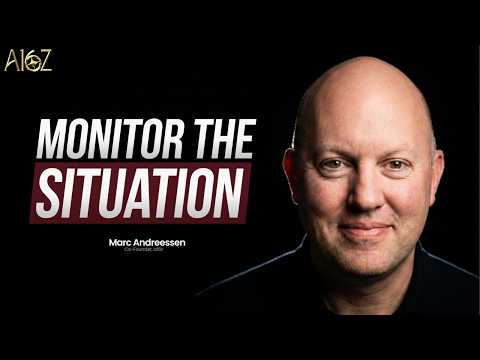
Marc Andreessen on how the internet changed news, politics, and outrage | The a16z Show
AI Summary
The discussion delves into the evolution of media, the concept of "the current thing," and the nature of online discourse, drawing parallels between historical media shifts and the current internet landscape.
The conversation begins by examining the historical concept of "randomonium" coined by Reese Schoenfeld in the founding of CNN. This concept described the idea that at any given moment, there is one "current thing" that is the most amazing, interesting, or controversial event in the world, and a 24-hour news channel should continuously cover it. The Gulf War in 1991 is cited as a prime example of CNN successfully implementing this by providing round-the-clock live coverage. However, the internet, particularly social media, has reinvented this concept. The experience of "monitoring the situation" online, especially on platforms like X, has become a dominant meme.
This acceleration of "current things" is attributed to two key factors highlighted by Marshall McLuhan's concepts. First, the internet has created a "global village," connecting everyone constantly. McLuhan, who did not view this positively, foresaw a lack of privacy and an overwhelming flood of information, impacting human brains which are not evolved to handle relationships with billions of people. This constant connection means that even events like historical crises would have played out very differently with social media. Second, McLuhan's idea that "the medium is the message" is applied to the internet. Just as television turned events into polished, emotional dramas or morality plays, the internet turns everything into a viral social media meme. This meme then often devolves into a moral panic, with tribes forming and engaging in online conflict.
Each viral meme explosion, it's argued, follows a roughly two-and-a-half-day cycle. The old "current thing" is quickly forgotten as a new one emerges, leading to a continuous cycle of emotional outrage. This rapid cycle makes predicting political outcomes difficult, as by the time an election arrives, the issues dominating the current discourse will be long forgotten.
The speaker argues that despite the apparent chaos, the current media environment might be better than previous eras. While acknowledging the prevalence of both truth and lies online, the collapse of gatekeepers allows for more direct and clear communication of truth. More importantly, the speaker posits that while previous media formats (posters, radio, television) were linked to increasing levels of physical violence (Spanish Civil War, Nazi propaganda, Vietnam War, 1960s riots), the current era of online virtual combat has coincided with political violence being at an all-time low in Western society. The ability to engage in intense rhetorical combat online, without physical harm, may be shunting away the energy that would have previously translated to street violence.
The idea of political polarization is examined, with the argument that while people may find their online tribes, leading to a disconnect from family or differing viewpoints, this is arguably preferable to the physical combat of the past. Historical examples like the TV show "All in the Family" and "Family Ties" are used to illustrate that intense culture wars have always existed, and the past is often viewed through rose-tinted glasses, with the harsh realities of historical conflict sanded off. From the American Revolution through to more recent events, Western civilization has been characterized by constant strife and warfare. The concept of physical duels for men in positions of power is cited as a stark reminder of how recent and normalized violence once was.
The discussion then touches on the attributes of a "current thing." It needs to provoke emotional reaction and outrage, much like professional wrestling or reality TV. It should allow for the formation of moral tribes that can square off against each other, creating a sense of "rumble" online. The truth or falsity of the event, and even the magnitude of the issue, often don't matter as much as the ability to activate these tribes and create a moral panic. The Jussie Smollett case and the Spanish Civil War's use of propaganda and atrocities are cited as examples where the narrative and its ability to justify moral stances are more important than factual accuracy.
The role of "ops" or coordinated influence operations is acknowledged. While some events are organic, others are paid for. However, the effectiveness of an op depends on its ability to resonate with people and tap into existing sentiments. The concept of "availability cascades," where an "availability entrepreneur" injects a specific focus into public consciousness, is discussed. Rosa Parks' activism is presented as an example of an "op" that, through its resonance, led to profound societal change. The speaker emphasizes that just because something starts as an op doesn't negate its real-world impact.
Finally, the transition from legacy to new media is explored. Trust in centralized institutions and legacy media is collapsing, mirrored by declining ratings for traditional formats. Conversely, podcasts, social media, and live streaming are rising. While some legacy media like The New York Times are adapting, many are struggling. The speaker highlights the dichotomy of trends: the rise of short-form, trivial content on platforms like TikTok, and the simultaneous growth of long-form, substantive content in podcasts and online courses. The emergence of "practitioner media," where individuals doing the work share their insights, is also noted as a positive development. The speaker predicts that the "true internet election" and the "true internet candidate" have yet to emerge, someone who will operate entirely online, disregarding traditional media like television. The concept of deepfakes is briefly addressed, with the argument that society has always dealt with misinformation, and the current era is not fundamentally different in that regard.