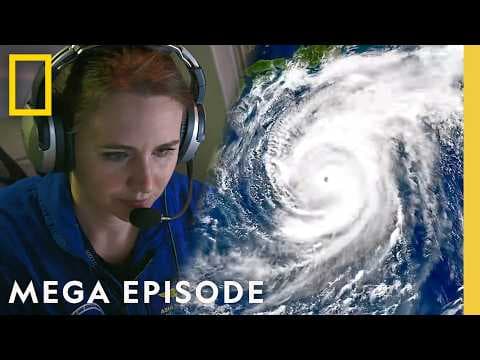
Deadly Hurricanes & Typhoons | Gathering Storm MEGA Episode | National Geographic
Audio Summary
AI Summary
Off the coast of Texas, veteran captain Carl Roby, on the fishing boat Cynthia Renee, is hauling his first catch of the day. The Cynthia Renee has been at sea for eight days during the hottest June on record. Commercial fishing in the Gulf of Mexico generates $900 million a year, but for almost half the year, boats operate under a constant threat. June 1st marks the start of hurricane season. The Gulf coast is home to 15 million people, and in the ocean, there are three and a half thousand oil platforms, all in one of the most notorious hurricane hot spots in the world. Some of these platforms, as well as cargo ships, government vessels, and fishing boats in the Gulf of Mexico, will carry National Geographic cameras for an entire hurricane season to document one year's storms across our changing planet on a scale never seen before.
Kenneth MacWhirter is at the Grand Isle 22, Lima platform. Cox Oil is one of the few privately-owned oil companies in the Gulf, operating more than 500 platforms stretching from Florida to Texas. In hurricane season, all eyes are fixed on the skies to the southeast, towards the Atlantic and Caribbean, which is the usual route for hurricanes. However, just a few weeks into the season, meteorologists have spotted a threatening weather pattern coming from the opposite direction, the north. This is not where hurricanes usually come from. If the system hits the Gulf, high sea temperatures could cause it to intensify, becoming a hurricane in less than a day.
220 miles off the Texas coast, the United States Coast Guard Cutter Cypress is en route to a designated location in the middle of the Gulf. The Cypress has a specialist role among Coast Guard ships; they work with the National Oceanic and Atmospheric Administration (NOAA) to maintain their network of ocean weather monitoring buoys. These buoys provide data in the Gulf of Mexico, giving early warning of storms. A lot of commercial traffic, valued in trillions of dollars, goes through the Gulf of Mexico, making this a very important mission. Today, the crew of the Cypress is deploying a weather buoy that will give NOAA live wind and wave data from more than 200 miles offshore. But the weather will play a big part in determining how smoothly this operation goes. They will be setting a four-ton concrete anchor, 12,000 feet of cable, and a fragile half-million-dollar weather buoy. Even in calm weather, this is a precarious operation.
The storm has turned South and is approaching the warm seas of the Gulf. The National Weather Service issues coastal forecasts and is now preparing to announce storm warnings. They are concerned because if it gets into the Gulf of Mexico, it will encounter much warmer water off the Louisiana coast, where the upper-level shear will become more favorable for intensification and development. Almost as soon as the system reaches the warm seas of the Gulf, it intensifies to a sustained wind speed of 40 miles per hour, making it officially a tropical storm and earning it the name Barry. Across the Gulf, ships carrying cameras are seeing the skies change. In the middle of the ocean, the oil platforms are exposed, and increasing winds are a big concern. A powerful hurricane could completely destroy an oil platform, taking its crew down with it. If Cox Oil deems the incoming system a threat, they will shut down the rigs, seal the wells, and evacuate the workers. Safety of the crews and the environment are paramount, but a shutdown can cost millions of dollars in lost oil revenues.
In New Orleans, Louisiana, Cox Oil's senior management has all rig supervisors on the line to decide if and when to initiate an evacuation. The final decision rests with Cox Oil President, Rodney Dykes. They anticipate having to take some form of evacuation, planning for the worst but hoping not to execute. Hurricanes can be devastating for rigs; Hurricane Katrina destroyed 46 oil platforms and damaged 100 pipelines. Oil spills from damaged platforms prompted strict new regulations, enforcing costly measures in the face of a hurricane threat. Rig operators now face tough decisions.
The Coast Guard crew is trying to deploy the buoy before the bad weather hits, but this is not a job easily rushed. The buoy smashing into the ship could be a half-million-dollar mistake. The buoy lands in the water just as the rain and winds hit. The buoy surges away from the ship on the wind and waves, but the line is tangled, putting the deck crew at risk of being caught and pulled overboard. The sudden arrival of a storm makes the job of deploying a weather buoy much more difficult. Working in the deluge, the Coast Guard crew unsnags the line. Once all the line is out, the crew drops the anchor—a four-ton block of concrete that will take almost 15 minutes to reach the ocean floor. They are already receiving real-time information from it; the buoys are in, working properly, and providing data to mariners.
Data from the buoys is invaluable to forecasters trying to predict the path and intensity of storms, but it's not enough on its own. The call has gone out to launch one of NOAA's hurricane hunters. The specially equipped Lockheed Orion P3 aircraft fly from NOAA's Aircraft Operations base in North Florida, carrying cameras. Almost as soon as they are airborne, they are into rough weather. On the ground, near the Florida Panhandle and the center of the ever-building storm, the Marine Units of the Okaloosa County Sheriff's Office are responding to a distress call. An inshore leisure boat has been caught in the rapidly growing ocean swell. Tropical storm Barry is churning up the seas, and the stranded boat may be in real trouble. They have a line wrapped around the prop and the anchor wrapped up in it. The small sheriff's boat is immediately getting knocked around by the waves, indicating a need for the Coast Guard 45.
On board the fishing boat Cynthia Renee, Carl and his crew have also hit serious problems. His engine has shut off right in the middle of fishing, and he can't get it started again. The Cynthia Renee is a sitting duck in front of the rapidly building storm system. A tropical storm watch has been issued, with a tropical cyclone expected to form by Thursday over the North Central Gulf of Mexico. On the oil platforms in the path of tropical storm Barry, Cox Oil must now decide if they are going to shut down production and evacuate. NOAA's forecasters now expect intensifying storm Barry to become a hurricane within days. Cox Oil has made the big decision to shut down production, seal oil wells, and evacuate 51 platforms in the storm's path.
In Destin, Florida, tropical storm Barry is making the seas rougher by the minute. A freak wave has crashed through a boat's screen, showering the driver with glass. He is still conscious, but he and his passenger both need medical attention. The Coast Guard is already on their way, but for now, the pontoon boat must face the waves alone. In Dulac, Louisiana, Captain Donnie of the fishing boat Intrepido II has received Carl's distress call. Carl's boat has been adrift in the open ocean for more than 24 hours, 140 miles offshore, and it will take Donnie at least another day to reach them. In the skies above the Gulf, NOAA 4-2 is beginning another run into the center of tropical storm Barry. Radio transmitters fitted with temperature, pressure, and wind speed monitors are dropped into the storm to give a real-time cross-section of the intensifying cyclone. Tropical storm Barry is picking up power fast.
Carl Roby has been adrift for three days without an engine and continues to film. All over the Gulf of Mexico, vessels carrying cameras alter their course, doing what they can to avoid the worst of the incoming storm. But the Intrepido II has other priorities. Donnie and the crew of the Intrepido II found the Cynthia Renee not a moment too soon. Barry is now within 24 hours of the Louisiana coast. Ron Dufrene, owner of the shrimp boat Mr. Jug, should have been halfway across the Gulf of Mexico by now. The Texas shrimping season starts in a few days, and Ron had hoped to be there, but with a brewing hurricane now just offshore, it's too dangerous to leave. The crew of the Intrepido II have arrived in Dulac, Louisiana, their rescue mission complete. But despite now being tied up at the dock, Carl and his crew are not clear of danger yet. Some models are showing 20 inches of rainfall for isolated locations, so the flash flood risk is really ramping up with this system, potentially causing catastrophic, life-threatening flash flooding. The other issue, as it slows down, is a 3-6 feet storm surge and battering waves on top of that, which is a big concern along the Louisiana coast. Three hours before landfall, wind speeds hit 75 miles per hour, and tropical storm Barry becomes Hurricane Barry. As night falls on southern Louisiana, category one hurricane Barry arrives. Carl Roby and his crew are thankful they are not still at sea.
Hurricane Barry's bizarre track continues the next day as it moves north into Arkansas, almost making a complete loop and breaking rainfall records as it goes. The tail end of Barry brings a new threat: storm surge. Coastal areas experience almost 8 feet of flooding. Ron Dufrene can't afford to wait for the winds to completely pass. He is heading out into the Gulf, towards Texas, with 400 miles to go to his desired location. The Texas shrimping season opens in two days, and Ron is three days away. Offshore, rig workers can begin to make their way back to their platforms. The shutdown has already cost the Gulf of Mexico oil industry almost a billion dollars, and they are not wasting any time getting back online. The hottest summer on record passes with no more hurricanes in the Gulf.
As October begins, marine workers can start to hope that they may have got lucky, but sea temperatures are still alarmingly high. Warm seas mean hurricane formation is always a threat, and two weeks into October, it's becoming a reality. A buildup of clouds by the Yucatan Peninsula, Mexico, is moving slowly eastward. If it develops into a storm, it has a run of more than 1,000 miles over warm ocean toward America's Gulf Coast—ideal conditions for a hurricane. In the Bay of Campeche, west of the Yucatan, the 190,000-ton Saipem 7000, the third largest semi-submersible crane ship in the world, is building an oil platform and carrying cameras. As the growing storm approaches, Saipem 7000 has to detach from the platform for safety reasons. They get the ship clear of the platform just in time. The incoming weather is almost on them; if faced with hurricane-force winds, the ship could be smashed into the new platform. They are safer battling the storm alone.
On the Texas coast, skies are clear, but forecasts are now showing increasing winds and cloud beginning to build. Outside most major ports, there is an offshore anchorage where incoming cargo ships queue for a space to unload, and outgoing ships can drop anchor and await their next instructions. Ryan Marine operates a delivery and supply service to ships anchored outside Houston's ports. If a hurricane develops, deliveries to ships will be cut off, so they need supplies immediately. But the bigger the waves, the trickier the operation becomes. Sea conditions in the northern Gulf of Mexico are much worse than forecasts suggested this morning. The wind is causing ships to swing back and forth on their anchor chains.
Jon Zawislak, Field Operations Director of NOAA's Hurricane Research Division, is closely watching the latest data on the storm. They have seen nearly hurricane-force winds from the radar. At this point, the hurricane center still expects those winds to increase in the next 12 hours or so as it heads towards landfall. This is the kind of storm that doesn't look like a hurricane or a tropical storm on satellite and might fool some people, but it does have strong winds. The weather system is building, but its irregular shape means it's not yet classified as a tropical storm, and storm warnings are not being issued. Jon will now head to NOAA's Aircraft Operations Base in Lakeland, Florida, to fly with the Hurricane Hunters into the eye of the storm to find out just how bad it really is. The storm is heading for the U.S.; the question now is how powerful it will be when it gets there.
In Louisiana, the fishing boat Saucy Wench is heading to sea despite the incoming storm. They are heading down the bayou after being stuck on land for four days due to repairs for their autopilot system. They have risks: the trip might not be profitable, and there's a big storm coming this weekend. The path of the storm puts them on a collision course