The Paradox of Masculinity
Audio Summary
AI Summary
The video explores how movies and media influence our perceptions of masculinity and gender roles, featuring insights from individuals and academic research.
The discussion begins with moviegoers sharing their thoughts on how films from their childhood shaped their ideas of manhood. Natasha, a UC Berkeley senior, grew up watching movies like "Raiders of the Lost Ark" and "Jaws," which she describes as featuring "manly men" who "kick butt and kill sharks." Her father encouraged her to watch these films, embodying a "manly perspective." While she enjoys "Raiders," some older movies now feel uncomfortable. Riley, an elementary school librarian, grew up in the early to mid-2000s, a time he feels was a "backlash to the macho hyper-masculine idea." He gravitated towards "nerdy films," while his father preferred genres like Westerns and black exploitation films, which he characterizes as featuring "the cowboy and the pimp" as archetypes of men who "took charge" and were often solitary.
Natasha observes that her father, despite being a kind person with a strong sense of justice and a history of defending others, internalized aspects of these masculine films, leading him to engage in fights when younger. She believes this inclination stems from movies where men "go out into the world and like doing a sacrifice for the sake of others." Riley feels his dad, who was often the "loudest and funniest person in the room," put on a "performance of masculinity" he saw on TV.
The conversation then shifts to contemporary movies, with Riley critiquing "Marty Supreme," which he found "terrible." He describes the film's narrative as a "very masculine narrative" about a man seeking success in foreign lands for his family, though he suggests the character's motivations are not truly selfless. Riley contrasts the main character, who "lies and cheats and steals and has little to no empathy," with his friend who survived the Holocaust, highlighting a scene of tenderness and intimacy between men.
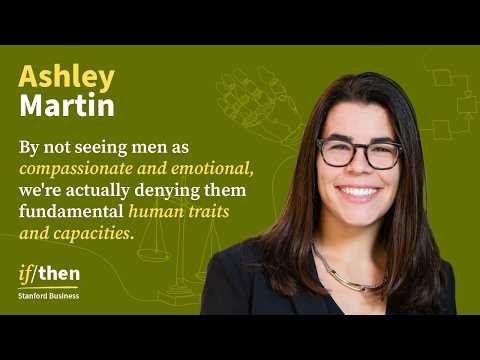
Ashley Martin, an associate professor at Stanford Graduate School of Business specializing in organizational behavior and gender research, joins the discussion. She notes that while women are often deemed unqualified for leadership due to being "too emotional or too compassionate," simultaneously, by not seeing men as compassionate and emotional, we deny them "fundamental human traits and capacities."
Martin explains her research journey, which began with understanding her own experiences as a woman in a competitive business program and questioning why inequality exists and why people treat men and women differently. Her research investigates how gender impacts individuals and organizations.
She discusses studies on hiring processes where de-identified résumés or genderless auditions led to women being more likely to be hired or called back. However, when people were asked to imagine the person behind the résumé or audition, they still used gender, often defaulting to assuming the person was a man. This led to the question of whether gender is truly being eliminated or if an "androcentric default" is being created.
A notable study involved participants creating "pet rocks" and then describing them. The study found that people ascribed gender much more strongly than any other social category, and the more gender was ascribed, the more humanlike the rock was perceived. This suggests a strong link between gender and humanness in our perception.
To investigate whether this is a fundamental human process or a culturally specific phenomenon, Martin conducted a study in Nicaragua, in a Mayangna community with limited access to global media. The study found the exact same pattern: gender was the most strongly ascribed social category and the only one that predicted how humanlike the rock seemed. This suggests that the primacy of gender in understanding humanness might be a universal or even evolutionary trait.
Martin posits that gender provides a lot of information, acting as a useful heuristic for prediction and understanding, which are fundamental human desires. However, she acknowledges its "double-edged nature," as the same process that aids understanding can also lead to inequality, stereotyping, and inaccurate assumptions. She clarifies that while the *use* of gender might be innate and adaptive, the *content* of stereotypes is not.
The conversation touches upon the gendering of products, using the example of ships being referred to as "she" and AI assistants like Alexa. Martin and her collaborator Malia Mason found that product gendering can lead to increased attachment. They observed that when products are anthropomorphized, they are almost always gendered, and typically female. This is attributed to the association of women with care, tenderness, nurturance, and helpfulness – qualities desired in interactions with products or services. The lack of readily available male-gendered anthropomorphized products is noted, reinforcing the stereotype that these caring traits are primarily female.
The discussion then pivots to a new line of research focusing on the psychological and social costs of masculinity for men. Martin's work argues that traits like stoicism, risk-taking, aggression, self-reliance, ambition, and dominance, while often rewarded organizationally, can be personally harmful. She observed that inherently human traits like morality, compassion, love, and emotion are associated with women, while traits associated with men, such as being tough, strong, hard, and aggressive, can also be attributed to non-human entities. This led her to question the consequences of associating men with non-human things and the potential disadvantage of not seeing men as compassionate or emotional.
The conversation links this to the rise of the "manosphere," where some groups attempt to "reclaim men's voices" or agency. Martin suggests that while women have become more associated with masculine traits like independence and assertiveness, men have not similarly become associated with feminine traits like compassion and emotionality. This imbalance, she argues, prevents men from expressing emotions or engaging in tender and caring behaviors, potentially leading to maladaptive coping mechanisms and a turning towards unhelpful communities for support.
The proposed solution involves finding ways to foster connection, community, and support for men, creating spaces where they can be vulnerable, express emotions, and seek help. The societal expectation for men to be stoic and unemotional is seen as harmful. Martin acknowledges that changing this deeply entrenched cultural conditioning is a significant challenge, a "new frontier" for her research.
She observes that people are increasingly moving away from traditional masculinity, finding non-emotionality, rigidity, and toughness less attractive. This shift makes it difficult for men to find alternative models, as there are few readily available. The destructive solutions offered by some online communities are contrasted with the need for healthier alternatives.
Martin's future research will focus on masculinity, exploring how our descriptions of the material world are tangled with how we describe men and women, and the specific impacts on men. She believes that by reversing the traditional focus of gender research from women's disadvantage to men's experiences, valuable insights can be gained into societal problems, including authoritarianism and the climate crisis, which she believes are bound up in masculinity.
The podcast episode concludes with thanks to the guests and a reminder of the podcast's origin and affiliations.