What we can learn from duck fossils | Martijn van der Meer | TEDxJvL Youth
Audio Summary
AI Summary
Hello everyone. Today, I'll be discussing my research into fossil birds from the North Sea, focusing on highlights from my bachelor's thesis. While many might associate the North Sea with common gulls or seabirds like the common murre, my research has uncovered a surprising array of bird species that once inhabited the region.
The key to understanding these findings lies in recognizing that the North Sea, as we know it today, was once a dry landmass called Dooland during the last ice age, in the late Pleistocene epoch, which concluded around 10,000 years ago. This area was home to iconic ice age fauna like woolly mammoths and rhinos, but also included bird species that are now unexpected finds on the seabed. When the ice age ended, rising sea levels inundated Dooland, leading to the submergence of this land and its inhabitants, whose remains are now discovered on our beaches.
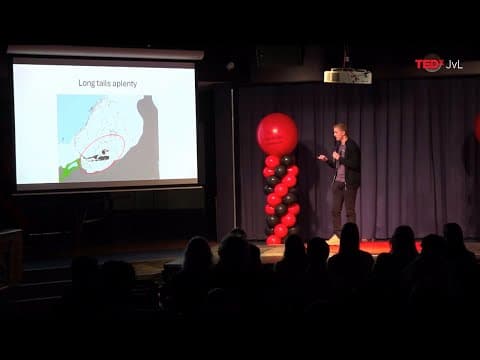
This geological history creates an interesting fossil record, which is subject to biases. For instance, while a common crow is familiar to most, a rare bird like the long-tailed duck, which is scarce in the North Sea today, appears abundantly in the fossil record. This discrepancy isn't because crows were absent from Dooland, but rather because ducks, with their robust bone structure, are more likely to fossilize well compared to the more delicate bones of crows. Therefore, ducks serve as a valuable proxy for understanding past bird distributions.
My research specifically focused on duck fossils. Identifying them is challenging due to the similarity between the 24 European duck species, even when dealing with damaged, isolated bones. I examined 304 such bones, including humeri, coracoids, and carpometacarpi. The abundance of long-tailed duck fossils is particularly noteworthy. During the late Pleistocene, the Baltic Sea, a current habitat for these ducks, was inaccessible due to glaciers. Dooland, however, provided a suitable environment. As the climate warmed and the ice melted, long-tailed ducks likely shifted northward, finding refuge in the Baltic Sea, explaining their current distribution.
Another significant find was a harlequin duck bone, a species that rarely ventures into the North Sea and is primarily found around Iceland. Its presence in the fossil record suggests it was a vagrant, meaning it got lost and ended up in the North Sea, a phenomenon that still occurs today with rare species.
Conversely, the common eider, a highly abundant duck in the North Sea today, is conspicuously absent from the fossil record I studied. This absence led me to develop a hypothesis, which I presented at a conference, though the details are too extensive to cover here.
In summary of the duck findings, most European species are represented in the fossil record, with only a few exceptions. We see an unexpected abundance of long-tailed ducks and the presence of a vagrant harlequin duck, alongside the surprising absence of common eiders. These findings clearly indicate that duck distributions in the past were very different from today, offering insights into current distributions and aiding in predictions for future shifts due to climate change.
Moving beyond ducks, I also investigated fossils of birds of prey, specifically their claw bones and toe bones, which are crucial for hunting. These remains have revealed fascinating species. For example, a tiny bone, about two millimeters in size, belonged to a northern hawk owl, an owl currently confined to Scandinavia and not found in the Netherlands today. We also found snowy owl remains, another arctic species that would be exceptionally rare in the Netherlands now.
I also identified an osprey claw, perfectly adapted for catching fish with its long, slim, and sharp structure. Additionally, a phalanx bone belonged to a golden eagle, marking the first fossil record of this species in the Netherlands. This discovery garnered significant media attention, leading to an appearance on the radio.
In conclusion, North Sea bird fossils reveal species that are unexpected in the region today. The concentration of these fossils can inform us about the origins of past populations, as seen with the long-tailed duck. Studying these ancient bird populations helps us understand present-day distributions and predict future movements in response to climate change. There is still much work to be done in identifying more bird fossils, including those of the extinct great auk, a bird that was the closest relative to penguins and even lent its name to them. I'm happy to discuss these topics further after the event. Thank you for attending my presentation.