The Mammal Tier List
Audio Summary
AI Summary
Mammals have become the dominant class in the current meta, with viable builds across nearly every biome. A key ability for mammals is lactation, which allows low-level players to quickly grow in size, significantly increasing their chances of reaching the late game. Most mammals also possess fur, which, while less armored than reptile scales, offers enhanced perception and cold resistance. Mammals are warm-blooded, generating their own body heat. This requires more food and leads to shorter lifespans, making them a high-skill floor faction. However, it also grants higher max speed and faster stamina regeneration, unaffected by temperature or sunlight.
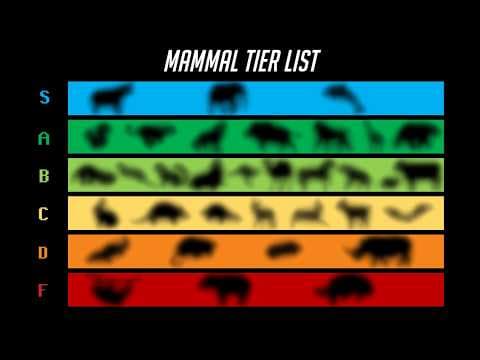
Starting at the bottom of the tier list, F-tier includes the sloth, tapir, and sea cows. Sloths have terrible base stats, especially mobility, which is unusual for a mammal. They trade mobility for the ability to digest cellulose and rely heavily on stealth. However, they frequently expose themselves to danger when moving between trees or defecating, making them easy prey. Their swim speed buff is also rarely utilized. Tapiers are related to rhinos but have a short trunk that isn't versatile enough for advanced techniques, primarily functioning as a snorkel. Despite being the largest terrestrial mammal in South America, their size isn't sufficient to deter predators like jaguars and caimans. Sea cows (manatees and dugongs) are large, slow marine herbivores with high HP but no offensive capabilities. Their tusks are dulled by feeding, and their defense relies on size, which fails against predators like caimans and sharks. They have low metabolism to subsist on a low-calorie diet, leading to low stamina regen and surprisingly poor frost tolerance, making them vulnerable to cold fronts.
D-tier features the platypus, opossum, mole, and rhinoceros. The platypus is a build with a strange mix of abilities (webbed feet, beaver-like tail, duck-like bill, venomous spurs, electroreception, egg-laying) that mostly compensate for numerous weaknesses rather than amplify strengths. It struggles with poor underwater vision, short breath-holding, slow swimming, no teeth, and poor camouflage. Its webbed feet, while boosting aquatic mobility, hinder land movement. The opossum has one signature move: playing dead, which is effective against some predators due to chemical secretions that simulate disease. However, it's an automatic response, not player-controlled, and ineffective against domestic dogs or ambushes. Despite low intelligence, opossums have reasonable tankiness and strong jaws. Moles are small carnivorous builds operating in the subterranean server. They have suffocation resistance for deep burrowing and a paralytic bite to store prey. This venom is a workaround for their inability to store fat due to their burrowing lifestyle. While apex predators underground, their low base stats make them vulnerable to skilled players above ground. Rhinoceroses are powerful, heavily armored herbivores with a dangerous basic attack. Their low intelligence and perception create exploitable vulnerabilities, making them easily tricked by both intelligent predators and accidental environmental triggers. Despite strong power and defense, their inability to focus attacks on actual opponents limits them.
Moving to C-tier, we find rabbits and hares, armadillos, pangolins, deer, antelope, goats, and bats. Rabbits and hares are mobility-focused herbivores specializing in jumping for movement and escape. They are fast, can quickly reach cover, and their vertical jumps disrupt predator attacks. Their fangs can pierce scale armor. However, they lack the climb ability, opting to burrow where their movement is restricted. Armadillos are the mammal equivalent of tortoises, with high defense and a "defense curl" move that makes them nearly impervious. They are not excessively slow and effectively dig for insects. Their main weakness is a vulnerable underbelly, which predators can exploit due to their poor perception. Pangolins are similar to armadillos but slower, with strong claws for tearing into termite mounds. They rely on armor and curling into an impenetrable ball when attacked. Their scale armor is effective, but skilled predators can exploit their immobility by dropping them in water to force them to uncurl. Deer are a diverse group focusing on stealth and agility, supplemented by respectable power and rumination (increasing XP from fibrous plants). While capable, their below-average HP and intelligence make them slow to adapt to counterplay. Their powerful antlers are temporary and not universally available. Antelope are similar to deer but with lower HP and stealth, higher mobility, and permanent horns for all players. They are nimble sprinters but often face experienced predators that target their necks. Goats have lower top speed but superior agility on uneven surfaces and a greater power stat due to their skull bash attack and cranial cushion. Their smaller stature makes them vulnerable to multiple opponents. Bats are the only flying mammals, with echolocation for nocturnal hunting and incredible mobility for accessing difficult loot. However, they have extremely low defensive stats and their constant chirping gives away their location.
B-tier includes anteaters, seals, kangaroos, camelids, horses, weasels, mongooses, hyenas, shrews, and bovines. Anteaters use powerful claws to tear into insect bases. Lacking armor, they invest in claw DPS for combat, making them dangerous even to apex predators. Their main weakness is low perception. Seals are agile marine carnivores that traded paws for flippers, gaining aquatic mobility but sacrificing land prowess. They are split into true seals, sea lions, and walruses, with varied stats. They thrive in diverse marine environments but are vulnerable on land. Kangaroos are the largest marsupials, using powerful kicks for traversal and damage. Their true strength is efficiency: maintaining top speed costs almost no stamina, making escape easy. However, their dominance in Australia might be due to a lack of strong predators. Camelids (camels, llamas) prioritize environmental survivability over DPS and bulk. Their humps store fat, and padded feet negate terrain penalties, making them excel at long-distance traversal. They lack offensive tools but are naturally durable and resistant to dehydration and starvation. Horses are mobility-centric herbivores, favoring pure speed and endurance over armor. They sweat for efficient thermoregulation and use a powerful kick as a counterattack while retreating. However, they lack the ruminant perk, requiring extensive grazing with their heads down, making them vulnerable to ambushes. Their kick is situational, leaving them exposed if cornered. Weasels are energetic carnivores known for bringing down larger prey. Their loose skin helps shrug off attacks, and many have chemical defenses. Their slender frames aid evasion and flushing targets. Despite their durability, they are often overrated. Mongooses are similar to weasels but are more intelligent and use safety in numbers. They have worse stats than weasels but are carried by poison immunity. Hyenas are often misunderstood, with high bite force, resilient immune systems for scavenging, and superior endurance. However, they lack top speed, are noisy, and suffer from infighting, often losing kills to larger felids. They also cannot climb. Shrews are ferocious "glass cannon" builds with a venomous bite that causes paralysis. Combined with high mobility and olfactory perception, this makes them dangerous. They have basic echolocation but extremely low defense and a turbocharged metabolism requiring constant feeding, leaving no room for mistakes or stealth against birds of prey. Bovines (cattle) are the tankiest ruminants, with excellent defensive stats and large average weight. Their lactation ability allows rapid leveling. At max size, their "Goring Rush" is a powerful head bash with knockback. However, they have little damage mitigation, including recoil from their own strikes.
A-tier begins with rodents, arguably the most adaptable build. They possess continuously growing incisor teeth for environmental block damage and combat, and a high intelligence stat. This combination gives them excellent terraforming abilities. Despite often losing 1v1, their rapid respawn rate and ability to infest environments make them a meta force. Cats are ultimate rogue assassins, combining high stealth, mobility, and perception for ambush strikes. Their fangs deal critical damage, and retractable claws aid climbing and inflict bleed. Their main weakness is a mid-range bite force for an apex predator, requiring them to fish for critical hits, which can backfire. Dogs, the classic foil to cats, have absurdly high perception (smell and hearing). While slower and with lower damage output than cats, they excel in persistence and endurance, using bleed damage, pack hunting, and extended chases. This allows smaller dogs to achieve big wins. Their weakness is the reverse of cats: they must play the long game, requiring sustained flawless gameplay, as one mistake can derail a hunt. Hogs are unorthodox tank builds with impressive intelligence and adaptability. Their tusklined snouts are weapons and tools for digging up valuable omnivorous loot. They are often underestimated but can hold their own against top tiers. Primates, including humans, lemurs, monkeys, and apes, have mid base stats except for high intelligence and situational mobility (in vertical environments). They are poorly armed, lacking sharp claws or specialized teeth, and struggle in 1v1 combat. However, their intelligence manifests in dexterity, tool use, and strong social cohesion, making them excellent for group play. Giraffes are the tallest build, gaining advantages from their height: negating stealth bonuses for ambush predators, placing vitals out of reach, and giving their attacks incredible range. Their main weakness is difficulty recovering from being knocked prone. Bears are the largest omnivorous builds, combining adaptive generalism and apex predation. Their stat spread is formidable: loose skin, high HP, brutal claw swipes, and paws useful for breaking open loot. Their omnivorous diet and hibernation ability allow them to skip harsh months. They would be S-tier if not for pandas.
Finally, S-tier features builds with almost no weaknesses, dominating their servers. Hippopotamuses are ridiculous tank builds with excellent stats and combat prowess. Their density allows them to run on the seabed, dominating lakes and rivers. They can ignore crocodiles, shrugging off attacks that would one-shot most mammals. Their only real vulnerability is to piercing attacks that cut deep enough, and their only bad matchup is the elephant. Elephants are overpowered characters whose physical size alone makes most matchups one-sided. Their tusks are deadly. Beyond strength, their high intelligence combined with their trunk allows for tool use (e.g., projectiles for distraction and intimidation), invalidating potentially unfavorable matchups. Citations (whales, dolphins, porpoises, narwhals) are highly intelligent marine mammals. They sacrificed walking, smell, and fur to maximize swim speed. They dominate ocean servers with insane base stats: excellent echolocation perception, intelligence second only to humans, HP ranging from decent to the highest in the game, and great mobility. Their sonar invalidates camouflage and can be used as a sonic weapon. Their intelligence leads to optimized social coordination and hunting techniques, exploiting enemy weaknesses. Their consistent mammalian metabolism fuels their massive brains and high-speed pursuits. These advantages give them a monopoly on ocean resources.
Despite mammal dominance, some abilities common in other factions are rare or absent in mammals, such as health regeneration (amphibians, reptiles, invertebrates), color-changing abilities, and widespread venom. This suggests unexplored territory for future mammal builds.