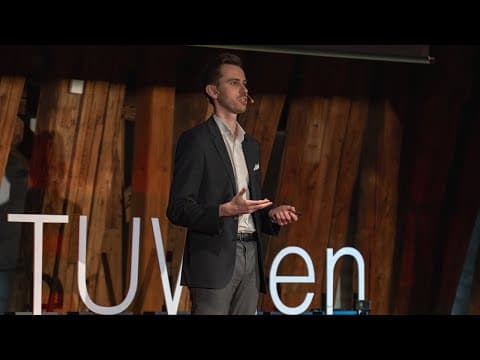
Space: The New Frontier for Builders and Innovators | Moritz Novak | TEDxTUWien
Audio Summary
AI Summary
The speaker has always been fascinated by the idea of flying and the freedom it represents. Humans, not being naturally equipped for flight, developed wings, propellers, and jet engines, allowing them to overcome biological limitations and achieve what was once only a dream. This ability to imagine a better future and then build it is what excites the speaker, leading them to study aerospace engineering.
The human story is now expanding beyond Earth, with many essential systems like economies, communications, weather forecasts, and national security relying on satellites orbiting hundreds of kilometers above. These satellites form the invisible scaffolding of modern civilization, connecting communities, guiding aircraft and ships, and acting as the backbone of our world.
However, a significant difference remains between Earth and space: movement. On Earth, movement is easy, cheap, and normal; a click of a button can change direction. In space, changing an object's path is almost impossible once it's released by a rocket. Its speed and heading are locked, causing it to continuously circle Earth on the same path, making changes extremely difficult and expensive. Most satellites lack this capability.
Imagine an object the size of a household fridge racing around Earth faster than a bullet, endlessly and uncontrollably, unable to steer or avoid collisions. Now imagine thousands of these objects being released annually. This poses a significant threat because when these satellites collide, they violently smash into thousands of razor-sharp metal fragments. Each fragment then races around Earth at deadly speeds, and this debris doesn't disappear; it causes further collisions. Currently, over 100 million individual objects orbit our planet, each with enough kinetic energy to destroy a satellite or endanger astronauts.
The speaker envisions a future where satellites move freely in space, gliding into perfect positions, reacting responsively to events on Earth, and swerving to avoid collisions. In this future, aging satellites would be collected, repaired, and given a second life, allowing humanity to not just reach space but live and move within it as we do on Earth. This future is not just imaginary; it can be built.
Four years ago, the speaker's team began working towards this future, believing they could apply human learning from Earth to space. Their goal is to make movement in space as easy and common as flying a drone. Despite humble beginnings in an old garage with no insulation or heating, fueled by pizza, Red Bull, and adrenaline, and initially building rocket engines that failed to ignite, they persevered. Each failure provided valuable lessons.
A turning point came when Austria's only astronaut, Franz Viehböck, believed in their vision and became their first backer. This led to attention from the European Space Agency, which awarded them three contracts, and investors who provided capital. The garage project rapidly transformed into a real company with patents, clean rooms, and customers. Today, they are a team of 22, but the hardest part—space—still lies ahead.
Next year, their first product will launch into space on a SpaceX rocket. When their engine ignites for the first time in space, it will be more than an engineering test. It will be proof that imagination is the first stage of engineering, and engineering is how ideas become reality. It embodies what it means to be human: to imagine a world that doesn't yet exist and then build it. The speaker believes the best way to predict the future is to invent it.