ราคาสินค้าเสี่ยงแพงขึ้นอีกในไตรมาส 3 พิษ ‘พลังงาน-เอลนีโญ’ ดันเงินเฟ้อพีกสุด | THE STANDARD WEALTH
Audio Summary
AI Summary
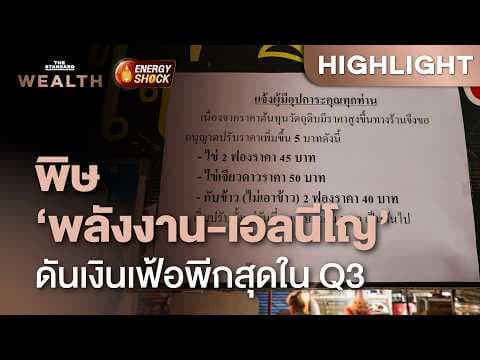
Global inflation is a significant concern, with our country experiencing a notable increase, moving beyond previous low levels. The Ministry of Commerce reports that April's Consumer Price Index (CPI) rose to 2.89% year-on-year, the highest in 38 months, primarily driven by a supply push from fuel prices. This global trend is exacerbated by conflicts in the Middle East. Locally, ready-to-eat meal prices have increased due to entrepreneurs passing on costs, and fresh vegetable prices have risen due to extremely hot weather, not just oil.
Core inflation, which excludes fresh food and energy, also increased by 0.83% year-on-year, accelerating from the previous month. The average CPI for January to April this year increased by 0.32% compared to the same period last year.
Looking ahead, the forecast for the entire year is uncertain, with two main scenarios. The base case assumes Dubai crude oil prices peak at $120 per barrel for two months (April-May) before easing to $70. In this scenario, the annual inflation trend is projected to be 1.5%-2.5%. A worse scenario sees Dubai crude remaining at $120 for three months (April-June) and then falling only to $80. This could push the annual inflation trend to 2.5%-3.5%, or even 5%, exceeding the upper limit. May's inflation rate is already projected at 3.06%, surpassing the policy target.
The primary drivers of inflation are rising energy prices, increased job costs, and transportation expenses. The October inflation rate surged to 4.05%, influenced by a low base last year. The inflation basket in April showed ready-to-eat meals up 2.51% and fuel prices up 30.23%. Public transportation fares have also seen significant increases: minibuses and vans by 9.24%, motorcycle taxis by 4.94%, boats by 11.14%-14%, inter-district vans by 3.26%, first-class air-conditioned buses by 6.68%, provincial prices by 10.12%, and international airfares by 24.09%. Some items, like non-alcoholic beverages, rose slightly (1.35%), while cooking ingredients decreased (4.66%).
Food prices, particularly for popular single-dish meals, have increased across all price ranges: 31-40 baht by 20.64%, 41-50 baht by 13.36%, and 51-60 baht by 16.16%. These figures do not include fast food or delivery services.
Economically, there are concerns about "stagflation," a combination of slowing growth and high inflation. While the Thai economy showed positive growth in Q1 (exports up 17.8%, private consumption up 4.7%, private investment up 12.4%), the trend may slow due to reduced foreign demand from Middle East conflicts and increased consumer costs domestically. Government measures like the "Half-Price" scheme are crucial to stimulate private consumption and support businesses struggling to pass on increased costs.
Inflation in Thailand has surged past the target range since the Russo-Ukraine war in 2022. After a period below the bank's target, it's now back in positive territory, within the 1-3% target range for the first time in 14 months. However, this is seen as the beginning of a sharp increase. Kasikorn Research Center projects overall inflation to remain above the target range at 3.4% to 4% for the year, peaking in Q3 and remaining high in Q4. This is due to energy prices, which are expected to decline in the second half if the Middle East situation eases, though not to pre-war levels. The average crude oil price is anticipated to be around $90 per barrel.
Agricultural commodity prices are also a factor, with fertilizer costs tied to petrochemicals and weather conditions potentially adding pressure. Core inflation, once adjusted upwards, tends to stabilize at higher levels. Government support programs are expected to temporarily boost purchasing power and confidence but may not significantly impact inflation.