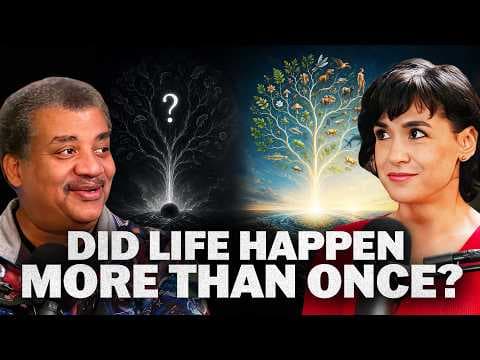
An Astrobiologist Pieces Together How Life Started
Audio Summary
AI Summary
Here's a summary of the provided transcript, focusing on key insights and main conclusions, within the 1200-word limit:
The discussion centers on the nature of life, its origins, evolution, and future, emphasizing a planetary perspective on biology. Dr. Betul Kachar, Director of the NASA-funded MUSE (Metal Utilization and Selection Across Eons) and head of her own lab at the University of Wisconsin-Madison's bacteriology department, shares her expertise.
**1. Life's Resilience and Microbial Dominance:**
* Life is fundamentally about survival and finding ways to persist through challenges, often by transforming itself and adapting.
* The Earth is a microbial planet, largely run by microbes. Humans are essentially "vessels for microbes to do their work," with more microbes in a centimeter of the lower intestine than the total number of humans ever born.
* Microbes are ubiquitous; there's no "unliving" or "non-living" corner on Earth. Life is found "under every rock," even in what humans perceive as extreme environments.
**2. Resurrecting Ancient Life and Understanding the Past:**
* Dr. Kachar's lab is "obsessed with understanding life's origins and its first steps," focusing on what happened after life emerged and how it survived over billions of years.
* A key research method involves "resurrecting ancient enzymes" by cloning extinct DNA into microbial organisms, forcing them to "speak an ancient dialect." This is achieved through computer modeling to extrapolate ancient DNA sequences and then using gene-editing tools like CRISPR.
* This process allows scientists to "replay the tape" of evolution, studying ancient biological systems and their limits under simulated past or even Martian conditions. This approach is crucial for astrobiology, as it provides insights into what "alien life," which is essentially Earth's own past life, might have looked like.
* The goal is not to create new agriculture but to understand ancient biological solutions to decrease dependence on energetically demanding artificial processes, like the Haber-Bosch process for nitrogen fixation.
**3. Singularities in Earth's Biological History:**
* Despite life's adaptability, certain pivotal evolutionary events, termed "evolutionary singularities," happened only once and profoundly transformed the planet.
* **Origin of Life:** Life on Earth originated once.
* **Oxygen Production:** Biology invented only one way to produce oxygen (photosynthesis), which became foundational for much of life as we know it, despite oxygen being corrosive to early life forms.
* **Nitrogen Fixation:** The biological process of converting atmospheric nitrogen (N2) into a usable form like ammonia (nitrogen fixation) also originated once, about 3 billion years ago, relying on a single enzyme. This process is vital for all life, as nitrogen is essential for ATP and DNA. Without biological nitrogen fixation, half the world's population would starve if solely reliant on the artificial Haber-Bosch process.
* These singularities highlight the delicate and contingent nature of life's evolution; removing one could collapse entire systems.
**4. The Concept of "Extremophiles" and Life's Laziness:**
* The term "extremophile" is considered "outdated" because "what is extreme" is relative. Organisms thriving in harsh conditions (e.g., undersea volcanic vents) are simply living in their preferred environments.
* Life is "lazy," always choosing the "laziest option." This applies to how organisms depend on each other, waste nothing, and find ways to survive by eating anything from sunlight to acid.
* The saying "life is an electron looking for a place to rest" encapsulates metabolism as the engine of life, driven by the precise channelization of electrons across energy gradients.
**5. Defining Life and Planetary Microbiology:**
* Life is defined as "a form of chemistry that maintained a memory over really long time periods."
* Beyond metabolism, life must also be able to reproduce and be susceptible to evolution to pass on its "memory of information."
* A new paradigm, "planetary microbiology," is proposed to connect molecules, cells, and organisms to the planet's context. This approach is essential for understanding life's dance with its environment and for finding life elsewhere.
* The "tree of life" analogy is acknowledged as a useful metaphor but is scientifically flawed as it doesn't account for genetic exchange between organisms and implies a purity or direction that doesn't exist. A "web" or "network" of life is a more accurate representation.
**6. Chemical Intelligence and Early Life Forms:**
* "Chemical intelligence" refers to the underlying intelligence at the heart of life's emergence, where early chemical reactions were coupled in autocatalytic cycles. These cycles produced waste that became input for other cycles, forming fundamental metabolic processes.
* Early life forms were likely much smaller than what was initially considered viable. The size of an organism is not a sole determinant of life.
* The study of Mars meteorites and early Viking lander experiments highlighted the human bias in searching for "life as we know it," emphasizing the need for open-mindedness when exploring extraterrestrial life.
**7. Silicon-Based Life and Metal Utilization:**
* While science fiction often explores silicon-based life, experiments have shown that enzymes can be engineered to use silicon instead of carbon, demonstrating a degree of functional interchangeability, though perhaps with less efficiency.
* Astrophysically, carbon is far more abundant than silicon in the universe, suggesting carbon-based life is more probable due to life's "laziness" and tendency to use readily available resources.
* Life also heavily relies on "rare elements and metals," like iron, which were abundant on early Earth. The MUSE center studies how oceanic metal content over billions of years influenced organisms.
* The banded iron formations in the geological record are evidence of ancient microbial activity, showing how life transformed the planet (e.g., oxygen reacting with iron to form rust deposits). This understanding that microbes leave lasting marks is relatively recent (30-40 years old).
**8. Learning from the Past for the Future:**
* Understanding life's past, including extinct forms and environmental shifts, is crucial for shaping our future. Past events, such as the rise of oxygen, caused catastrophes for existing life but paved the way for new forms.
* The planet's history, with its "ups and downs," offers lessons for addressing future challenges, as past conditions often resemble potential future scenarios.
* The work aims to understand how ancient systems survived and adapted, allowing for re-engineering and repurposing for better efficiency in the face of current planetary changes.
* The research, funded by NASA, NSF, John Templeton Foundation, and the Keck Foundation, demonstrates the importance of curiosity-driven basic science that can lead to significant practical implications for human civilization.