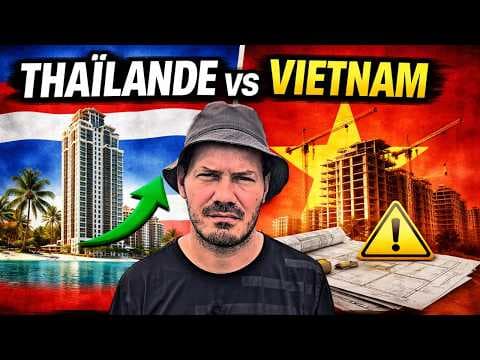
Thaïlande vs Vietnam : La vérité sur l’immobilier que personne ne te dit
AI Summary
This video compares the differences between becoming a property owner in Vietnam and Thailand, with a focus on real estate investment for foreigners. The speaker, currently in Danang, Vietnam, shares insights based on personal investigation.
A fundamental point highlighted is that in both Thailand and Vietnam, foreigners cannot directly own land. While some suggest forming a company to own land, this is legally problematic because a foreigner can only own 49% of such a company. True land ownership through a company requires a legitimate business with real turnover, and even then, it's primarily for occupying a property like a villa, not outright ownership of the land.
In Thailand, foreigners can achieve 100% recognized ownership of a studio or apartment within a condominium building. This process involves signing a property title, known as a "Chanut," at the land office, making the foreigner a full owner, similar to a Thai citizen.
Vietnam, however, presents a vastly different and more complex scenario. The speaker describes Vietnam as a dynamic but noisy country with laws that struggle to keep pace with its rapid development. Investing in Vietnam is characterized as "gambling" rather than buying, especially for those averse to risk. A crucial difference is that foreigners cannot be outright owners of an apartment in Vietnam. Instead, they can only purchase "off-plan" projects—properties that are not yet finished or are still under construction. This carries significant risks, similar to off-plan purchases in Thailand, where investors can lose their money if the project fails, the developer goes bankrupt, or other unforeseen issues arise. The speaker recounts a friend's experience of losing money on an off-plan hotel project in Danang.
Even if an off-plan project is successfully completed, foreign ownership in Vietnam is limited to a 50-year lease, meaning the individual is effectively a tenant, not a full owner. This contrasts with Thailand, where freehold ownership is possible for apartments within the foreign quota, allowing the property to remain in the owner's name indefinitely.
Another major challenge in Vietnam is reselling property. If a foreigner buys an off-plan apartment, they can only resell it to a Vietnamese national. The speaker points out that Vietnamese people generally have lower purchasing power than foreigners, as the cost of living is about 10% lower than in Thailand. This disparity means that a foreigner is unlikely to recoup their initial investment price upon resale, often resulting in a loss. The speaker views this as a system that disadvantages foreigners, comparing it to buying a car that depreciates over time, rather than a real estate investment that should theoretically appreciate.
Regarding profitability, the speaker emphasizes that the goal of investing money is for it to work for the investor. In Thailand, profitability is straightforward due to massive tourism, constant demand, and a mature market. Renting out an apartment in popular tourist areas like Phuket, Pattaya, Samui, or Bangkok is relatively easy, with returns typically ranging from 5% to 10% depending on the location. The real estate market in Thailand is stable, transparent, and liquid, with a strong secondary market allowing sales to both Thais and foreigners.
Vietnam, while appearing attractive on paper with a young population and rapid growth, carries higher risks that can erode potential returns. A project promising 12% returns might fail to deliver if construction is delayed, laws change, or new regulations are introduced. The Vietnamese market is described as speculative, nervous, and young, driven by price increases rather than market stability. Unlike Thailand, where money is made from tourism, in Vietnam, it depends on the economic system's reliability, which is not guaranteed.
From a legal and transparency standpoint, Thailand offers clear and strict laws. The procedures for buying and reselling condominiums are clean, taxes are legible, and real estate laws do not change frequently. While there have been changes in visa and immigration policies, these mostly relate to tourism-department-issued visas rather than fundamental property laws. The speaker advises consulting a good lawyer for clarity on Thai property matters.
Vietnam, in contrast, is described as a legal labyrinth. Rules, variants, exceptions, and sudden government revisions make the legal landscape complex and unpredictable. The administration can be slow, opaque, and prone to immediate changes in law. The speaker likens investing in Vietnam to fighting a video game boss whose attacks change every 30 seconds—making it difficult and complicated.
In summary, Thailand is recommended for those seeking stability, simplicity, and transparency in their investments. It's suitable for individuals who want a clear framework, peace of mind, and easy comprehension of their investment. Vietnam, on the other hand, is for ambitious, impatient, or "gambler" types who are attracted to explosive markets and rapid opportunities, and who are willing to navigate a system still under construction. It's a country of potential high rewards but also significant risks.
The speaker concludes by reiterating that Thailand offers security, ease of resale, real ownership, and a clear framework. Vietnam, however, is potentially dangerous due to unpredictable growth, the restriction on reselling to Vietnamese nationals, and the 50-year lease limit after which the property reverts to the state. The speaker views these Vietnamese laws as potentially exploitative for foreign investors.