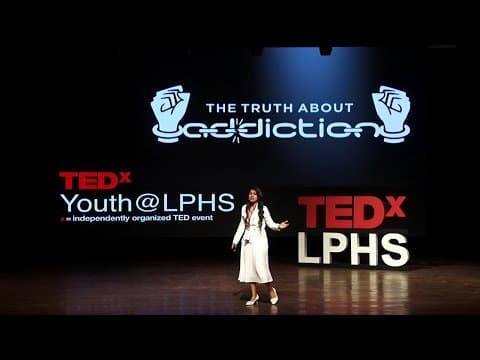
The Truth, the Trap & the Way Out | Dr. Nilam Gada | TEDxYouth@LPHS
Audio Summary
AI Summary
Dr. Nilam Gada challenges conventional wisdom about addiction, suggesting that much of what we've been told is incomplete or wrong. She highlights the pervasive nature of addiction, affecting all demographics, and notes the alarming increase in youth addiction despite awareness efforts. This failure, she believes, stems from addressing the wrong problem.
She posits that humans have fundamental psychological needs, similar to physical needs like food and shelter. Just as addiction crosses all boundaries, so does love, leading her to question if addiction is a phenomenon of bonding. She argues that our understanding of addiction is largely based on flawed experiments.
She references a 1920 experiment where a rat in an empty cage repeatedly consumed drug-laced water and died. This led to the conclusion that drugs are inherently addictive. However, in the 1970s, Professor Alexander created "Rat Park," a stimulating environment with social interaction and activities. In this enriched environment, rats rarely consumed the drug water, suggesting that social connections and purpose are antidotes to addiction.
This "Rat Park" theory was corroborated by a real-world human experiment: the Vietnam War. Many American soldiers became addicted to heroin in Vietnam, but 95% ceased drug use upon returning home and reconnecting with family and purpose. This illustrates that addiction is not a moral failing or lack of willpower; it’s a disease, not a choice, and stems from a natural human need to bond. If not bonded to healthy relationships or activities, people bond to substances, social media, or other compulsive behaviors.
The speaker emphasizes that while the initial choice to try a substance might be voluntary, addiction profoundly alters the brain's reward system, making the choice for you. The illusion of control is a dangerous first trap. Addiction is not about weak willpower but strong brain wiring, often initiated by peer pressure.
She urges young people, whose prefrontal cortex (responsible for decision-making and impulse control) is still developing until age 24, to avoid substances. Bombarding the brain with addictive substances before this age can lead to learning difficulties and cognitive impairment. MRI scans show more empty spaces in the gray matter of an addicted brain.
Finally, she warns against marketing traps that promote vapes and hookahs as safe. These products are strategically designed with flavors, convenience, and sugar to lure youth, despite being highly damaging. One hookah session equals 100 cigarettes, and vapes are "diet coke of nicotine." She encourages choosing wisely, based on knowledge rather than curiosity or peer pressure, and saying "no" to immediate highs that lead to future lows, thereby choosing purpose over poison.