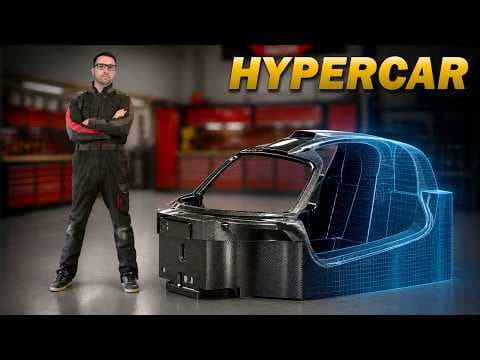
Je construis la MONOCOQUE CARBONE de mon HYPERCAR
Audio Summary
AI Summary
The video details the intricate process of creating the carbon monocoque for a Hypercar project, emphasizing its complexity and cost. The presenter begins by explaining the concept of a monocoque, a revolutionary car construction method introduced in 1922 by Lancia. Unlike traditional chassis-poutre (beam chassis) designs where the chassis and body are separate, a monocoque integrates both, forming a single, self-supporting structure. This innovation significantly reduces weight, increases rigidity, improves aerodynamics, and enhances safety by allowing for deformation zones. While chassis-poutre is still used in some vehicles like pickups, monocoques are standard in modern cars.
The discussion then shifts to carbon fiber, a material synonymous with performance, lightness, and rigidity, commonly seen in high-end and competitive vehicles. Carbon fiber itself is a fabric, but when combined with resin, it forms a composite material. Historically, racing cars evolved from tubular chassis to steel monocoques (like the GT40 Mark I and II), then to aluminum monocoques (GT40 Mark IV, Lotus 25), and finally to carbon fiber monocoques, pioneered in Formula 1 by McLaren with the MP4 in 1981. This advancement revolutionized motorsport, offering superior rigidity and weight reduction compared to aluminum, leading to better handling, precise steering, and improved acceleration and braking. Carbon monocoques also enhance safety with their inherent rigidity and integrated crumple zones.
The multi-functional nature of carbon monocoques, allowing for integrated structural elements, reinforcements, and aerodynamic shaping, makes them highly desirable but also incredibly complex and expensive to manufacture. This complexity is why they are typically reserved for competition cars and prestige models, requiring skilled labor and extensive production time. While cars like the Alfa Romeo 4C are considered more accessible examples, the BMW i3 is cited as a more expensive example of a carbon monocoque chassis.
The Hypercar project's carbon monocoque is presented as the central challenge. Modern carbon monocoques are 3D structures, unlike earlier flat or origami-like designs. The design process involves creating a 3D model of the car's exterior, which then forms the basis for the monocoque. The monocoque itself integrates the chassis structure and the carrosserie (bodywork). The presenter breaks down the design into distinct parts: the lower section housing occupants and mechanics, the upper section derived from the carrosserie, and internal elements that define the monocoque's shape. The result is a complex, single piece that took the presenter, a seasoned 3D modeler, a considerable amount of time to design.
A technical point regarding the wheels is addressed: the front and rear subframes are not made of carbon but steel. This decision, common among manufacturers like Koenigsegg and Lamborghini, reduces costs and allows for a simpler, three-part structure: front suspension, central carbon cell, and rear powertrain subframe.
The fabrication of the carbon monocoque is the core focus. Unlike simpler carbon parts like a hood, which can be molded directly, a monocoque requires a "master" – a highly accurate physical representation of the desired shape, from which the molds are made. Creating this master is a significant challenge. The presenter explores several methods for master fabrication:
1. **Artisanal Sculpting:** Using foam blocks and manual sculpting. This method is affordable but lacks precision and detail, especially for complex shapes.
2. **Skeletal Method:** Creating an outline of the shape using sliced sections and filling the void with expanding foam. While more precise than pure sculpting, it's still labor-intensive and not ideal for highly detailed forms.
3. **CNC Machining:** Carving the master from a large block of high-density foam using a multi-axis CNC machine. This is a precise and sophisticated method, capable of generating intricate details.
4. **3D Printing:** Printing the master in smaller blocks that are then assembled. This method offers flexibility but faces challenges with dimensional accuracy and assembly, especially for large structures. The presenter initially considered a collaborative 3D printing project with viewers but abandoned it due to anticipated tolerance issues.
5. **Stratified Machining:** Building the master layer by layer using plates, similar to CNC machining but potentially with simpler machines. This method is less limited by machine size and can be relatively quick and cost-effective.
The presenter ultimately chose the stratified machining method using a large-format, 3-axis CNC machine. The monocoque's complex shape, featuring "counter-depouilles" (undercuts that prevent direct mold release) and thin walls, presented significant design hurdles. The process involves converting the 3D model into a "machinable" solid model. Eight distinct masters are required for the monocoque, including exterior and interior molds for the main tub, roof, A-pillars, and interior trim.
Initial quotes for professional 5-axis CNC machining of the masters were prohibitively expensive, ranging from €30,000 to €100,000. Large-format 3D printing also proved too costly, with quotes between €10,000 and €20,000 for just the monocoque masters. This led to the decision to undertake the master fabrication in-house.
The presenter's CNC machine, with a large bed size but limited Z-axis travel, is ideal for panel machining and stratification. The chosen material for the master is XPS (extruded polystyrene) foam, selected for its affordability, lightness, and ease of machining, despite its fragility and less refined surface finish compared to denser polyurethane foams. The XPS foam will be coated with epoxy resin to create a hard, rigid surface suitable for mold making.
The machining process involves several stages:
* **Surfacing:** Initial flattening of the XPS foam blocks to a precise thickness.
* **Balayage (Sweeping):** A process where the CNC machine's cutter sweeps across the material, layer by layer, to create the 3D form. This method allows for complex shapes to be achieved with a 3-axis machine. The precision of the finish depends on the fineness of the layers.
* **Contouring:** Defining the outer edges and final shape of the master.
The presenter details the use of CAD/CAM software to generate toolpaths, specifying cutting tools, speeds, and strategies. A crucial aspect is generating the machine code (ISO language) through a post-processor, which translates the design into instructions the CNC machine can understand.
Extensive testing and simulation are performed before actual machining. The presenter simulates the cutting paths to identify potential issues, optimize parameters, and ensure the machine's program is correct. This includes testing different tool sizes and cutting strategies. Initial simulations revealed errors, such as incorrect tool count and unexpected movements, which were rectified by adjusting software settings and removing problematic commands like G19.
The actual machining tests involve using different tools and programs on the XPS foam. The surfacing program is executed first, followed by the balayage program. After approximately 40 minutes for surfacing and 40 minutes for balayage and contouring, a satisfactory result is achieved, demonstrating the viability of the chosen method. The presenter notes that further optimization is possible, such as using larger step-overs for roughing and then finer passes for finishing, to improve efficiency.
A significant issue encountered is the ineffectiveness of the dust extraction system, which fails to capture the polystyrene chips, creating a mess and potential problems for future work. This needs to be addressed before proceeding with the main master fabrication.
Despite the challenges, the presenter expresses confidence and readiness to proceed with fabricating multiple foam blocks. The official manufacturing of the carbon monocoque masters is now launched. The presenter plans to continue producing video content on the car's construction, highlighting the automated nature of the CNC machining process, which allows other tasks on the car to be addressed concurrently. The video concludes with a call to action for viewers to like, share, comment, and subscribe for future updates on the Hypercar project.