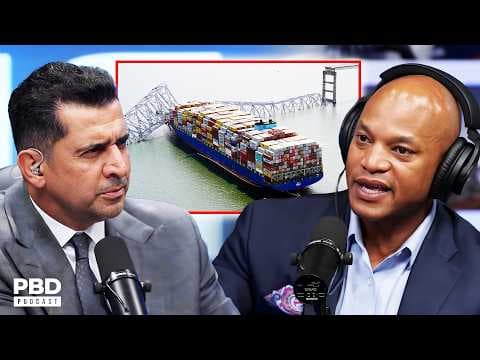
"I FIRED Them" - Gov. Wes Moore GOES OFF On Key Bridge Contractors Over Cost & Delays
Audio Summary
AI Summary
The conversation focuses on the reconstruction of the Francis Scott Key Bridge in Baltimore, Maryland, after its collapse. The speaker initially praises the governor's efforts in improving the market and reducing crime in Baltimore.
Regarding the bridge, it took 78 days to remove debris from the 1.6-mile steel truss bridge. The governor addresses critics who question the project's speed and the estimated $5.2 billion budget, which suggests completion by 2030. He highlights the accelerated timeline achieved so far: clearing the channel in 11 weeks instead of 11 months, securing permitting in months instead of years, and completing a 7% design build in 14 months instead of five to seven years. This makes it the fastest-moving major project in the country. He contrasts this with the original bridge, which took 12 years from design to implementation. The new bridge will adhere to federal guidelines for enhanced safety to prevent a recurrence of the March 26 incident, where a ship the size of three football fields struck the two-mile-long bridge.
The governor emphasizes speed, safety, and cost savings. He recently fired the initial contractor due to escalating costs, although phase one work will continue with them until January. A new team will be sought for phase two to ensure faster completion and better cost management. He cites other large bridge projects, like the Gordie Howe Bridge and Harbor Bridge in Texas, which took decades, to underscore the aggressive timeline for the Key Bridge.
The Port of Baltimore is crucial, handling 40,000 cars daily and serving as a major artery for goods, with two-thirds of the country receiving products from it. Despite the tragedy, last year was the second most productive in the port's history, showcasing the rapid response to the crisis.
The governor has collaborated with President Biden and Secretary Duffy, with the Department of Transportation supporting Maryland's decision to change contractors. The federal government, with bipartisan congressional support, is providing 100% cost-share, essentially bridge financing, acknowledging the lengthy litigation process for what is expected to be the most expensive maritime tragedy in U.S. history. The federal government acts as the main underwriter for such large infrastructure projects, as no single state has the resources to fund them independently. The governor's willingness to collaborate across political lines is highlighted as a key leadership quality.