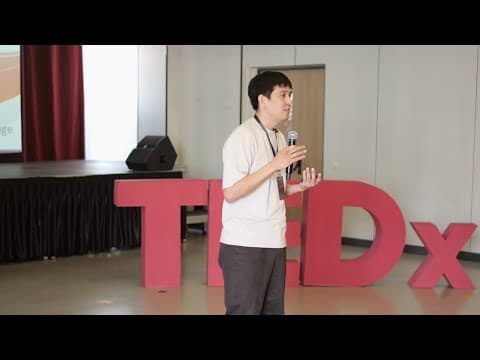
Неожиданный путь к возможностям | Баглан Кутурбаев | TEDxQuantum STEM Youth
Audio Summary
AI Summary
The speaker discusses the transition from a teaching profession to entrepreneurship, highlighting four common myths. Unlike careers such as finance, where job changes are seen as normal, professions like teaching and medicine are often linked to a "calling," making career changes seem more ambiguous to the public.
The speaker's journey into education was accidental. Initially aspiring to be an engineer, they found the teaching methods uninspiring during university. A pivotal encounter with Marlin Nagai, who led an aircraft modeling club, revealed a more creative, constructive side of engineering. This experience ignited the speaker's passion for organizing teams and achieving results.
In their fourth year of university, needing money, the speaker began teaching at RFMSh school, staying for four years. They discovered a natural aptitude for connecting with children and fostering their strengths, particularly through club activities and projects. The speaker believes projects are crucial for children's long-term development, potentially leading to careers as startup founders or inventors.
After four years, the speaker moved to a new school, taking on leadership roles, which provided a comfortable structure with a good salary and clear career path. However, three years ago, they decided to pursue their own venture, an idea conceived during their first year of teaching.
The first myth addressed is that quitting a stable job to start a business is a heroic act. The speaker refutes this, viewing it as a simple, everyday decision. They argue that the perceived heroism makes many hesitant, fearing extraordinary effort is required. In reality, organizations don't collapse when someone leaves, and individuals are not irreplaceable. The speaker's decision was tempered by staying within education and understanding that the worst outcome—failure—would still leave them with experience and a network, allowing a return to their starting point.
The second myth is "the main thing is to start." The speaker contends this is a major misconception. While starting is often easy, driven by impulse or inspiration, sustained commitment is the real challenge. Initial enthusiasm and support fade, leaving individuals alone with their ideas. Continuing requires a strong belief in the goal's worth.
The third myth is the belief in needing to do everything oneself. The speaker spent years taking various courses, thinking they needed to master every skill, from programming to management. This lack of focus prevented them from excelling in any single area. It's more effective to assemble strong, complementary teams. While understanding different aspects is important for earning respect and communicating with professionals, one doesn't need to be an expert in everything. The speaker realized their strength lay in finding the right people for the right roles, emphasizing the importance of shared values over identical skill sets.
The final myth concerns the "cruel outside world" of business, contrasted with the "bubble" of academia. The speaker was warned about "sharks" and aggressive environments. However, they found that people are inherently social and willing to help, provided one approaches them with a well-defined request. Drawing an analogy from teaching, a student who has made an effort to understand a missed topic and asks for specific help is more likely to receive assistance than one who simply asks for a complete re-explanation. Similarly, in their startup journey, the speaker learned "Elvish" (startup jargon) by watching videos and making progress, then approached experienced individuals with specific questions, like how to calculate unit economics. People were happy to share their knowledge. Rejections are normal, and one should simply approach someone else.