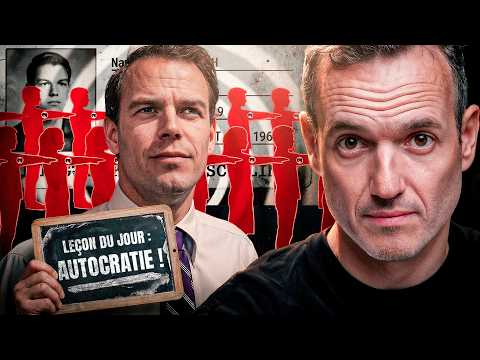
Le Prof qui a prouvé que VOUS auriez suivi Hitler (La 3ème Vague)
AI Summary
In April 1967, at Cubberley High School in Palo Alto, California, an extraordinary social experiment known as “The Third Wave” unfolded, demonstrating how easily a community could adopt authoritarian behaviors. The experiment, orchestrated by 25-year-old history teacher Ron Jones, aimed to help his 10th-grade students understand how ordinary German citizens could claim ignorance of the Holocaust and participate in or allow the atrocities of the Nazi regime.
The setting was a progressive high school, home to bright, educated, and affluent students, many of whom believed they were immune to authoritarian movements. Jones, a Stanford graduate, surfer, and left-wing activist, was a popular teacher. When a student questioned how the Germans could have allowed the Holocaust, Jones decided that theoretical explanations were insufficient. Instead, he would create a live, immersive experience of fascism for his students, without warning them.
The experiment began on a Monday. Jones introduced strict new rules: students had to be at attention before the bell, sit up straight, stand to speak, keep responses to a maximum of three words, and begin every statement with "Mr. Jones." Initially, students treated it as a game, but they complied without significant rebellion. The class became remarkably focused, surprising Jones, who had only planned for a single day.
On Tuesday, Jones found his students already in the disciplined posture from the previous day. Fascinated, he decided to continue the experiment. He added "Strength Through Community" to the board and named the burgeoning movement "The Third Wave," a surfing term for the most powerful wave in a series. Jones later revealed the name also subtly referenced the Third Reich. He introduced a unique salute, a wave-like gesture, which members were to use whenever they encountered each other, inside or outside the classroom. He assigned tasks like creating a banner, recruiting new members, and preventing non-members from entering the classroom. The movement quickly grew, attracting students from other classes, expanding from 30 to 43 members in a single day. Jones realized he was losing control.
By Wednesday, Jones added "Strength Through Action" to the movement's tenets. He distributed membership cards, some with a large red 'X' on the back. These 'X' cards designated students as "formers," tasked with reporting any deviance from group norms, such as a member failing to give the salute. Jones sometimes referred to this group as his "Gestapo." This marked a critical turning point. While Jones officially appointed three "formers," about 20 other students spontaneously approached him to denounce classmates for not saluting or for criticizing the movement. A climate of paranoia quickly set in, making free speech, even among close friends, impossible. Loyalty became vertical, directed solely at Jones, the leader. By the end of the day, the movement had exploded to nearly 200 participants across multiple classes and high schools in the Palo Alto district. A new rule forbade members from gathering in groups of more than three outside of class, making pre-existing friendships suspect and allowing for better control through division.
One student, Robert, initially marginalized in class, found a sense of purpose and belonging in the movement. He volunteered to be Jones's personal bodyguard, following him everywhere, opening doors, and walking slightly ahead. When Jones once tried to enter the teachers' lounge alone, Robert, despite the rule against students being there, insisted he was not a student but a bodyguard, highlighting how deeply he had internalized his new identity. This incident made Jones realize the experiment was no longer a game for some.
However, a brilliant student named Cherry Tosley openly challenged the rules, asking why they couldn't just speak their minds. Jones immediately banished her to the library. The school librarian, who had grown up in Nazi Germany, recognized the danger and encouraged Cherry to resist. That night, Cherry and her father created anti-Third Wave posters and displayed them throughout the school. By morning, all posters had been torn down by movement members. Cherry formed a small resistance group called "The Breakers," but they were too few and isolated to make an impact. The entire school seemed contaminated; even the principal reportedly exchanged the Third Wave salute with Jones.
By Thursday, Jones was exhausted and terrified. He later wrote that he was instinctively acting like a dictator, even when unnecessary, and was surprised by his own immersion in the role. He faced a dilemma: ending the experiment abruptly would publicly humiliate the most invested students, particularly those like Robert who had found meaning in the movement. Allowing it to continue, given the rapid escalation, risked losing all control. He chose a third path: a dramatic mise-en-scène. He announced to the class that The Third Wave was not just an exercise but a national movement, claiming that teachers in over 1,000 high schools across the U.S. had recruited similar youth brigades. This claim was unverifiable in 1967, and students fully believed him. He declared that on Friday at noon, the Third Wave's presidential candidate would make a national televised announcement.
On Friday, the auditorium was packed with over 200 students, along with "journalists" and "photographers" recruited by Jones to simulate media presence. The television screen displayed static. Jones then revealed the truth: there was no national Third Wave movement. He explained that they had been manipulated, driven by their own desires into the situation. He turned on a projector, displaying a countdown and then images of the Third Reich, accompanied by the roar of the Nuremberg rallies. The film showed Nazi discipline, marches, propaganda, camps, and blank-faced crowds, ending with the chilling statement: "Everyone must accept their share of responsibility. No one can claim not to have participated."
The students were horrified, recognizing their own adopted behaviors: blind discipline, the salute, denunciation, exclusion of dissenters, and collective fervor for a leader. Robert, the bodyguard, burst into tears. Other students cried, and many fled the auditorium in shame. After the initial shock, a profound silence fell. In the aftermath, the incident was largely suppressed. The school newspaper, in its April 21, 1967, edition—the only contemporary media trace—reported reactions ranging from stupefaction to unease. One student felt "stupid," another admitted to having "liked it," while others claimed they were merely curious. For four years, according to Jones, no participant publicly acknowledged being present at the Friday assembly.
The experiment received no media coverage in 1967, and life quickly returned to normal. Jones's class moved on to the Vietnam War. While some parents reportedly sought Jones's dismissal, he was denied tenure two years later in 1969, which he attributed to his anti-war stance rather than the experiment itself. Cubberley High School closed in 1979, and the Third Wave remained largely unspoken of for nine years until 1976.
In 1976, Jones coincidentally met a former student, Steve Coniglio, who, upon seeing him, ran up and gave him the Third Wave salute. This encounter prompted Jones to write his detailed account of the experiment, published that same year. This text became the basis for a series of adaptations: a 1981 ABC TV movie, "The Wave," which won an Emmy; a novel by Todd Strasser (under the pseudonym Morton Rhue), which sold millions of copies and became mandatory reading in German and Israeli schools; and a 2008 German film, "Die Welle" (The Wave). These adaptations, however, are increasingly fictionalized versions of Jones's already somewhat dramatized account. For instance, the 2008 film depicts a student pulling a gun, shooting a classmate, and committing suicide, with the teacher arrested—a dramatic departure from the actual events, added by the director to reflect modern concerns about fascism.
The Third Wave experiment illustrates several psychological mechanisms:
1. **Conformity Bias:** People tend to conform to group behavior, even against their own judgment, to avoid social rejection. The experiment showed that a single dissenter, like Cherry, could break this effect, but only if they remain within the group and are not immediately excluded.
2. **Authority of the School Setting:** The respect accorded to a teacher within the institutional framework of a school, with grades at stake, reinforces obedience. This aligns with Stanley Milgram's work on obedience to authority, where individuals obey orders they would normally find unacceptable when the authority is perceived as legitimate and institutionally supported.
3. **Group Identity:** As demonstrated by Henri Tajfel and John Turner's social identity theory, belonging to a group becomes part of one's self-identity, boosting self-esteem through the group's perceived superiority over others.
4. **Progressive Escalation:** The experiment started with simple acts like sitting straight, gradually escalating to salutes, slogans, and denouncing peers. Each step made it harder to retreat, as doing so would require acknowledging a mistake, leading to cognitive dissonance.
These mechanisms are not unusual or "bugs" in human behavior; they are fundamental to social cohesion and can be exploited. Jones's own 1976 account, written nine years after the events, and retrospective student testimonies, are the primary sources. The exact timeline and scale differ from contemporary records, such as the high school newspaper, which suggests the experiment lasted 5-8 school days, possibly over two weeks, and involved three classes (90 students initially), not just one. The origin of the salute and slogan is also debated. While the core events—the experiment, the movement, the final assembly, and Jones's eventual departure from the school—are attested, the precise details and dramatization largely rely on memory, which can be embellished over time.
Ironically, the story of The Third Wave itself exemplifies how narratives transform with each retelling, evolving from a real event into a TV film, a novel, a movie, and ultimately a global pedagogical myth. Ron Jones, perhaps unintentionally, demonstrated that totalitarianism doesn't begin with concentration camps but with seemingly innocuous acts like a straight posture, an absurd rule, the pleasure of belonging to an elite, and the subsequent creation of a compelling mythology.