Comment Sécuriser sa Maison en Thaïlande à 100% (Usufruit vs Leasehold)
AI Summary
This video explains how foreigners can legally purchase property in Thailand, focusing on the common pitfalls and recommended solutions. In Thailand, foreign nationals are strictly prohibited from owning land directly, which also makes purchasing a house, whose ownership is tied to land, problematic. To circumvent this law, expatriates typically employ three main strategies.
The first, setting up a company, is highlighted as a significant financial and legal risk. The second is a 30-year lease agreement, which may not appeal to everyone who prefers outright ownership. The third and most common option is joint ownership with a Thai spouse, which is the primary focus of this video. The presenter, who has lived in Thailand for 10 years and assists expatriates, aims to explain how to secure this arrangement to protect one's investment, even if the marriage ends.
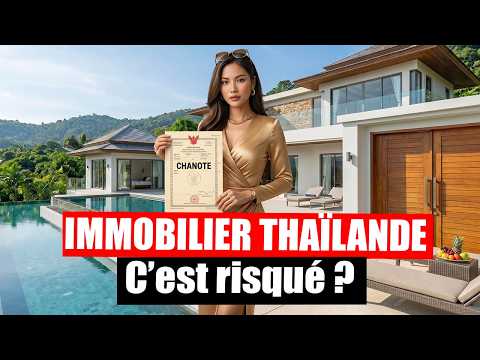
The core issue arises when a foreigner intends to buy a house, often in popular locations like Chiang Mai, Phuket, Hua Hin, or Koh Samui. The seemingly straightforward solution of placing the property title deed (Chanote) in the name of a Thai spouse is fraught with danger. Thai law, specifically at the Land Office during the signing of the deed, requires the foreigner to sign a document, often only in Thai, known as "sing san tai." This declaration confirms that all the funds used for the purchase are the wife's property and an irrevocable gift. Consequently, the foreigner legally relinquishes all rights to the money and the property, becoming merely a guest in their own home. If the marriage deteriorates, the Thai spouse gains full control and can sell the property, evict the foreigner, or use the property as collateral for loans without the foreigner's consent.
To counter this, a legal safety net is essential. The video strongly advises against the common expatriate solution of setting up a company to own property. This method, often promoted by unscrupulous agents or "fake lawyers," typically involves a foreign national holding 49% of shares and Thai nominees holding the remaining 51%. While the foreigner might be appointed director, believing they have control, this practice is considered a "grey area" and highly risky. Thailand's Foreign Business Act of 1999 explicitly prohibits the use of nominee shareholders to circumvent land ownership laws. Despite its prevalence, authorities are increasingly cracking down on such arrangements.
The video explains that Thai authorities, using algorithms and data cross-referencing, can detect companies that purchase expensive properties without declaring any revenue, employees, or genuine commercial activity. Such anomalies trigger immediate audits. During an audit, officials investigate the Thai nominee shareholders, demanding proof of the source of funds used to capitalize the company. Nominees, often administrative staff, are unable to provide legitimate explanations for large sums of money. The consequence is severe: the company is liquidated, the property is seized and auctioned, and the foreign director faces up to three years in prison, substantial fines, and permanent deportation. Therefore, the company setup is strongly discouraged for acquiring a primary residence.
For married couples, the video presents two primary legal strategies to secure property ownership: usufruct and leasehold.
The first, **usufruct**, known in Thai as "Sitt Chai Kin," is a real right registered in the Thai Civil and Commercial Code. It legally separates the physical ownership of the property into two parts: the wife retains "bare ownership" (nu-propriété) of the land, while the foreigner holds the "usufruct." This grants the foreigner the absolute, exclusive, and legal right to use the property for their entire life. It also includes the right to "reap the fruits," meaning the foreigner can rent out the property and keep 100% of the rental income, even if they are temporarily living abroad. Crucially, the usufruct is physically registered on the back of the Chanote title deed, making it a right enforceable against third parties. If the wife attempts to sell the property without the foreigner's consent, the buyer would acquire the property with the foreigner still residing there, making such a transaction unattractive. This effectively prevents any unconsented sale.
From a cost perspective, usufruct is very economical when granted between spouses. Government taxes are minimal, around 75 Baht in stamp duty, making it almost free. However, the video emphasizes the critical importance of professional legal assistance. Attempting to set up a usufruct with an online form is dangerous, as Land Office officials have discretion and can refuse registration if they suspect coercion or a dubious arrangement. Engaging a qualified lawyer or legal advisor is essential. Their fees for drafting a bilingual contract and assisting at the Land Office typically range from 20,000 to 50,000 Baht, a small investment for significant security.
A major pitfall with usufruct is Article 1469 of the Civil Code, which allows either spouse to unilaterally annul any agreement made during the marriage, even up to one year after divorce. In a contentious divorce, a Thai wife could argue that the usufruct was a "gift of convenience" and have it annulled by a judge, leading to the foreigner losing their rights to the property. To counter this, the usufruct contract must be meticulously drafted by a lawyer to prove that it is not a mere marital agreement but a strict financial consideration. This is achieved by explicitly stating that the usufruct is granted in direct exchange for the foreigner's financial contribution to the property purchase. Maintaining proof of international fund transfers, such as the FET forms issued by Thai banks, is vital. By linking the financial input to the usufruct grant in a specific agreement, it transforms from a cancellable marital arrangement into an unassailable financial compensation contract, making Article 1469 inapplicable.
The second key legal tool is **leasehold**, also known as a long-term lease registered at the Land Office. Thai law limits residential leases to a maximum of 30 years. The choice between usufruct and leasehold primarily hinges on asset transmission. A significant drawback of usufruct is that it is tied to the individual; upon the foreigner's death, the usufruct ceases to exist, and the wife gains full ownership, preventing any inheritance by the foreigner's children.
Leasehold, conversely, is a tangible commercial asset. Firstly, it is **transmissible**: if the foreigner dies during the 30-year lease, the remaining term can be bequeathed to their children via a will. Secondly, it is **marketable**; the remaining lease period can be sold to a third party. Thirdly, it is more robust against divorce because it is viewed as a standard commercial contract, not a conjugal arrangement, rendering Article 1469 irrelevant.
The video debunks the myth of the 90-year lease. While some agents offer 30-year leases with clauses for two 30-year renewals, Thai law only recognizes a maximum of 30 years for registered leases. Renewal clauses are merely personal promises between the parties, not legally binding on the wife's heirs. The Land Office will only register a maximum of 30 years at a time.
The main disadvantage of leasehold compared to usufruct is its cost. The Thai government levies a tax of 1.1% on the total cumulative rental value over the lease period. For example, a property with a declared total rental value of 100 million Baht over 30 years would incur a tax of 1.1 million Baht, payable upfront, in addition to legal fees.
A more advanced option is the "right of superficies," where the land is leased via leasehold, but the ownership of the building itself is registered in the foreigner's name. This offers the highest level of security but involves complex building permit and local administrative procedures.
**Choosing the right strategy** depends on individual profiles. Young retirees with moderate budgets, no direct heirs to protect, and a desire for serene living with their spouse are best suited for usufruct due to its low cost and strong protection, provided Article 1469 is effectively addressed. Younger individuals with significant assets, children from previous marriages in Europe, and those viewing their investment as something inheritable should opt for leasehold, despite the higher upfront taxes, as it creates a tangible asset that can be passed on.
Regardless of the chosen method, three golden rules for survival in Thailand are essential:
1. **Absolute Timing:** The usufruct or leasehold must be registered on the exact same day and at the same time as the property transfer. Delaying this process, even by a few months, can make it impossible to secure these rights later if the relationship sours. Security must be established at the source.
2. **Local Network:** Legal interpretations, bureaucracy, and official attitudes vary by region. It is crucial to use a reputable, locally established law firm in the specific province where the property is located. They will have a better understanding of local officials and procedures. Foreigners cannot be lawyers in Thailand; only Thai nationals can hold this title. Be wary of visa agencies offering legal services at low prices.
3. **Psychology and Transparency:** Purchasing property in a foreign country with unique laws is stressful. It is vital to explain the need for protective legal documents to one's Thai spouse openly and calmly, emphasizing that it is not a lack of trust but a responsible measure to protect a lifetime's capital. A supportive spouse will understand the need for legal guarantees for the financier of the property.
The video concludes by offering assistance for expatriation processes, including visa, insurance, company formation, investment security, and access to a network of lawyers and real estate experts. Interested viewers are encouraged to book a consultation via a link in the description.