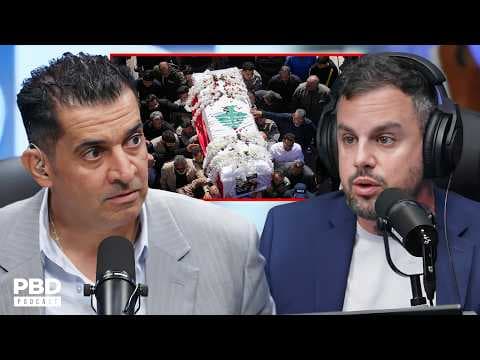
"They Actually LIKE Each Other" - Trump ANNOUNCES 3-Week Israel–Lebanon Ceasefire Extension
Audio Summary
AI Summary
The discussion centers on President Trump's announcement of an extension to a ceasefire between Israel and Lebanon, a development met with mixed reactions and analyses. Trump's statement that the two nations "like each other" is highlighted as a particularly surprising and perhaps optimistic, if not entirely accurate, observation.
Rob, a participant, confirms the clip and notes the historic nature of such a meeting given the long-standing border tensions. He relays Trump's sentiment that high-level officials from both Lebanon and Israel met, and that the presidents of Lebanon and the prime minister of Israel are expected to visit soon. The core of the announcement is the agreement to an additional three weeks of "no firing," or ceasefire. However, Rob also points out the continued presence of Hezbollah as a significant factor that complicates the situation.
Elan offers a more critical perspective, calling Trump's remark about mutual liking "hilarious." While acknowledging the possibility of improved relations between Lebanon and Israel in the future, particularly as the influence of certain groups wanes, Elan emphasizes that this is not the current reality. Elan views Trump's influence over Israel as significant, citing this ceasefire extension as evidence that Israel listened to Trump's push for it. Elan believes Trump's underlying intention was to foster stability and peace in the region and suggests that, in his own way, Trump is achieving this.
Tom expresses skepticism about dealing with Israeli Prime Minister Netanyahu, describing him as historically difficult for US presidents. He references past instances where Trump alluded to potential disagreements on battle plans with Israeli leadership. Tom believes that behind closed doors, diplomatic progress has been made, and the three-week ceasefire, if implemented to establish accords, is beneficial for the innocent civilians in Lebanon, particularly Christian citizens who may feel unrepresented. He finds Trump's comment about them being long-time neighbors humorous, given the decades of conflict. Tom interprets Trump's "they like each other" statement as an attempt to extend an olive branch and send a positive message.
Adam shifts the focus to the broader sentiment of people being "sick and tired of fighting wars." He argues that the Lebanese people are particularly weary of their country being "hijacked by Iran." Adam challenges the notion of Israel controlling America, demanding proof and instead pointing to Iran's control over Lebanon, contrasting its current state with its past as the "Paris of the Middle East." He asserts that many Lebanese people, including those with friends on the show, hate Hezbollah more than Israel. Adam draws a parallel between the discontent in Iran with the IRGC and the situation in Lebanon, suggesting that the people in both nations are tired of their leadership's priorities. He then pivots to economic disparities, highlighting Israel's significant economic boom and its status as the "Silicon Valley of the Middle East," contrasting it with the struggles in Lebanon, Syria, and Gaza. Adam posits that the Lebanese people desire a normal life, stability, and a good society for their children, rather than constant conflict and the pursuit of terror tunnels over capitalist development.
The conversation then delves into the nature of conflict and the definition of "victory." One participant expresses that while a ceasefire is positive, the ultimate goal of eliminating terrorists is elusive, as "terrorists are always going to be there" and "multiplying." The idea of Israel conceding land for peace is brought up, noting that such concessions have historically led to either retaliation or sustainable peace depending on the other side's genuine desire for it. The Lebanese Christian population's desire for better relations with Israel is affirmed.
A broader tragedy in the Middle East is identified: the decay of opportunities, natural resources, culture, and history in many countries due to extremism. This extremism is seen as the fundamental issue plaguing Lebanon, Gaza, and other nations, hindering their potential.
The question of "how to win" against such pervasive extremism is posed. Victory is defined not just regionally but across the entire Middle East, citing the UAE and Gulf States as examples of countries prioritizing growth and prosperity over religion, integrating with Western societies. In contrast, the motivation of groups like Hezbollah, Iran, and Hamas is seen as prioritizing destruction over the well-being of their people. When an adversary's fundamental starting point is destruction, negotiation becomes incredibly difficult.
The difficulty of eradicating deeply entrenched extremist elements is compared to the challenge of eliminating alcoholism or drug addiction. While stopping the supply of drugs or prohibiting alcohol might seem like solutions, the underlying human tendencies for addiction and conflict are seen as constant. The question then becomes whether to do nothing because conflict is inevitable, or to strive for incremental decreases in these issues. The analogy of dealing with domestic issues like divorce or bankruptcy is used to illustrate that while these problems may persist, efforts are made to mitigate them.
The importance of focusing on present leadership and making things better "today" for "reasonable players," as opposed to "emotional players," is stressed. The ability of individuals to change and improve their lives is emphasized, using personal anecdotes of overcoming destructive habits and finding peace through faith. The idea that individuals can choose to change and that this choice has a positive impact on themselves and those around them is a recurring theme.
The discussion touches on the media's tendency to favor drama and negativity over positive and constructive content. The limited success of a Tony Robbins television show is contrasted with the enduring popularity of more sensational programming, suggesting that drama and conflict capture more attention. This highlights a societal preference for negativity, which makes the efforts of "reasonable players" striving for progress all the more challenging but also more crucial.
The conversation shifts to a case study of El Salvador, where President Bukele's efforts to combat MS-13, described as a "cancer in society," are presented as a model for reclaiming a country. This is likened to the situation in Lebanon, where a diverse population is allegedly being controlled by extremist Shiite radicals. The hope is expressed that the people of Lebanon will similarly reclaim their country.
Finally, the discussion revisits the possibility of sustainable relations in the Middle East, citing examples like Iraq, Oman, the UAE, Morocco, Egypt, and Jordan as evidence of progress that was once unimaginable, especially given the historical animosity towards Israel from the Arab League. The segment concludes with promotional material for merchandise related to the podcast.