How the Iran War Spiked Oil Prices
Audio Summary
AI Summary
The shutdown of the Strait of Hormuz, in retaliation for US and Israeli strikes on Iran, led to Iran’s SEPA Navy broadcasting a message forbidding all navigation through the Strait until further notice. This declaration was backed by the Iran Revolutionary Guard Corps attacking vessels attempting to transit the waterway, bringing traffic to a halt. While 20% of the world's oil passed through this choke point before the conflict, global oil production in March 2026 only shrunk by about 8%. However, prices spiked a massive 60%, 7.5 times more than the contraction in supply. This phenomenon can be explained by the complexities of global oil markets.
The Gulf region is crucial for oil production, possessing both the largest reserves and the lowest production costs. Bahrain, though small, is the world's 35th largest oil producer, outputting about 200,000 barrels a day. Its economy is diversified, focusing on refining Saudi Arabian oil, manufacturing, and finance. Qatar, the next largest Gulf producer at 1.3 million barrels a day, has also diversified into natural gas production, with its Ras Laffan industrial city responsible for 20% of the world's liquid natural gas supply. Kuwait, the world's 10th largest producer at 2.6 million barrels a day, is heavily reliant on oil. These three nations, Bahrain, Qatar, and Kuwait, faced an almost existential crisis due to the Strait's closure, as they are 100% reliant on oil tankers transiting the waterway for exports. While devastating for their economies, their collective 16% share of Gulf oil production meant a minimal impact on global prices.
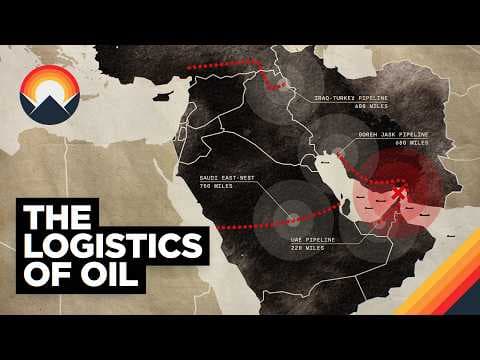
Other Gulf countries were in a more favorable position. The United Arab Emirates (UAE), producing about 4.1 million barrels a day, has a coastline on the other side of the Strait. In 2008, the UAE began building a pipeline to bypass the Strait, anticipating Iran's threats to close it. Before the war, a substantial portion of the UAE's oil was loaded at Fujairah via this pipeline, making the country resilient to the closure.
Iran, the world's seventh-largest producer at 4.2 million barrels a day, developed a similar strategy. While 90% of its oil exports previously went through Kharg Island, it also built a pipeline to the port of Jask on the other side of the Strait, which could handle about 15% of normal export flows with existing infrastructure.
Iraq, with a tiny Gulf coastline, relies on offshore platforms for most of its oil exports. It also has a pipeline to a port in Turkey, which bypasses both the Strait of Hormuz and the Suez Canal. However, this pipeline's operation is often interrupted by political disputes between Baghdad and the autonomous region of Kurdistan. An agreement made a few weeks into the war, in response to the Strait's closure, is expected to ramp up this route to 600,000 barrels a day, nearly 15% of pre-war export totals.
Saudi Arabia, the Gulf's largest oil producer, has a Red Sea coastline and a robust contingency plan. Its 750-mile East-West pipeline, built in response to the Iran-Iraq war in the 1980s, can operate at 5 million barrels a day and potentially surge to 7 million. Although tanker loading terminals at its terminus, the port of Yanbu, might limit capacity to 5 million barrels a day, this still represents a tremendous amount of oil, allowing Saudi Arabia to maintain its position as the world's third-largest producer despite the Strait's closure.
Collectively, these four pipelines provide significant export capacity, mitigating the impact of the Strait's closure. Additionally, a "drip feed" of tankers, primarily exporting Iranian oil or linked to Iranian allies, continued to pass through the Strait, providing some downward pressure on global oil prices.
The 8% contraction in supply leading to a 60% price jump is explained by the inelasticity of demand for oil. Unlike products with many substitutes, oil has few immediate alternatives for internal combustion vehicles, which are essential for many non-discretionary journeys and commercial operations. While long-term elasticity of demand exists as people might switch to EVs or shorten commutes, short-term elasticity is low, estimated around negative 0.1. The initial weeks of the war showed an implied elasticity of negative 0.13, close to theoretical predictions.
The market's initial muted reaction to the Strait's closure was influenced by commodity traders, who make money by betting on future oil prices. Their decisions are often shaped by narratives. In the early days of the conflict, a widespread belief among traders was that it would be a limited, short-term operation, based on President Trump's statements and previous administration actions. This led to a modest 6% price rise on the first trading day, followed by smaller increases and even a flat market day, despite reports of drone strikes and insurance cancellations.
However, reality soon set in. Major marine insurance companies issued 72-hour cancellation notices for war risk insurance policies in the Gulf. Ship owners, facing immense financial risk, simply cannot operate without such insurance. This bureaucratic impediment made it functionally impossible for oil to flow out of the Gulf, regardless of physical blockades. As the conflict continued, some insurers began writing policies again, but at more than tenfold the pre-war cost (around 3% of a ship's value per journey, up from 0.1-0.25%). This massive additional cost further solidified the market's concern.
Throughout March, the intractability of the disruption became clear, and the market responded accordingly. Even as diversion routes increased and supply contraction lessened in the second half of March, oil prices remained near $100 a barrel. Traders' sentiment shifted, balancing increased supply with growing concern about the potential length of the disruption. The illusion of Gulf stability was shattered, as Iran's ability to shut down the region's economy demonstrated the fragility of the belief that these countries were geopolitically isolated. The market will likely price this uncertainty in long-term, meaning that until the Strait of Hormuz is no longer relevant for global oil logistics, the world will likely pay more at the pump.